
What to Wear When You Work From Home: A 2026 Guide
What if the best work-from-home outfit isn’t the most relaxed or the most polished, but the one that helps the day feel like it has begun? The question of what to wear when you work from home isn’t solved by staying in pajamas or dressing for an office you never enter. Sleepwear can blur the morning; formal clothes can make an ordinary Tuesday feel like a performance.
If getting dressed feels like another decision, or a video call makes comfort seem at odds with looking put-together, you’re not alone. A home wardrobe can have its own quiet structure. A few comfortable, considered pieces can create a balance between ease and polish, without turning remote work into office cosplay.
This guide will help you build a repeatable wardrobe around your real workday, with practical layers, camera-ready combinations, and a simple outfit formula for mornings when you’d rather not deliberate. The aim isn’t to dress for someone else’s idea of professionalism. It’s to feel intentional, comfortable, and like yourself as the day unfolds.
Key Takeaways
- Build a work-from-home outfit around a comfortable base, a suitable top, and an optional layer.
- Choose what to wear when you work from home by matching your outfit to the day’s tasks and how visible you’ll be on camera.
- Create a small set of repeatable combinations to make weekday dressing simpler.
- Start with clothes you already own, then adjust your choices as your routine changes.
- Use personal details to make a practical workday wardrobe feel like your own.
What to Wear When You Work From Home: Finding the Balance
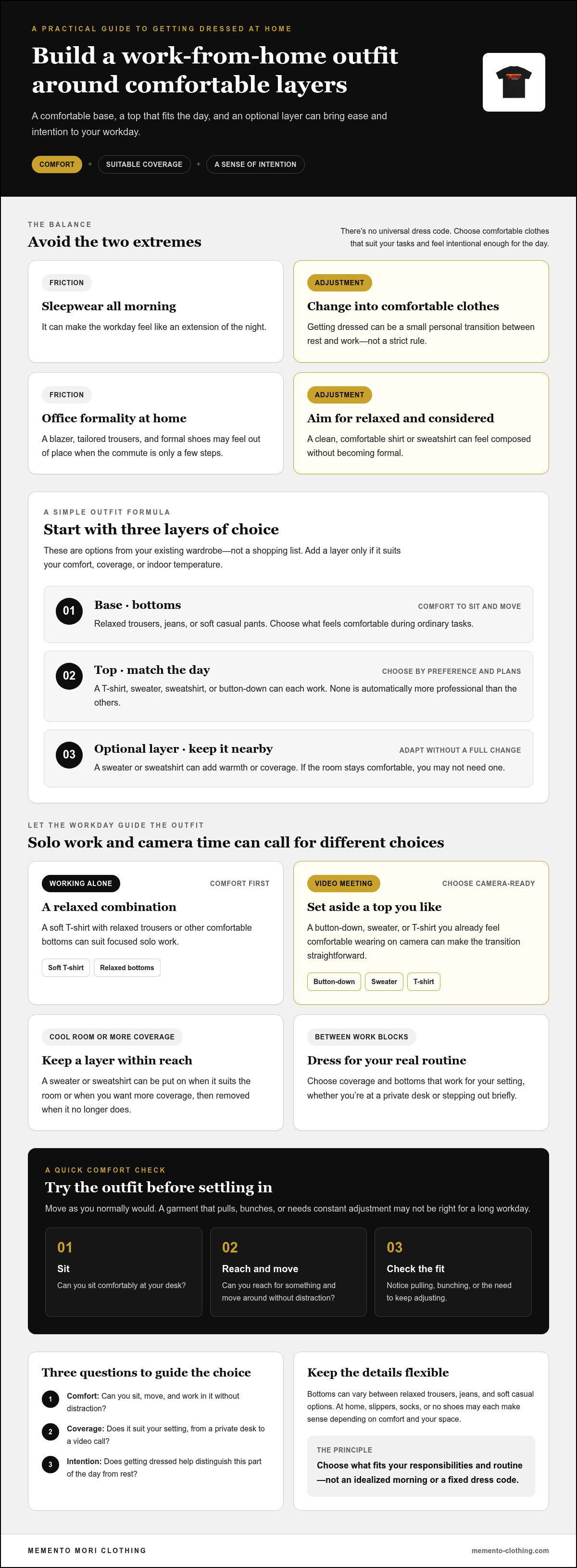
Sleepwear can make the workday feel like an extension of the night. A blazer, tailored trousers, and formal shoes may feel just as out of place when the commute is only a few steps. There’s no universal dress code for what to wear when you work from home. Start with comfortable clothing that suits your tasks, provides the coverage you want, and feels intentional enough to mark the day as yours.
That leaves room for real life. A work-from-home outfit might be a soft T-shirt and relaxed trousers for focused work, or a comfortable top with a layer nearby before a video meeting. It needn’t resemble office attire, and there’s no proven uniform that guarantees productivity. The history of remote work helps explain why expectations have shifted; the evolution of remote work and its influence on attire reflects a broader move away from one fixed idea of workplace dress.
Why getting dressed can create a useful workday boundary
Changing clothes can serve as a small personal ritual between rest and work. It isn’t a productivity technique that works the same way for everyone, and it doesn’t need to become a strict rule. Notice how you feel on days when you change before opening your laptop. Does it help signal that work time has begun, or does another routine fit your day better?
Schedules differ. A parent balancing school drop-offs, a worker with an early call, and someone whose workday begins later may each need a different transition. The useful boundary is the one that fits your responsibilities, not an idealized morning routine.
How to define your own level of polish
Think about who you’ll see and what the day asks of you. If you’ll work alone, comfort may matter most. A call with colleagues might lead you to choose a top that feels more considered, while a client-facing meeting could call for more coverage or a layer. These are personal choices, not rules about how a remote worker should look.
Polished doesn’t have to mean stiff. A clean, comfortable shirt or sweatshirt can feel composed without becoming formal. Choose a standard that lets you participate comfortably, whether that means being camera-ready from the waist up or dressing fully for a quick errand between work blocks. The aim isn’t to perform professionalism at home. It’s to feel at ease in the clothes you’ve chosen.
Use three questions to make the choice concrete:
- Comfort: Can you sit, move, and work in it without distraction?
- Coverage: Does it suit your setting, from a private desk to a video call?
- Intention: Does getting dressed help distinguish this part of the day from rest?
You don’t need the same answers every morning. Let the day’s tasks guide you, then keep what works. Comfort, suitable coverage, and a measure of intention are enough to begin.
Build a Work-From-Home Outfit Around Comfortable Layers
A useful work-from-home outfit doesn’t need a complicated formula. Start with a comfortable base, choose a top that suits the day, and keep an optional layer nearby. The pieces can come from your existing wardrobe. This makes getting dressed easier while leaving room to adjust to your work, comfort, or indoor temperature.
- Base: Choose bottoms you can sit and move in comfortably, such as relaxed trousers, jeans, or soft casual pants.
- Top: Pick a T-shirt, sweater, sweatshirt, or button-down according to your preference and plans.
- Layer: Keep a sweater or sweatshirt close if you want another option for a cooler room or more coverage.
Think of the layers as choices, not a shopping list. If your home stays comfortable throughout the day, you may not need an extra layer. If the temperature shifts, having one within reach lets you adapt without changing your whole outfit. Before settling in, sit at your desk, reach for something, and move around as you normally would. A garment that pulls, bunches, or needs constant adjustment may not be the right choice for a long workday.
Choose tops that suit your workday
A T-shirt can be an easy choice for solo work; a sweater or sweatshirt offers more coverage. A button-down or a structured, vintage-inspired blouse from Kitten D'Amour may feel right for a scheduled meeting or simply suit your style. None is automatically more professional or confidence-building than the others. Let the occasion and your own comfort guide the choice.
If you have a video call on the calendar, set aside a top you’re comfortable wearing on camera. That could be a button-down, a sweater, or a T-shirt you already like. Keeping it accessible makes the transition straightforward, without requiring a separate wardrobe or a full change of clothes.
Pair relaxed bottoms with a practical layer
Relaxed trousers, jeans, and soft casual bottoms are all possible starting points. Choose based on how the garment feels during ordinary tasks: sitting, standing, walking to another room, or stepping out briefly. There’s no need to wear the same kind of bottoms every day. A small rotation of familiar options keeps dressing simple while giving you flexibility.
Keep an optional layer within reach, such as over the back of a chair. Put it on if you feel cool or want more coverage, then remove it when it no longer suits the room. Footwear can follow your home routine: slippers, socks, or supportive indoor options from retailers such as Feet for Life may each make sense, depending on what feels comfortable and works for your space.
As you settle on combinations, leave room for personal expression. Memento Mori Clothing’s personal-expression apparel can add a considered detail to an everyday outfit without turning it into office cosplay.
Choose Between Casual and Camera-Ready Work-From-Home Outfits
The same outfit doesn’t have to serve every kind of workday. A morning spent writing alone, a scheduled video call, and a quick errand between work blocks may each call for different choices around comfort, coverage, and polish. Use the comparison below as a starting point, not a dress code. Your work, home, and sense of ease should shape the final choice.
Focused solo work
Comfort: Prioritize ease for sitting and moving through your usual tasks.
Coverage: Choose what feels comfortable in your home setting.
Visible polish: Keep it simple, perhaps a T-shirt with relaxed trousers.
Video calls
Comfort: Wear a familiar top that won’t distract you during the meeting.
Coverage: Consider what the camera framing shows and what feels appropriate for the call.
Visible polish: Add a sweater or choose a button-down if that suits the occasion.
Errands between work blocks
Comfort: Pick pieces that let you move easily beyond your desk.
Coverage: Consider the setting you’ll step into.
Visible polish: Keep your everyday outfit, or add a layer if you prefer a more finished look.
These are adaptable combinations, not universal rules. A sweatshirt may feel right for one person’s call and too casual for another’s. Jeans might suit a day that includes a short outing, while relaxed trousers may be more comfortable at home. The question of what to wear when you work from home is best answered by matching your clothes to the moment, rather than aiming for one standard of “professional” appearance.
What to wear for focused work without meetings
For a meeting-free stretch, choose everyday clothes that feel distinct from sleepwear if that difference matters to you. A T-shirt and soft casual bottoms can be enough; choose a sweater or sweatshirt if you prefer more coverage. Reusing a simple combination can reduce outfit decisions, but there’s no need to dress formally in hopes of improving concentration.
How to feel prepared for video calls
Choose a comfortable top that fits the meeting’s context and feels like you. Before joining, consider the camera frame: it may show only your upper half, or more if you stand or move. Adjust your clothing to feel comfortable with what’s visible. Dressing up can be a personal preference, but it doesn’t guarantee how colleagues will perceive or evaluate you.
Keep one meeting-ready option within easy reach if calls are part of your routine. That might mean setting aside a top you already enjoy wearing, rather than planning an entirely separate outfit. For a style shaped by the idea to “live fearless, remember humbly,” explore Memento Mori Clothing as an expression of personal meaning beyond a dress code.
Create a Simple Weekly Work-From-Home Wardrobe Routine
A little planning can make weekday dressing feel less like a fresh decision each morning. You don’t need a separate work wardrobe or a new outfit for every day. Start with clothes you already own, then make a short plan based on your calendar and what feels comfortable. The goal is a dependable routine, not a productivity guarantee. Your answer to what to wear when you work from home can change with the week.
Try this four-step reset at the start of the week:
- Review the week. Scan for video calls, focused work blocks, and commitments outside the home. Note the days that might call for different coverage or polish, but leave room for plans to shift.
- Choose outfit combinations. Pick a comfortable default for ordinary workdays, then choose a familiar alternative for days with meetings or errands. Build combinations from garments you already reach for, rather than buying pieces just to create a work uniform.
- Prepare a backup. Set aside one easy alternative in case a top is in the laundry, the room feels cooler, or your schedule changes. A backup can be another combination from your closet, not a reason to keep extra clothes solely for work.
- Adjust as you go. At the end of the week, notice which combinations felt comfortable and suited the day. Keep useful choices, revise what didn’t work, and let the next plan reflect your actual routine.
Plan outfits around meetings and daily tasks
Use the calendar as a guide, not a command. A day with no calls may suit your default outfit, while a meeting-heavy morning might prompt you to set aside a top you feel comfortable wearing on camera. If you’ll leave home between work blocks, choose a combination that feels appropriate for that commitment too. Planning one or two variations is often more practical than assigning a rigid look to every day.
Keep the routine flexible and easy to repeat
Write down a short list of combinations if that helps, or simply keep the options in mind. Repeating a familiar outfit is useful when it removes an unnecessary choice, but there’s no need to follow a plan that stops feeling right. Indoor temperature, comfort, and the day’s demands can all change. Add or remove a layer, swap one piece, or return to your default.
Keep the review brief. Ask yourself what you actually wore, what needed adjusting, and whether the plan made mornings simpler. Carry forward only the changes that matter. A wardrobe routine should make room for your life, not become another task to maintain.
For clothing shaped by intentional style and personal meaning, explore Memento Mori Clothing.
Make Work-From-Home Style Feel Like Your Own
A work-from-home wardrobe can be practical without feeling anonymous. A familiar silhouette, a graphic that means something to you, or a colour you return to can make an outfit feel personal. There’s no need to adopt a new look or follow a remote-work dress code. Keep what feels like you, and let your clothes reflect your preferences as much as your plans for the day.
Use clothing as a quiet form of self-expression
Notice which pieces you reach for repeatedly. Perhaps it’s a favourite sweatshirt, a well-worn graphic tee, or a simple shape that feels comfortable and familiar. You might choose a detail for its meaning, or simply because you enjoy seeing it in the mirror. Either way, let your own taste lead. Personal style can be understated; it doesn’t need to announce itself to anyone else.
That idea sits close to Memento Mori Clothing’s ethos, “live fearless, remember humbly.” It’s an invitation to make choices with intention, not a promise that what you wear will change your workday. The brand’s mission statement, “New Season. New Perspective.,” offers another way to think about personal style: small choices can express a point of view while leaving room for change. Your own version might be a graphic, a familiar colour, or a piece that carries a private memory.
A factual example of design with a point of view
The Memento Side-Zipped Hoodies offer one specific example of casual clothing design with distinctive details. They’re crafted from soft cotton and feature unique side zippers, along with a buttoned hood printed with “Believe in Yourself.” The Memento Side-Zipped Hoodies are currently sold out and unavailable for purchase. Their details show how a familiar garment can carry a point of view without setting a rule for what anyone else should wear.
You don’t need a statement piece to make an outfit yours. Consider what you’d like your clothes to express, even if the answer is simply ease, familiarity, or a small reminder of something important. Then let that detail sit alongside the practical choices that suit your day. The result can feel considered without becoming a performance, and personal without requiring a completely new wardrobe.
As you settle on what to wear when you work from home, leave room for both routine and change. Some days call for the piece you know by heart; others invite a different detail. Explore Memento Mori Clothing for a closer look at the brand’s point of view and clothing designs.
Let Your Workday Style Begin With You
The best answer to what to wear when you work from home is one that leaves room for your own life. Let your clothes support the day without asking them to transform it. A familiar shape, a meaningful graphic, or a small detail you enjoy can make an ordinary morning feel more considered, while keeping comfort at the center.
That balance reflects Memento Mori Clothing’s ethos: “live fearless, remember humbly.” The Memento Side-Zipped Hoodies offer one expression of that point of view, with soft cotton, unique side zippers, and a buttoned hood printed with “Believe in Yourself.” They’re currently sold out and unavailable for purchase, but their design speaks to the possibility of finding meaning in everyday clothing.
Let your wardrobe evolve at its own pace. Keep what feels useful, make space for what feels like you, and allow your routine to change as your days do. For a closer look at the brand’s perspective on clothing and self-expression, explore Memento Mori Clothing.
Frequently Asked Questions
Is it okay to wear pajamas while working from home?
Yes, pajamas can be fine if they’re comfortable and suit your workday. Consider whether you’ll share your workspace with family or housemates, or might need to join an unexpected call. If sleepwear makes the day feel too much like bedtime, try changing into lounge clothes instead. There’s no universal rule; choose what feels appropriate for your responsibilities and helps you feel at ease.
What should I wear for a work-from-home video call?
Choose a top that feels comfortable and suits the meeting’s tone. To make a practical choice about what to wear when you work from home, open your camera preview before the call and check what’s visible from your usual seat. A quick glance can show whether a collar sits comfortably or a layer shifts when you move. There’s no need to change your whole outfit just for the frame.
Do I need a separate work wardrobe when I work from home?
No, a separate wardrobe isn’t necessary. Your everyday clothes can serve work and personal time, especially if they’re comfortable for desk work and suitable for your usual meetings. Before buying anything, look at what you already wear and identify any genuine gaps, such as a clean top you like for calls. Avoid duplicating clothes just to label them “workwear” if your current options meet your needs.
Can I wear the same outfit more than once during the workweek?
Yes. Repeating an outfit is a practical choice, not a style mistake. If the pieces are clean and comfortable, you can wear the same combination again or repeat one item with a different top or bottom. Consider whether the outfit suits that day’s plans, including any calls or time outside the home. You don’t need a new look simply because another workday has arrived.
What should I wear when working from home in a cold room?
Choose pieces that keep you comfortable without making it difficult to move or work at your desk. A long-sleeved base layer under a sweater can provide another option, while warm socks may suit a home routine where you don’t wear shoes indoors. If you tend to warm up later, choose layers you can easily take off. Adjust for the room rather than dressing for a fixed idea of workwear.
How can I look presentable while staying comfortable at home?
Start with clothes that fit comfortably and look cared for, rather than relying on formal pieces. Before a call, check for visible lint, creases, or a twisted collar, and smooth anything that distracts you. Keep a spare top nearby if spills or household tasks are part of your day. Presentable can mean neat and suitable for the moment, not dressed as though you’re heading to an office.