
What to Look for in a Quality Vintage Tee: A Guide to Restoration and Longevity
A garment is not merely an object; it is a vessel for memory and a witness to time. Many collectors seek a piece of history only to be met with the disappointment of modern, paper-thin fabric masquerading as a relic. To build a wardrobe that carries weight, you must understand exactly what to look for in a quality vintage tee before you begin the hunt. It is about recognizing the density of the cotton and the quiet integrity of the seams.
You likely know the frustration of a DIY restoration gone wrong or the confusion surrounding fabric weights. True quality is found in the intentionality of construction. This guide promises to help you master the art of identifying high-caliber vintage pieces. You will learn the meditative rituals required to restore a faded black tee to its former glory without stripping away its essential character.
We will examine the structural hallmarks of a true grail shirt and provide a roadmap for maintaining a wardrobe built on longevity. From identifying authentic stitching to understanding the history woven into every fiber, your journey toward an intentional collection begins here.
Key Takeaways
- Master the art of discernment by learning exactly what to look for in a quality vintage tee, focusing on the weight of history rather than the age of the stitch.
- Explore why heavyweight cotton serves as the essential foundation for deep pigment absorption and structural longevity.
- Decode the language of graphics; learn to distinguish between a crackle that adds soul and wear that signals decay.
- Follow an intentional restoration ritual that revives the garment while protecting its unique historical narrative.
- Adopt a philosophy of mindful care to preserve the restored character of your pieces for a lifetime of wear.
Defining the Artifact: What to Look for in a Quality Vintage Tee
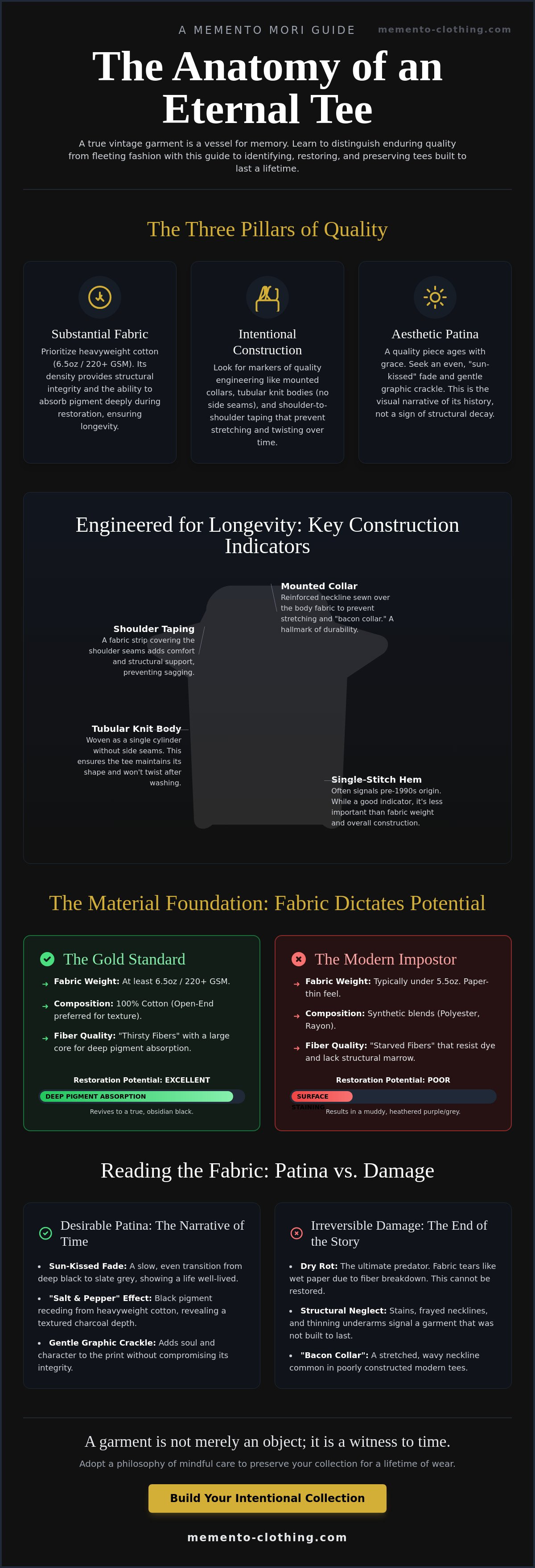
A true artifact is more than its age. When considering what to look for in a quality vintage tee, you must look beyond the date on the tag. A superior garment balances three pillars: substantial fabric weight, intentional construction, and an aesthetic patina that tells a story. Throughout the history of the T-shirt, the transition from military undergarment to cultural canvas has left behind various markers of quality that modern fast fashion often neglects.
The "single-stitch" rule is often treated as gospel in the resale world. While single-needle hems usually signal a pre-1990s origin, they don't always guarantee excellence. A thin, fragile tee from 1982 is still a fragile tee. We prioritize the structural integrity that allows a garment to endure another thirty years. Understanding what to look for in a quality vintage tee requires an eye for the density of the knit rather than just the number of threads in the hem.
A "good fade" is sun-kissed and intentional. It's the slow transition from deep black to a slate grey. This is different from structural neglect. Stains, frayed necklines, and thinning underarms aren't character; they're signs of a garment that wasn't built to last. We seek the pieces that have aged with grace.
At the heart of our philosophy is the Memento Mori perspective. We don't fear the fade. We value pieces that record the passage of time and the individual footprint of the wearer. A quality tee shouldn't look brand new. It should look eternal.
Construction Indicators of Longevity
Longevity is engineered. A mounted collar, where the ribbing is sewn over the body fabric, provides a reinforced neckline that resists stretching. This prevents the unsightly "bacon collar" common in modern garments. Tubular construction, a method where the body is a single cylinder without side seams, ensures the shirt won't twist or lose its silhouette after washing. We also look for shoulder-to-shoulder taping. This extra strip of fabric covers the raw seams, providing comfort and preventing the shoulders from sagging under their own weight.
Patina vs. Damage
Distinguishing between character and collapse is vital. Dry rot is the ultimate predator. It occurs when sulfur-based dyes react with moisture to break down cotton fibers, making the fabric tear like wet paper. It's a defect that no ritual can restore. Conversely, the "salt and pepper" effect is a sign of high-caliber cotton. As the black pigment slowly recedes from a heavyweight tee, it reveals a textured, charcoal grey depth. Patina is the visual narrative of a garment’s history.
The Material Foundation: Why Heavyweight Cotton Dictates Restoration Potential
The weight of a garment is its soul. When discerning what to look for in a quality vintage tee, the physical density of the fabric is your most honest guide. It's not merely about the tactile pleasure of a thick knit. It's about the garment’s ability to survive the rituals of renewal. A tee that has thinned to the point of transparency over thirty years lacks the structural marrow required to hold new pigment. We look for substance because substance allows for a second life.
The gold standard for restoration is a fabric weight of at least 6.5oz, or approximately 220+ GSM (grams per square meter). This density creates what we call the "thirsty fiber." In heavyweight cotton, the individual fibers are mature and robust. They possess a larger medulla, the central core of the fiber, which absorbs pigment deeper than the starved, thin threads of modern fast fashion. This depth of absorption is why a heavyweight piece can return to a true, obsidian black, while thinner alternatives merely take on a muddy, bruised purple hue.
Success in color revival depends on molecular bonds. 100% cotton is an absolute requirement. Synthetic blends, often found in modern "soft-wash" shirts, contain polyester or rayon that resists traditional dyes. These fibers remain stubbornly grey, creating a ghost-like heathered effect that betrays the vintage soul. Following the principles of textile conservation ensures that we respect the natural limits of these organic materials while pushing them toward a vibrant future.
The Science of the Heavyweight Tee
Open-end cotton is the silent architect of the vintage aesthetic. Unlike the overly slick, combed cotton of today, open-end spinning creates a slightly rougher, more porous texture. It ages with a specific grit. This texture is exactly why our Memento Crewnecks serve as the blueprint for restorable quality. They're built to withstand the relentless degradation of UV rays, which slowly shatter the cellulose bonds in high-density fibers over decades of sun exposure.
Assessing Fiber Integrity
You must learn the "Pinch Test." Grip the fabric between your thumb and forefinger in high-friction areas like the underarms or the nape of the neck. If the fibers feel brittle or significantly thinner than the rest of the body, the structural integrity has collapsed. High-density weaves act as a structural barrier, preventing pigment from bleeding through the fibers during the restoration process. If you're seeking a piece that will last another lifetime, consider the enduring weight of a heavyweight vintage-inspired silhouette as your starting point.
Evaluating the Graphic: Print Styles and Their Resistance to Time
A graphic is a visual echo. It’s the artifact’s voice. When you research what to look for in a quality vintage tee, the ink’s composition determines the garment’s future. Some prints endure. Others vanish. You aren't just selecting a design; you're choosing a material that must coexist with the rituals of restoration. The chemistry of the print dictates whether a shirt can be revived or if it must remain a faded relic of the past.
Plastisol is the most common survivor. It is a PVC-based ink that sits atop the fibers like a protective skin. Because it’s essentially plastic, it doesn’t absorb fabric dye. This makes it a perfect candidate for restoration. You can darken the cotton without muddying the art. Heat-set graphics are your allies here. Their cured state makes them the easiest to protect during a concentrated color bath, as the pigment remains locked within its own boundaries.
The "crackle" factor is a delicate balance. Fine, spiderweb cracks are a badge of honor. They represent decades of wear and washing; this is the soul of the piece. However, if the ink is brittle and flaking away from the fabric, the graphic has reached its end. This is a sign of structural death. Restoration won't save a print that has lost its grip on the cotton. You must also watch for "ghosting." This occurs when old pigments bleed into the surrounding fabric over time, creating a permanent shadow that restoration may inadvertently highlight.
Plastisol: The Resilient Shield
Heavier prints act as a natural resist. They shield the original design from restorative pigments. This is why the aesthetic value of a heavy graphic on a Memento Mori Vintage Tee is so high. It’s built to remain vibrant. Puff prints are a specific subset. They are raised and textured. They require a gentle touch. Aggressive heat or chemicals can cause them to deflate, losing their three-dimensional history in an instant.
Water-Based and Discharge Prints
Water-based inks offer a "soft hand" feel. They are elegant and breathable. They are also difficult to restore. Because these inks saturate the fiber, they often absorb new dye along with the cotton. Discharge printing is even more complex. It doesn’t sit on the fiber; it replaces the fiber’s color entirely. Restoration of an all-over discharge print requires managing expectations. You might lose the subtle gradients of the original art in exchange for a deeper, more uniform base color. It’s a choice between clarity and depth.
The Restoration Ritual: Reviving a Faded Tee Without Erasing Its History
Restoration is not a chore. It is an act of preservation. When you understand exactly what to look for in a quality vintage tee, you realize the garment is a vessel for history. To revive it is to honor its journey. This ritual requires patience and a steady hand. We do not seek the "fast fixes" found in digital clips. We seek a renewal that respects the aging process and the structural integrity of the artifact.
The deep clean is the first movement of the ritual. Legacy oils, skin cells, and decades of detergent residue clog the cotton fibers. These microscopic barriers prevent new pigment from reaching the medulla of the thread. A thorough, gentle soak in a pH-neutral cleanser is non-negotiable. It clears the path for the transformation to come. Without this step, the new color will sit on the surface, destined to wash away in the first rain.
Immersion requires a mastery of temperature and movement. For heavyweight 220+ GSM fabric, the water must be hot enough to open the cellulose bonds but not so aggressive that it damages the weave. Constant, meditative agitation ensures the pigment reaches every fold and seam. This is how you avoid the mottled, uneven appearance that plagues amateur attempts. You are not just dyeing a shirt; you are re-pigmenting a piece of history.
The Masking Technique
Protecting the graphic is a surgical task. For intricate screen prints, a thin layer of petroleum jelly or a specialized resist acts as a shield. It prevents dark dyes from muddying white or vibrant inks. Apply the resist with care. Use a fine brush for the edges. After the bath, remove the resist with a soft cloth and gentle soap. The underlying ink remains untouched; its narrative is preserved while the surrounding fabric regains its depth.
The Dyeing Process for Heavyweight Cotton
Choosing the right pigment is essential for permanence. Fiber-reactive dyes are the professional standard. They create a molecular bond with the cotton, unlike all-purpose dyes that merely coat the surface. This is the secret to a "True Black" formula. Cheap alternatives often result in a purple-grey hue that feels hollow and artificial.
The Memento Mori story teaches us that beauty exists in the cycle of life and renewal. We fix what is broken because the object has earned its place in our lives. Once the pigment is set, drying must be done with intention. The sun is the enemy of a fresh revival. UV rays will immediately begin to shatter the new pigment bonds. Hang the garment in a cool, dark space. Let the air do the work. If you seek a canvas worthy of this ritual, consider the Memento Mori Vintage Tee as your next foundation.
Beyond the Revival: Intentional Care for a Lifetime of Wear
The restoration ritual is complete. The deep, obsidian black has returned to the fibers. Now, the true work of stewardship begins. To maintain the soul of the garment, you must adopt a "Wash Less" philosophy. Every immersion in water, no matter how gentle, is a slow erosion of the pigment you've fought to restore. Abstinence is the highest form of care. Spot cleaning and air-freshening should be your primary tools for preservation.
Laundering must be approached as a meditative ritual rather than a chore. When a full wash is unavoidable, use only cold water and pH-neutral detergents. Invert the garment to protect the graphic from the mechanical friction of the machine. This is where the knowledge of what to look for in a quality vintage tee pays its final dividend. A heavyweight 220+ GSM fabric handles these stresses with a quiet strength that modern, disposable fibers simply cannot match. You're not just cleaning a shirt; you're protecting an investment in time.
Storage is an act of preservation that many overlook. Hanging a heavyweight tee is a slow death for the neckline and shoulders. Gravity is relentless. The weight of the dense fibers will eventually pull the collar into an unsightly shape, ruining the silhouette. Fold your artifacts. Store them in a cool, dark space where the air can breathe but the light cannot fade. A garment that ages in tandem with its wearer becomes a second skin, a record of years lived and stories told.
The Maintenance Checklist
Consistency is the hallmark of the custodian. Small habits prevent the return of the fade. Avoid optical brighteners at all costs. These additives are designed to make whites "pop" by coating fibers in fluorescent chemicals, but they will quickly dull the deep, rich blacks of a restored tee. Consider the following daily rituals:
- Use a fabric shaver to maintain a "bright," clean silhouette by removing microscopic pilling.
- Air-dry your garments in the shade to prevent UV degradation of the new pigment.
- Refer to our Caring Tips for Vintage Tees for a deeper look at daily habits of preservation.
Building the Personal Archive
Investing in quality, such as our Youth Graphic T-Shirts, represents a choice to reduce future waste. It's a psychological shift from consumer to custodian. When you choose pieces built on a foundation of heavyweight cotton and intentional design, you're building an archive rather than a temporary wardrobe. Your clothes are artifacts. They carry the weight of your history; treat them with the reverence they deserve. The beauty of a quality piece isn't that it stays perfect, but that it matures with dignity.
Cultivating an Eternal Wardrobe
A garment is a legacy. You now understand exactly what to look for in a quality vintage tee, from the structural integrity of a mounted collar to the pigment-retaining power of 6.5oz heavyweight cotton. These aren't just technical details. They're the markers of a piece that can withstand the relentless passage of time. True restoration is more than a simple process. It's a ritual that honors the history woven into every fiber.
By choosing pieces built for longevity and treating them with reverence, you transform from a mere consumer into a custodian of artifacts. Our collection is built on this very foundation of permanence and philosophical depth. Each piece is an invitation to leave your own footprint on a canvas that won't easily fade away. Build a collection that remembers.
Embrace a philosophy-driven aesthetic designed for a lifetime of wear. Explore the Memento Mori Vintage Tee Collection and find your next restorable grail. Honor the cycle of renewal. Wear the weight of your own history.
Frequently Asked Questions
How do I restore a faded black t-shirt without ruining the white graphic?
You protect the graphic by applying a masking agent like petroleum jelly or a specialized resist before the dye bath begins. This creates a silent barrier. It prevents the pigment from touching the art while the cotton drinks the new color. Once the ritual is complete, a gentle soap removes the resist, revealing the pristine narrative of the original print.
Can I use commercial dye on a vintage t-shirt with a screen print?
Yes, you can use commercial dyes, but fiber-reactive options are the superior choice for permanence. Most vintage screen prints are plastisol-based, which is a PVC material that naturally resists water-based dyes. The ink stays vibrant while the fabric regains its depth. It's a harmonious coexistence between the original artifact and the new pigment.
What is the best way to set the dye in a restored vintage shirt?
The most effective method is using a dedicated dye fixative followed by a cold water rinse. This locks the molecular bonds within the cotton fibers. Avoid the heat of a dryer. Instead, let the garment air-dry in a dark, cool space. This patience prevents UV rays from immediately degrading the fresh obsidian tones you've restored.
How do I know if my vintage t-shirt has "dry rot" before I try to restore it?
Identifying dry rot is a somber necessity when learning what to look for in a quality vintage tee. Perform a gentle tug test on a discreet area of the hem. If the fabric tears with the ease of old paper or makes a crisp, snapping sound, the fibers have collapsed. This structural decay is permanent and cannot be saved by any ritual.
Will re-dyeing a t-shirt make it shrink or change the fit?
The dye itself doesn't change the fit, but the water temperature can be a catalyst for shrinkage. High-quality heavyweight cotton is remarkably stable. It resists the distortion that plagues thinner, modern fabrics. If you maintain a steady, moderate temperature during the immersion bath, the silhouette of your artifact will remain true to its history.
Can I restore a vintage t-shirt that is a 50/50 cotton-poly blend?
Restoration of a 50/50 blend is often disappointing. Standard dyes only bind to natural cellulose fibers like cotton. The polyester threads will remain stubbornly grey or faded, resulting in a muddy, heathered appearance. To achieve a deep, intentional black, you must start with a foundation of 100% high-density cotton. Synthetics simply don't possess the same soul.
How many times can you re-dye a heavyweight cotton t-shirt?
A quality garment can typically withstand two or three restorations over its lifetime. Eventually, the medulla of the fiber becomes saturated with legacy pigments. The structural integrity begins to decline as the cotton loses its ability to absorb. Treat each restoration as a rare event. It is a gift of time that shouldn't be squandered through frequent, careless washing.
What is the difference between a "good fade" and a "bad fade"?
A good fade is an aesthetic patina that records the passage of time without sacrificing strength. It is the textured "salt and pepper" look of high-density cotton. A bad fade is the brittle, yellowing decay of a garment that was never meant to endure. Knowing what to look for in a quality vintage tee means recognizing when a fade is a story and when it is an ending.