
What Is a Memento Mori Lifestyle? The Art of Intentional Living in 2026
What if the only way to truly inhabit your life is to admit it's ending? In the first quarter of 2026, a growing collective of individuals has traded the frantic pulse of digital noise for a quieter, more deliberate path. You've likely felt that hollow ache after hours of mindless scrolling or the regret of choosing disposable trends over objects that carry a real story. We all crave a life that feels heavy with meaning rather than light with distractions. It's a natural reaction to a world that feels increasingly temporary.
Understanding what is memento mori lifestyle transforms an ancient meditation on mortality into a sharp, modern blueprint for high-quality living. It's not about gloom; it's about the clarity that comes from knowing your hours are finite. This guide will show you how to apply this philosophy to your daily rituals and purchase decisions. We'll explore how to cultivate a sense of presence, choose quality over quantity, and build a personal heritage that outlasts the current season.
Key Takeaways
- Understand what is memento mori lifestyle by reframing mortality as a profound catalyst for presence rather than a source of fear.
- Learn to apply the "Essentialist" filter to your daily choices, ensuring your energy is reserved only for what holds lasting significance.
- Discover the connection between intentional living and the physical world, moving beyond "fast culture" toward a life of curated quality.
- Practice specific daily rituals and digital audits designed to reclaim your time from the scroll and return it to the soul.
- Explore how a narrative-driven uniform anchors your commitment to longevity and serves as an emotional anchor in a fleeting world.
Defining the Memento Mori Lifestyle: Beyond the Morbid Misconception
The phrase Memento Mori often arrives with a chill. It translates directly to "Remember you must die." In a culture obsessed with youth and the denial of aging, this sentiment feels heavy, even taboo. However, understanding what is memento mori lifestyle requires looking past the surface level darkness. It's not a fascination with the grave. It's a radical commitment to the present. Death isn't the enemy here. It's the ultimate motivator for clarity. By acknowledging the finish line, we finally start to care about the race. We stop drifting. We start choosing.
The Historical Roots of Stoic Presence
The architects of this perspective were not gloomy men. Marcus Aurelius, who governed Rome from 161 to 180 AD, and Seneca, writing his moral letters in 49 AD, used mortality as a lens. They viewed the history of memento mori as a practical framework for leadership and personal peace. They didn't have time for petty grievances because they knew their hours were numbered. They used the shadow of the end to filter out trivial distractions and social posturing. Memento Mori is a tool for prioritizing the essential over the ephemeral.
Modern Reinterpretation: The End of the "Slave, Save, Retire" Cycle
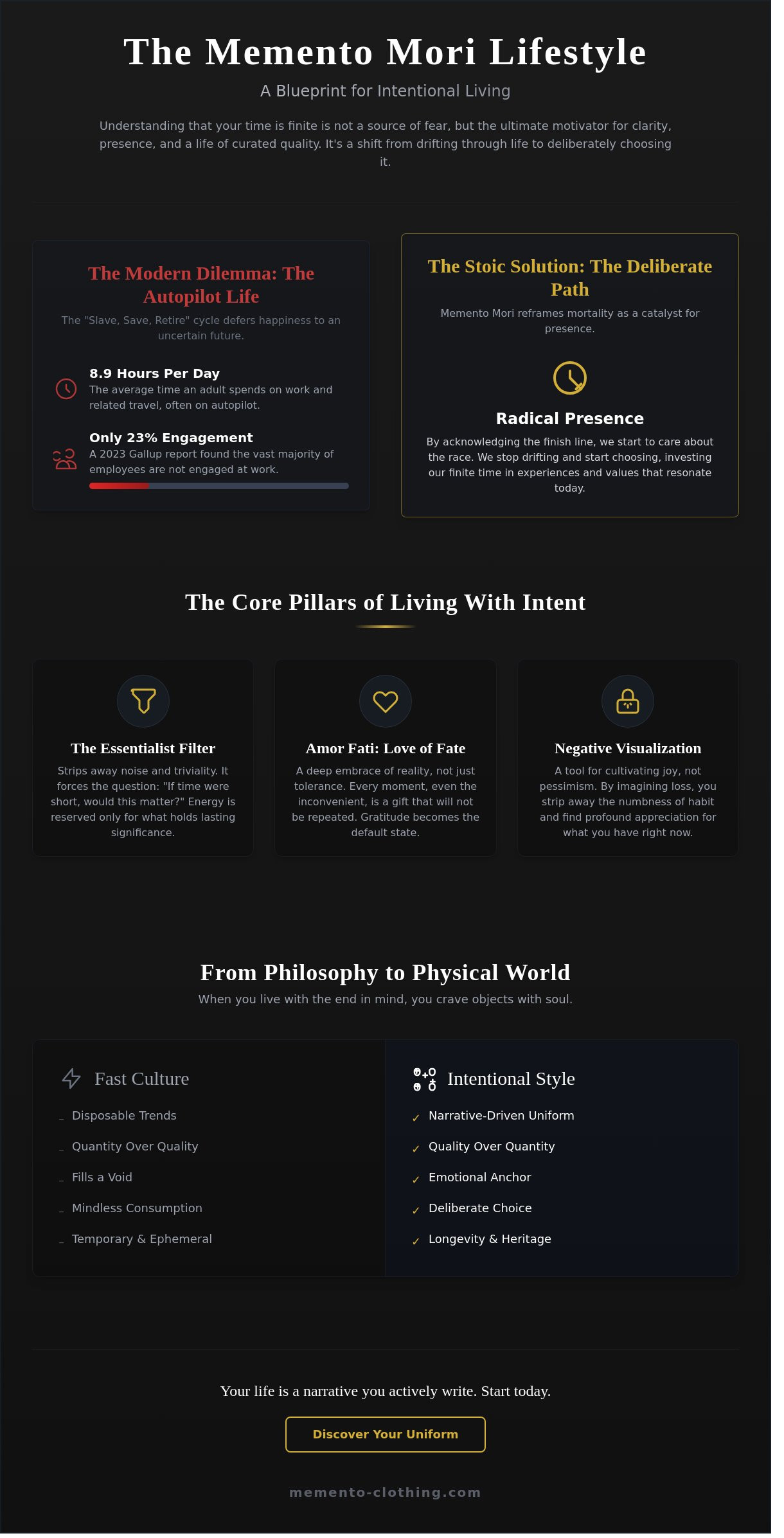
The traditional 40 year grind is built on a fragile assumption. It assumes that health and time will wait for a distant retirement. Data from the Bureau of Labor Statistics shows that the average adult spends 8.9 hours a day on work and related travel. This "Slave, Save, Retire" cycle fails the Memento Mori test. It defers happiness to an uncertain future that may never arrive. A 2023 Gallup report found that only 23 percent of employees feel engaged at work. The rest are on autopilot.
Adopting what is memento mori lifestyle is a quiet rebellion against this mindless consumption. It's a shift toward "living now" rather than waiting for a permission slip from a pension fund. We choose to invest in experiences that resonate today. We refuse to treat our best years as a down payment for a future we might not see. This isn't about recklessness. It's about the refusal to be a spectator in your own life.
This worldview eventually manifests in our physical surroundings. We call this intentional style. It's the opposite of fast fashion and disposable trends. When you live with the end in mind, you crave objects with soul. You look for garments that act as emotional anchors. You want pieces that carry a sense of lineage and quiet gravity. Every choice becomes a reflection of your values. Your clothes aren't just fabric. They're a statement of how you value your time. They're a commitment to quality in a world that settles for the temporary.
The Core Pillars of Living with Intent
Understanding what is memento mori lifestyle starts with a quiet realization: our time is the only currency we cannot earn back. It is a psychological framework built on the weight of the present. We often drift through hours as if they are infinite; this philosophy stops the drift. It demands an Essentialist mindset. If the sun set today for your final time, would these trivial worries matter? This perspective strips away the noise. It forces us to ask if our current actions contribute to a legacy or merely fill a void.
Anxiety often thrives in the gap between what we want to control and what we actually can. Memento Mori narrows our vision to the internal. You control your reaction. You control your character. Everything else is vapor. This shift reduces the mental load of modern life by discarding external expectations. This aligns with the Memento Mori story, where life is treated as a narrative we actively write, rather than a series of accidents we simply endure. It turns existence into a deliberate art form.
Amor Fati: Loving the Present Moment
Amor Fati is the pulse of this lifestyle. It translates to "love of fate." It is not just tolerance; it is a deep embrace of reality as it is. When a morning commute is stalled by a heavy storm, you don't just wait for it to end. You accept the rain as a necessary part of the day's texture. This acceptance allows for deeper engagement with the now. A cold wind becomes a reminder of your senses. A delayed train becomes an opportunity for reflection. Gratitude becomes a default state when you realize that every moment, even the inconvenient ones, is a gift that will never be repeated.
Premeditatio Malorum: The Power of Negative Visualization
This isn't pessimism. It is a tool for joy. By imagining the loss of your health, your home, or your loved ones, you strip away the numbness of habit. A 2008 study in the Journal of Personality and Social Psychology found that people who visualized the absence of a positive event in their lives experienced significantly more gratitude than those who simply thought about the event. You start to see your morning coffee as a miracle. You see a conversation with a friend as a rare, fragile event. This practice makes social interactions more deliberate. You stop checking your phone. You listen. You stay. It reminds us that every "hello" carries the quiet weight of a future "goodbye."
Living this way creates a life of substance. When we choose objects or garments that serve as a vessel for these memories, we anchor our philosophy in the physical world. We stop chasing trends and start building a heritage.
Intentionality in the Physical World: Why Quality Matters
Understanding what is memento mori lifestyle requires looking at the objects in our immediate reach. Our surroundings aren't neutral; they either anchor us to the present or distract us with the disposable. Fast culture, characterized by the 100 billion garments produced annually as of 2023, functions as a collective denial of the value of time. When we buy something intended to fall apart, we're admitting that our time and the resources of the earth are cheap. Choosing quality is a rebellion. It's an acknowledgement that since our days are numbered, the items we use should possess a soul and a lifespan that respects that scarcity.
The Philosophy of Durability
Durability isn't just a technical spec; it's a metaphor for a life well-lived. In a world of flimsy threads, the Memento Mori Vintage Tee serves as a tactile reminder of this principle. Fabric weight and construction are more than just design choices. They represent a commitment to permanence. We use the term "heavyweight" to represent the gravity and substance we should seek in all things. A garment that survives years of wear carries the stories of those years within its fibers. It becomes a piece of personal history rather than a landfill statistic.
Aesthetic as Mindfulness
A curated environment creates the silence necessary for reflection. This is a vital pillar of what is memento mori lifestyle. It's about removing the trivial to make room for the essential. Adopting a "uniform" reduces the 35,000 decisions the average adult makes daily, according to research from Cornell University. By limiting choices, we preserve mental energy for deep work and meaningful connection. Your space should reflect a sense of melancholic elegance, a quiet, dignified appreciation for the beauty that remains despite the passage of time.
- Natural materials: Use stone, wood, or heavy cotton to ground your senses.
- Muted palettes: Choose colors that don't compete for your limited attention.
- Patina over polish: Value objects that gain character and beauty as they age.
- Negative space: Allow for "white space" in your home to let the mind breathe.
Daily Rituals: How to Practice Memento Mori Every Day
Understanding what is memento mori lifestyle requires moving beyond theory into the rhythm of daily life. It's a commitment to awareness. The practice begins by auditing your digital existence. Data from 2023 indicates the average person spends 144 minutes daily on social media. This is time surrendered to the void. By removing the "scroll," you create a vacuum for the "soul." Reclaim those two hours. Use them to breathe, to think, or to simply exist without a screen.
Practice the "Last Time" meditation during mundane activities. When you walk through your front door or pour a cup of coffee, imagine it's the final time you'll ever perform that act. This shift in perspective strips away the boredom of the everyday. It reveals the hidden sanctity in the routine. You don't need a cathedral to find the divine; you only need the realization that your time is finite.
- Physical Anchors: Use coins, art, or specific objects to trigger philosophical reminders throughout your workspace.
- Reverse Bucket List: Instead of chasing future shadows, write a daily list of five things you possess right now that you're grateful for.
- Intentional Silence: Dedicate 10 minutes to absolute quiet. In a world that never stops talking, silence is a radical act of remembrance.
The Morning Reflection and Evening Review
Start your day with a five-minute Stoic routine. Before checking your phone, sit in the stillness of the early light. Acknowledge that you've been granted another day, a gift not promised to everyone. Set one intention based on your core values. This isn't a to-do list; it's a "to-be" list.
Close the circle with an evening review. Measure your actions against your principles. Did you act with kindness? Did you waste the hours you were given? This isn't about self-judgment. It's about calibration. Use these reflections to ensure your path remains true to your philosophy.
Wearing the Philosophy: Apparel as an Anchor
Psychologists identify a phenomenon called "enclothed cognition." A 2012 study published in the Journal of Experimental Social Psychology demonstrated that the clothes we wear significantly influence our psychological processes. What you put on your body dictates your mindset. It's the difference between dressing to impress and dressing to remember.
Choosing a Memento Mori Heavyweight Hoodie provides a tactile, weighted reminder of your mortality. The fabric serves as a physical anchor. In moments of stress or distraction, the touch of the heavy cotton brings you back to the present. It's a conscious decision to wear your values. You aren't just following a trend; you're carrying a legacy. This shift transforms apparel from a commodity into a tool for mindfulness.
Embrace the weight of the present and find your anchor for the journey ahead.
Choosing Your Uniform: Memento Mori Clothing as a Lifestyle Statement
Understanding what is memento mori lifestyle means recognizing that every daily choice carries weight. Your clothing is the skin you choose to show the world. It shouldn't be a hollow reflection of a passing trend. Memento Mori Clothing exists for those who value narrative over the noise of fast fashion. We don't chase the flickering lights of seasonal hype. We build for the long walk, creating pieces that act as a silent manifesto for the wearer.
The brand serves as a bridge between ancient philosophy and modern aesthetics. It's a rejection of the "disposable" era where garments are worn three times and discarded. Choosing this uniform is an act of rebellion against the temporary. It's a commitment to a life where quality outlasts the moment.
The Craftsmanship of Intentional Design
The soul of the brand lives in the details of its construction. We utilize heavyweight cotton and specific vintage washes to create a sense of history from the first wear. These aren't just textures; they're echoes of a life lived with purpose. The Memento Crewnecks stand as a testament to this heavyweight quality. They offer a physical weight that grounds the wearer in the present.
Choosing an oversized fit and heavy fabric isn't just a stylistic whim. It's about presence and comfort. A heavier garment provides a constant, subtle tactile reminder of your own existence. It doesn't cling; it drapes with a quiet authority. These high-quality garments eventually become mementos of our personal history, absorbing the stories of the years we spend inside them.
Building an Intentional Wardrobe for 2026
As we move toward 2026, the global fashion landscape is shifting toward radical intentionality. People are tired of the clutter. A wardrobe should last decades, not seasons. To achieve this, you must look for pieces that balance philosophical depth with a modern, national fashion context. It's about finding the "forever" pieces that speak when you stay silent.
- Invest in high GSM (Grams per Square Meter) fabrics that maintain their structure after a hundred washes.
- Select a palette of muted, earthy tones that reflect the cycle of nature and time.
- Integrate pieces that serve as "emotional anchors," helping you remember your "why" during the daily grind.
What is memento mori lifestyle if not the art of making every second, and every thread, count? We invite you to join a community that doesn't just exist but lives with profound purpose. It's time to stop wearing clothes that mean nothing. Live intentionally, dress with meaning, and leave a legacy that's felt long after the fabric fades.
Choose Your Legacy Today
Living with intent in 2026 means stripping away the trivial. We've seen how a heightened awareness of mortality transforms daily rituals into meaningful acts. It's the difference between existing and truly inhabiting your time. Quality becomes a moral choice. Choosing 400GSM heavyweight fabrics over disposable alternatives reflects a commitment to things that endure. These pieces don't just sit in a wardrobe. They witness a life lived with purpose. They carry the weight of your history.
Understanding what is memento mori lifestyle requires more than just reading. It demands a physical anchor. By selecting philosophy-driven designs built for longevity, you reject the cycle of fast fashion that discards 92 million tons of textile waste every year. You choose substance. You choose a wearable reminder that your time is finite, but your impact can be timeless. Every stitch serves as a silent pulse. A steady rhythm in a world that often forgets to breathe.
Explore the Memento Mori Collection and find your wearable reminder.
Let your presence be felt. Your story deserves a canvas that lasts as long as your memories do.
Frequently Asked Questions
Is a Memento Mori lifestyle depressing?
No, this philosophy acts as a vibrant catalyst for intentionality rather than a focus on sadness. A 2012 study published in Psychological Science found that awareness of mortality actually increases altruism and positive behavior. By acknowledging the end, you strip away the trivial and focus on what's truly essential. It's a celebration of the present moment through the lens of its eventual passing.
How does Memento Mori help with anxiety?
It provides a profound sense of perspective that shrinks modern worries to their actual size. According to Terror Management Theory, first developed in 1986, conscious awareness of mortality can help individuals prioritize intrinsic goals over superficial anxieties. When you accept the inevitable, the pressure to perform for others fades. You gain a quiet confidence that stems from understanding the temporary nature of all things.
Can I practice Memento Mori without being a Stoic?
Yes, this practice transcends any single school of thought and appears throughout history. You can find its roots in 17th-century Dutch Vanitas paintings and various spiritual traditions that predate Stoicism. It's a universal human tool for grounding oneself in reality. Anyone seeking a deeper connection to their time can adopt these principles to create a more meaningful personal history.
What are the best books to learn about this lifestyle?
Start with Meditations by Marcus Aurelius, written around 180 AD, for a direct look at disciplined reflection. Seneca's Letters from a Stoic, dating back to 65 AD, offers practical advice on valuing time. For a modern perspective, Ernest Becker's The Denial of Death from 1973 explores the psychological impact of our mortality. These texts provide the intellectual foundation for a life lived with purpose and awareness.
How does clothing relate to a philosophical lifestyle?
Clothing serves as a tangible emotional anchor and a silent declaration of your values. In 2024, fashion has shifted toward pieces that offer longevity and personal meaning rather than fleeting trends. When you wear something designed with intentionality, it becomes a ritual of remembrance. Every texture and silhouette acts as a physical reminder to inhabit your body and your time fully while you can.
What is the first step to living a Memento Mori lifestyle?
The first step is a simple 10 minute daily reflection on the transient nature of your current surroundings. Understanding what is memento mori lifestyle begins with observing the world's natural cycles of growth and decay. You don't need grand gestures to start. Small, quiet moments of honesty about your own timeline will naturally begin to shift your priorities toward quality and depth in all your relationships.
Does Memento Mori mean I should quit my job and travel?
No, it's about finding depth in your current path rather than escaping it through constant movement. A 2021 workplace survey showed that 65 percent of people seek more meaning in their daily tasks, not necessarily a different career. This lifestyle encourages you to perform your current role with total presence and excellence. It's about how you live, not where you are or what your title says.
How do I explain this lifestyle to friends and family?
Focus on the clarity and gratitude the practice brings to your life instead of the technical definitions. Tell them it's a tool that helps you value your time with them more deeply. Use the 17th-century concept of a keepsake to explain how you're curating a life of quality. Most people understand the desire to stop wasting days on things that don't matter once you explain the positive outcomes.