
The Psychology of What We Wear: Dressing with Intent in 2026
What if the fabric against your skin is actually a structural anchor for your soul? It's easy to feel lost in a sea of fleeting trends, especially when 66% of us are now seeking durability and value over the hollow promise of "newness." You've likely felt the disconnect between a crowded closet and a quiet mind. You're tired of the noise. You want your external self to finally mirror the depth of your internal values.
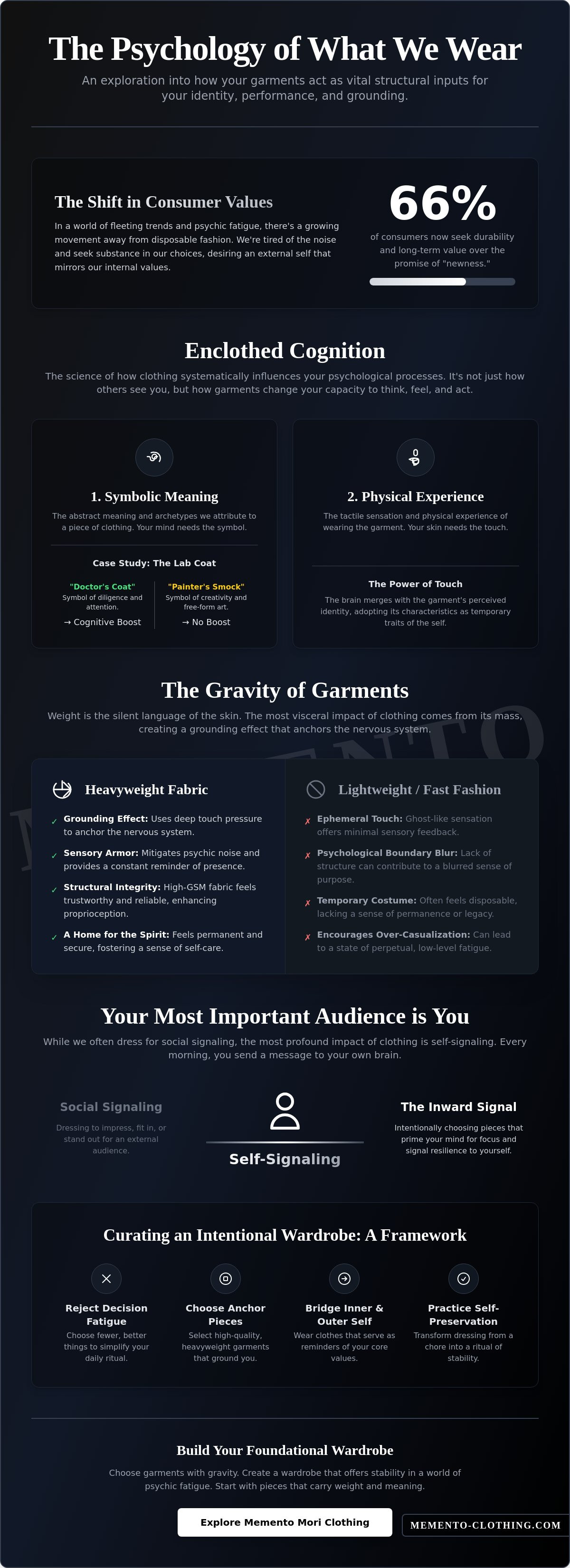
Understanding the psychology of what we wear is no longer a luxury; it's a necessity for emotional survival in 2026. This article explores how your garments act as vital structural inputs for your identity, cognitive performance, and grounding. We'll provide a framework for choosing clothes that offer stability in a world of psychic fatigue. We'll also examine the science of enclothed cognition and validate your desire for high-quality pieces that carry weight. By the end, you'll see your wardrobe not as a collection of objects, but as a ritual of self-preservation and a bridge to your truest self.
Key Takeaways
- Understand the science of enclothed cognition and how the marriage of symbolic meaning and tactile sensation shapes your daily performance.
- Explore the grounding effect of fabric weight, transforming a heavyweight garment into a vessel for emotional stability and mental clarity.
- Deepen your understanding of the psychology of what we wear to move beyond the trivial and embrace pieces that serve as philosophical reminders of what truly matters.
- Learn to distinguish between performing for the world and dressing for the self, choosing items that act as a bridge between your internal values and your outward presence.
- Gain a structured framework for curating an intentional wardrobe that rejects decision fatigue in favor of meaningful, high-quality anchors.
Enclothed Cognition: The Science of How Clothing Shapes the Mind
Fabric is more than a mere covering. It's a structural input for the psyche. To understand the psychology of what we wear, we must first look at the concept of Enclothed Cognition. This scientific principle suggests that clothing exerts a systematic influence on the wearer's psychological processes. It isn't just about how others see you. It's about how the garment changes your very capacity to think, feel, and act.
The science rests on two distinct pillars: the symbolic meaning we attribute to the piece and the physical experience of wearing it. A classic 2012 study demonstrated this perfectly. Researchers found that subjects wearing a white lab coat performed significantly better on selective attention tasks, but only if they believed the coat belonged to a doctor. If they thought it was a painter's smock, the cognitive boost vanished. The mind needs the symbol and the skin needs the touch. Dressing with intent acts as a pre-game ritual; it's a quiet preparation for the weight of the day ahead.
The Inward Signal: Why You are Your Own Most Important Audience
We've spent decades focusing on social signaling. We dress to impress, to fit in, or to stand out. Yet, the most profound impact of clothing is self-signaling. Every morning, you send a message to your own brain. When you choose a structured piece, you prime your mind for focus. When you choose something intentionally weighted, you signal resilience. There is a hidden psychological cost to over-casualization. While comfort is the modern mantra, a total lack of intentionality can lead to a blurred sense of purpose. Without the ritual of dressing, the boundary between rest and labor dissolves. This leaves the mind adrift in a state of perpetual, low-level fatigue.
Symbolic Meaning vs. Physical Sensation
Our minds are wired to recognize archetypes. We associate certain silhouettes with peace, power, or discipline. This isn't just cultural conditioning; it's an emotional resonance that happens the moment the fabric settles on your shoulders. A heavyweight cotton hoodie isn't just a garment. It's a tactile anchor that provides a sense of security through its physical density. The brain effectively merges with the garment's perceived identity, adopting its characteristics as temporary traits of the self. This fusion is why the psychology of what we wear remains the most intimate form of self-architecture we possess.
The Gravity of Garments: Why Fabric Weight Influences Confidence
Weight is the silent language of the skin. When we discuss the psychology of what we wear, we often focus on color or silhouette, yet the most visceral impact comes from mass. Heavyweight cotton possesses a unique grounding effect. It anchors the nervous system through deep touch pressure. This physical input acts as a subtle, constant reminder of the body's presence in space. It's a form of sensory armor that helps mitigate the psychic noise of a loud world. While fast fashion offers an ephemeral, almost ghost-like touch, pieces like Memento Mori Heavyweight Hoodies provide a sense of permanence. There's a profound link between the structural integrity of a garment and the perceived structural integrity of the self. If the fabric doesn't collapse, we feel less likely to collapse under the day's weight.
Tactile Psychology: The Sensory Link to Security
Our brains rely heavily on proprioception, the sense of self-movement and body position. Structured clothing enhances this awareness by providing clear physical boundaries. High-GSM (grams per square meter) fabrics feel inherently more trustworthy because they offer consistent tactile feedback. They don't flutter or distort with every movement. They remain. This reliability creates a legacy feeling that transcends the season. It's the antithesis of the disposable culture that dominates our current era. Research into the psychological benefits of fashion suggests that intentional choices in texture and density can significantly bolster one's sense of self-care. Thin, synthetic fabrics often feel like a temporary costume; heavyweight gear feels like a home for the spirit.
Armor for the Modern Day
In an era defined by psychic fatigue and global instability, clothing serves as a vital psychological boundary. It separates the fragile internal self from an unpredictable environment. A well-constructed Memento Crewneck acts as a physical reminder of personal strength. It's a quiet, heavy embrace. This durability mirrors the resilience we seek in our own lives. Choosing a garment that survives the seasons validates our own desire for longevity and meaning. It's a conscious choice to invest in items that grow with us rather than those that fade after a single wash. You can find these intentional pieces in our latest collection of heavyweight essentials. By understanding the psychology of what we wear, we turn the simple act of dressing into a ritual of fortification and remembrance.
Stoic Style: Wearing the Philosophy of Memento Mori
Memento Mori is an ancient echo. It translates to "Remember you must die." While some find this phrase dark, the Stoics saw it as a lens for profound clarity. It strips away the trivial. It forces a confrontation with the essential. When we apply this to the psychology of what we wear, the act of dressing becomes a philosophical statement. You aren't just choosing a color; you're choosing a perspective. It's a way to carry the weight of existence with a quiet, confident grace.
The most impactful figures in history often adopted a personal uniform. They understood that every trivial choice consumes a piece of the soul's energy. By simplifying the wardrobe, they preserved their focus for the work that outlives the self. In 2026, where 66% of consumers now prioritize value and durability over trendiness, this minimalist approach is a rebellion against the temporary. Integrating the Memento Mori story into your daily attire transforms a simple piece of clothing into a narrative tool for living well. It's no longer just a garment; it's a testament to your own history.
Aesthetic Minimalism as Mental Clarity
Visual noise creates mental static. A cluttered wardrobe often mirrors a cluttered mind. Aesthetic minimalism isn't about lack; it's about space. It's about the psychological relief found in knowing every item you own has a purpose and a place. A timeless design is a psychological hedge. It protects the wearer from the anxiety of being "outdated" by refusing to participate in the race of the ephemeral. It's about finding peace in the permanent. When your external environment is organized, your internal state often follows.
The Memento Mori Vintage Tee as a Daily Anchor
A graphic can be a compass. The Memento Mori Vintage Tee guide highlights how a single symbol can redirect a day's energy. It serves as a daily anchor. It reminds you of your limited time and your absolute agency. This is the transition from buying clothes to curating symbols. When you understand the psychology of what we wear, you realize that your reflection should be a reminder of your values, not just a display of your wealth. Each piece becomes an emotional horgony, a bridge between the material world and your personal history.
Authenticity Over Performance: Dressing for the Internal Self
Is the mirror a stage or a sanctuary? Many view the act of dressing as a performance for a phantom audience. They're wrong. When we study the psychology of what we wear, we find that the most vital conversation happens in the silence of the morning. Costuming is the act of wearing society's expectations rather than your own values. It creates a heavy psychological strain. You feel like an actor on a set you didn't choose, wearing a mask that doesn't fit. True power lies in coherence. This is the state where your exterior skin matches your interior soul. This alignment is a silent fortress. It erases the fear of being "found out." If you are exactly who you appear to be, social anxiety loses its grip on your day.
The Trap of Fleeting Trends
Fast fashion thrives on a hollow dopamine loop. You buy, you feel a fleeting spike of relevance, and then the inevitable psychological crash follows. This cycle fragments your identity. It leaves you as a collection of disparate moods rather than a singular, grounded person. In 2026, the tide is turning. Recent data shows that 66% of US consumers now prioritize value and quality over the 10% who still chase trendiness. There is a profound peace in intentional stagnation. It's the brave act of finding your aesthetic truth and refusing to move. It's choosing the permanent over the popular.
Internal Validation vs. External Approval
Dressing for yourself is a radical act of self-respect. It signals that you don't need the gaze of others to validate your existence. You're enough. This foundation starts early in life. High-quality basics, such as Youth Graphic T-Shirts, foster identity formation in younger generations by teaching them that quality is a form of self-care. By understanding the psychology of what we wear, we learn to curate symbols rather than just accumulate objects. We stop asking for permission to be ourselves. You can begin building your own coherent narrative by exploring our collection of intentional, high-quality essentials today. Each piece is designed to be an emotional anchor, a bridge between your personal history and the world you inhabit.
Curating an Intentional Wardrobe: A 5-Step Psychological Framework
Building a wardrobe is an act of self-architecture. It requires more than just an eye for color; it demands a deep understanding of the psychology of what we wear. When you curate with intent, you transform a cluttered closet into a sanctuary of clarity. Follow this framework to align your external skin with your internal truth.
- Step 1: Audit for Emotional Resonance. Examine every piece. Does it make you feel capable or merely cluttered? If a garment carries the weight of a past version of yourself that no longer exists, it's time to release it.
- Step 2: Prioritize Physical Grounding. Invest in weight. Seek out textures that provide a secure, tactile presence. High-quality, dense fabrics act as a sensory anchor throughout a chaotic day.
- Step 3: Align with Philosophy. Choose brands that represent your worldview. When the story behind the label matches your personal values, the garment becomes a meaningful extension of your identity.
- Step 4: Practice Selective Uniformity. Limit your color palette to reduce decision fatigue. This isn't about restriction; it's about creating a reliable aesthetic language that works for you every single morning.
- Step 5: Embrace Longevity. View each purchase as a memento of a life stage. Choose pieces built to survive the seasons, allowing them to become witnesses to your personal history.
Reducing Decision Fatigue
Choice overload is a silent thief of mental energy. The cognitive science of morning routines suggests that the more trivial decisions we make, the less energy we have for creative work later. A curated, high-quality wardrobe eliminates this friction. You no longer wonder if an outfit fits your mood or your mission. You already know. This certainty frees your mind to focus on the essential tasks that define your legacy. It's a quiet, daily victory over the noise of the modern world.
The Ritual of Getting Ready
Dressing is the first significant decision of your day. It's a meditative practice, a moment of transition from the internal world of sleep to the external world of action. This ritual sets the tone for everything that follows. By choosing pieces that offer both structural integrity and philosophical depth, you ground yourself in reality. Memento Mori Clothing serves as the foundation for this intentional lifestyle. It provides the weight, the symbol, and the quality needed to face the world with a focused mind and a steady heart. Every morning is a chance to remember who you are and what truly matters.
Architecting the Self Through Intentional Style
Clothing is never just fabric. It's a structural input that dictates how you move through the world. By embracing the science of enclothed cognition and the grounding weight of premium cotton, you transform the act of dressing into a ritual of self-preservation. You've seen that the psychology of what we wear is fundamentally about coherence; it's the bridge between your internal values and your external presence. This is the path toward a quiet, focused confidence that trend-chasing can never provide.
We invite you to step away from the hollow noise of fast fashion. Our philosophically driven designs are rooted in the wisdom of Memento Mori, reminding us that time is our most precious resource. Every piece features premium heavyweight cotton for grounding and durability, ensuring your garments serve as steady companions rather than disposable costumes. These items are designed for longevity, acting as physical anchors for your personal history. Discover the Memento Mori Collection and dress with intent.
Your wardrobe is the visual record of the life you choose to lead. Choose pieces that speak to your soul and honor the permanence of your values. Every morning is a new opportunity to wear your truth with a steady heart.
Frequently Asked Questions
How does clothing affect our mood and behavior?
Clothing functions as a direct input for the nervous system, altering your internal landscape through symbolic association. When you wear a structured piece, your brain adopts the characteristics of that structure. This shift isn't just about feeling better; it's about changing your actual capacity for focus or resilience. Your attire acts as a silent prime, setting the emotional tone before you even speak a word.
What is enclothed cognition and how does it work?
Enclothed cognition is the marriage of a garment's symbolic power and the physical sensation of wearing it. It works by triggering specific mental schemas within the wearer. For instance, a heavyweight hoodie provides the physical sensation of security while the symbol of the garment reinforces a sense of privacy and safety. The mind needs both the touch and the meaning to shift its cognitive state.
Can what you wear change your personality?
Your attire doesn't replace your core self, but it acts as a structural scaffold for your persona. It allows you to inhabit specific archetypes more fully. By understanding the psychology of what we wear, you can use clothing to amplify existing traits like authority or creative stillness. It doesn't change who you are; it changes which version of you is currently leading the way.
Why do I feel more confident in certain clothes?
Confidence stems from coherence. You feel most powerful when your external appearance perfectly mirrors your internal values. When there's no gap between who you are and how you look, you remove the psychological burden of performance. This alignment allows your true self to emerge without hesitation. High-quality, structured pieces provide the physical support needed to sustain this internal state throughout the day.
What is the psychological meaning of Memento Mori in fashion?
Memento Mori is a ritual of remembrance. In the context of fashion, it acts as a compass that points away from the ephemeral and toward the essential. Wearing this philosophy helps you reject the anxiety of fleeting trends. It grounds you in the knowledge that your choices should reflect a legacy, not just a season. It's a quiet rebellion against the triviality of modern consumption.
Does fabric weight actually affect how I feel?
Physical weight provides a grounding effect through deep touch pressure. High-GSM fabrics act as a tactile anchor, helping the brain maintain body awareness in high-stress environments. This physical density creates a sense of "armor" that thins, synthetic fabrics simply cannot replicate. The weight of the garment reminds the nervous system that you are present, secure, and capable of enduring the day's demands.
How can I start dressing more intentionally?
Begin by auditing your wardrobe for emotional resonance. Ask if each piece makes you feel capable or merely cluttered. Transition from the impulse of buying items to the ritual of curating symbols. Focus on quality over quantity. Select heavyweight, meaningful basics that serve as a permanent foundation for your life. Every piece should be an intentional choice that reflects your personal history and values.
Why is fast fashion psychologically damaging?
Fast fashion fuels a cycle of psychic fatigue. It relies on a hollow dopamine spike that quickly fades, leaving you with a fragmented sense of self. This constant search for the "new" prevents you from building a stable, long-term identity. It turns the act of dressing into a source of anxiety rather than a source of peace. Over time, this disconnect between your clothes and your values erodes your sense of authenticity.