
The Minimalist Wardrobe Philosophy: A 2026 Guide to Intentional Living
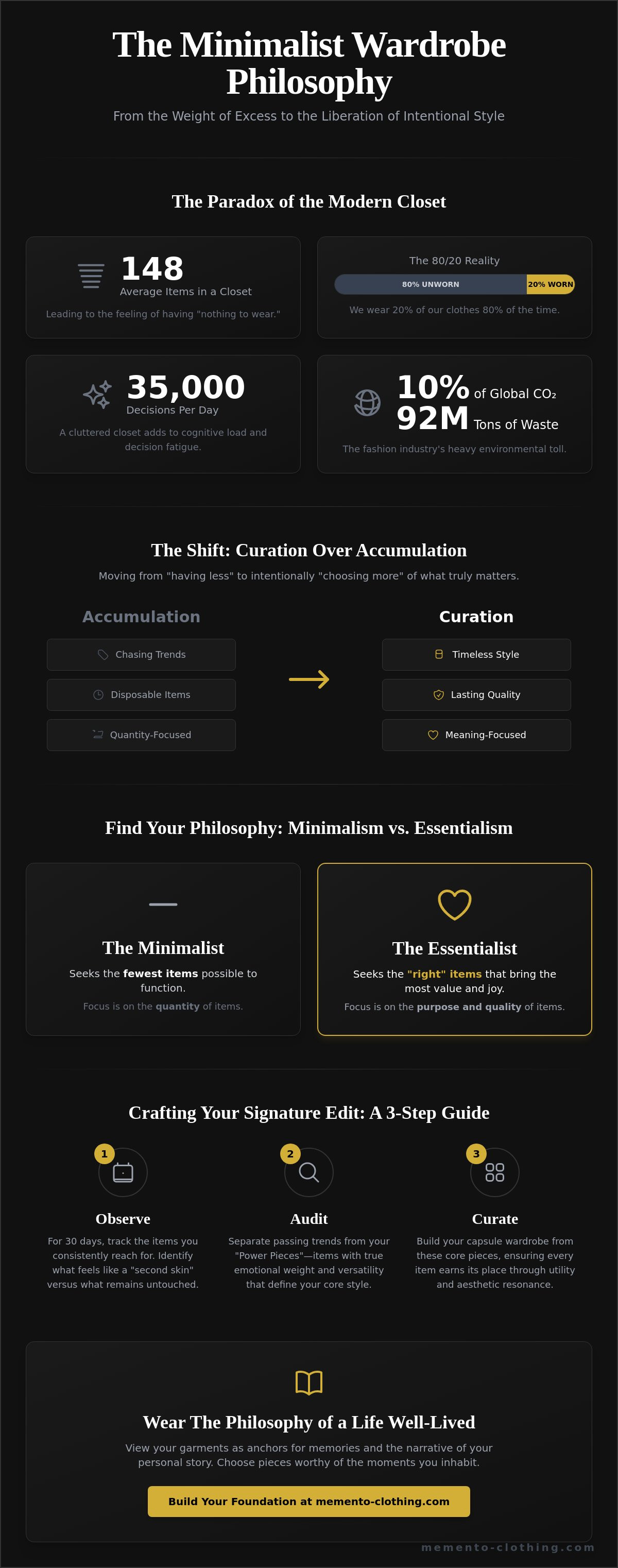
A closet overflowing with an average of 148 items often leaves its owner feeling like they have nothing to wear. It's a quiet paradox. The more we accumulate, the less we actually see ourselves in our reflections. You've likely felt that morning exhaustion, staring at racks of fast fashion while mourning the loss of your own aesthetic clarity. You aren't just looking for more space; you're looking for a way to let your clothing speak the truth about who you are. Adopting a minimalist wardrobe philosophy isn't about the cold subtraction of items. It's about the warm addition of meaning. It's a conscious choice to stop consuming and start collecting pieces that carry the weight of your personal history.
We agree that the cycle of disposable trends feels hollow and heavy. In this guide, you'll discover how to transcend simple decluttering to build a wardrobe that serves as a profound expression of intentionality and timeless style. We'll examine the path toward a curated collection of versatile pieces that offer both clarity and a deeper, more meditative connection to the objects you own.
Key Takeaways
- Shift your perspective from merely having less to intentionally choosing more of what truly defines your character.
- Reclaim your mental energy by understanding the cognitive benefits of a streamlined closet and the quiet power of a personal uniform.
- Explore how a minimalist wardrobe philosophy prioritizes heavyweight fabrics to create a foundation of lasting quality and silent confidence.
- Identify your "Power Pieces" through a meditative audit that separates passing trends from items with true emotional weight.
- Connect with the Memento Mori philosophy to view your garments as anchors for memories and the narrative of a life well-lived.
Beyond the Closet: Understanding the Minimalist Wardrobe Philosophy
True style doesn't scream for attention. It whispers. By 2026, the noise of hyper-consumption has reached a breaking point, leading many to seek refuge in a minimalist wardrobe philosophy that prioritizes the soul over the trend. This isn't merely a method for organizing a closet; it's a tool for reclaiming mental clarity. When we remove the burden of choice from our mornings, we grant ourselves the capacity to focus on what truly matters. The wardrobe becomes a sanctuary of intentionality.
The shift from "having less" to "choosing more" marks the evolution of modern dressing. We no longer seek to empty our lives but to fill them with objects that possess weight and meaning. This perspective is deeply rooted in the concept of Memento Mori. Remembering our mortality isn't a morbid exercise; it's a catalyst for better living. If our time is finite, every garment we wear should be worthy of the moments we inhabit. We stop buying for a hypothetical future and start dressing for the present self.
This intentionality carries a heavy environmental weight. The fashion industry currently accounts for approximately 10% of global carbon emissions, producing 92 million tons of textile waste annually. Choosing to own fewer, better pieces is the most radical act of sustainability available to the individual. It's a refusal to participate in a cycle of planned obsolescence. It's a commitment to the long term.
The Core Tenets of Intentional Dressing
Curation is the antidote to accumulation. It involves selecting versatile pieces that transition between roles, from a morning meeting to a quiet evening. We reject the frantic pace of trend-chasing. Instead, we embrace timeless silhouettes that remain relevant as the years pass. This approach honors the craftsmanship of the maker and the dignity of the wearer. Minimalist philosophy is the simple expression of a complex life.
The modern Capsule Wardrobe serves as the structural foundation for this practice. By 2025, data showed that the average person only wears 20% of their clothing 80% of the time. Curation aligns our physical reality with our actual needs, ensuring every item earns its place through utility and aesthetic resonance.
Minimalism vs. Essentialism: What Is the Difference?
Minimalism often focuses on the quantity of items, but essentialism focuses on their quality and purpose. It's a vital distinction. Having 30 items you truly love is far superior to owning 10 you merely tolerate. A minimalist wardrobe philosophy shouldn't feel like a punishment or a strict numerical limit. It's about finding your personal baseline where nothing is superfluous and nothing is missing.
- The Minimalist: Seeks the fewest number of items possible to function.
- The Essentialist: Seeks the "right" items that bring the most value and joy.
- The Baseline: Determined by your specific lifestyle, climate, and professional requirements in 2026.
To find your baseline, observe your habits for 30 days. Identify the pieces that feel like a second skin and those that remain untouched. The goal is a wardrobe that acts as an emotional anchor, helping you navigate the world with a quiet, unwavering confidence.
The Psychology of Less: Why Intentional Dressing Matters
Selection is an act of curation. It is a dialogue with the self. When we open a closet crowded with impulse buys, we aren't just looking at fabric; we're facing a wall of micro-decisions. The average adult makes 35,000 decisions every single day. Each choice, no matter how small, depletes our cognitive reserve. By embracing a minimalist wardrobe philosophy, we reclaim this mental tax. We transform the act of dressing from a chore into a ritual of clarity.
Iconic thinkers have long understood this. From the grey suits of 20th-century intellectuals to the dark turtlenecks of modern innovators, the "Uniform" is a tool for preservation. It is a refusal to waste brilliance on the mundane. Deep insights into the psychology of minimalist wardrobes reveal that a streamlined closet creates a cognitive sanctuary. It lowers cortisol levels and sharpens focus. When you remove the noise, your true identity finally has the space to speak.
Clutter carries an invisible emotional weight. Every garment you don't wear is a reminder of a version of yourself that didn't stick, or a mistake you've yet to discard. Empty space is not a void; it's a luxury. It represents the freedom to move, to think, and to exist without the heavy pull of the past. A curated collection is an investment in your future peace.
Breaking the Fast Fashion Cycle
Fast fashion thrives on the 20-minute dopamine spike. It's a fleeting high followed by a long, hollow decline. The psychological cost of cheap, disposable garments is a fragmented sense of self. We become collectors of trends rather than owners of our story. Transitioning to intentional acquisition means choosing the lasting satisfaction of quality over the rush of the new. It's about finding beauty in the grain of the fabric and the strength of the seam. We move from consuming to inheriting.
Confidence Through Consistency
There is a quiet power in knowing you look impeccable in everything you own. This consistency builds a daily foundation of confidence that doesn't fluctuate with the seasons. A signature style acts as a visual language, a shorthand for your values and your aesthetic. In a world that demands constant reinvention, standing still in your own truth is the ultimate rebellion. By 2026, the most radical thing you can wear is something you've loved for years. It's not just a garment; it's a piece of your history.
Quality Over Quantity: The Heavyweight Foundation of a Timeless Wardrobe
A minimalist wardrobe philosophy isn't a celebration of emptiness. It's an investment in the tangible. Most people overlook fabric weight, yet it's the primary factor in how a garment survives the years. Weight represents substance. It's the physical weight of a memory. It's the difference between a shirt that lasts a single season and one that becomes a legacy.
High-quality construction reveals itself in the details. Look for double-needle stitching and high fiber density. These aren't just technical specs; they're the architecture of longevity. When a garment has a high grams per square meter (GSM) count, usually above 400 for fleece or 280 for jerseys, it maintains its drape. It doesn't cling or sag. It holds its ground against the world.
The Heavyweight Advantage
Weight provides a specific tactile satisfaction. There's a quiet confidence in wearing something substantial. Heavyweight hoodies are the definitive anchor for an intentional closet. They offer a structural integrity that thin fast-fashion layers lack. This thickness acts as a shield, ensuring the piece retains its original silhouette after 60 or even 100 wash cycles. It's about the feeling of being grounded.
- Durability: Dense weaves resist tears and pilling better than lightweight alternatives.
- Drape: Heavy fabric follows the body's lines without losing its own shape; it hangs with intention.
- Comfort: The internal temperature regulation of thick natural fibers is superior to synthetic blends.
Natural Fibers and the Vintage Aesthetic
True quality doesn't need a logo to scream its value. It speaks through texture. 100% cotton remains the gold standard for those seeking a breathable, long-lasting wardrobe. It's a living material. A vintage tee earns its place in your history by how it ages. It develops a patina, a soft fading at the seams and a unique softness that only comes from years of use. Adopting a minimalist wardrobe philosophy means embracing this evolution.
This aging process is beautiful. It reflects the memento mori spirit; everything changes, but quality leaves a mark. By choosing heavy, natural textures over loud branding, you create a look that's timeless. You aren't wearing a trend. You're wearing a story that gets better with every passing year. Your clothes become emotional anchors in a fast-moving world. They're silent witnesses to your life.
Crafting Your Signature Edit: A Practical Guide to Curating Essentials
Curating a wardrobe isn't about subtraction alone. It's an act of quiet rebellion against the noise of fast fashion. To master the minimalist wardrobe philosophy, you must first confront the reality of what you actually wear. Industry data from 2024 indicates that the average person ignores 80 percent of their clothing. This clutter isn't just physical; it's a weight on your daily decision-making. Start your audit by categorizing items by frequency and feeling. Identify your Power Pieces. These are the garments you reach for every week without hesitation. They feel like a second skin. They represent your most authentic self.
Define a color palette rooted in neutrals. Charcoals, off-whites, and deep blacks allow for effortless mixing. This foundation ensures that every piece speaks to every other piece. To maintain this balance, adopt the "One In, One Out" rule. For every new item that enters your space, one must leave. This creates a cycle of constant refinement rather than mindless accumulation. It forces you to value quality over the dopamine hit of a new purchase.
Step 1: The Emotional Wardrobe Purge
We often dress for a "fantasy self." This is the version of us that goes to events we don't attend or leads a life we haven't chosen. Letting go of these items requires honesty. It's about accepting who you are today. If an expensive mistake is hanging in your closet, acknowledge the lesson it taught you and move on. The guilt of the price tag shouldn't dictate your future clarity. If you're hesitant, use a "maybe" box. Seal it for 90 days. If you don't open it, those items are no longer part of your story.
Step 2: Building the Essential Layers
Foundations are built on versatility. High-quality crewnecks serve as the anchor for a year-round rotation. They bridge the gap between solitude and the street. A heavyweight basic provides a sense of security and structure. It's a canvas. When you invest in pieces that transition from lounge to public life, you reduce the need for specialized costumes. Add a single, meaningful accessory. A well-crafted watch or a structured bag can shift the mood of a simple outfit from casual to formal in seconds.
Refining your collection is a slow, meditative process. It's an investment in your peace of mind and your personal legacy. Every piece should be an intentional choice, not a compromise.
Memento Mori: Wearing the Philosophy of a Life Well-Lived
Clothing acts as a physical anchor to our personal history. Every crease, fade, and softened seam tells a story of where we've been and who we've become. In 2026, the minimalist wardrobe philosophy has evolved beyond mere aesthetics. It's now a profound acknowledgment of our mortality used to fuel a more vibrant existence. The Memento Mori story reminds us that our time is finite. This ancient wisdom, when applied to modern fashion, shifts the focus from the temporary thrill of a purchase to the enduring value of a garment.
Mindful consumption is a radical act of self-respect. You don't just buy clothes; you curate the artifacts of your life. When you choose a single, high-quality piece over five disposable ones, you're stating that your presence matters. You're refusing to be a background character in a cycle of waste. This intentionality honors the present moment by ensuring that what you touch and wear is worthy of your time.
Intentional Design for a Meaningful Life
Memento Clothing operates on a "less but better" principle. Design isn't just about silhouettes or textile weights. It's about the narrative we weave into the things we own. A jacket isn't just a layer against the wind; it's a witness to a season of change. We focus on pieces that remain relevant as decades pass, avoiding the noise of seasonal trends. Every stitch is a commitment to longevity. Your wardrobe should be a legacy in the making.
Next Steps: Joining the Intentional Movement
Breaking free from the cycle of fast fashion requires constant awareness. Trends often disappear in less than 12 weeks, yet a well-made garment can last 20 years. To stay inspired, focus on these steps:
- Seek Quality Over Hype: Look for craftsmanship that survives the wash and the years.
- Value the Narrative: Choose items that resonate with your personal journey.
- Find Your Community: Connect with others who prioritize depth over surface-level consumption.
Explore the Memento collection as a starting point for your journey. It's time to build a collection that honors your past while dressing for the future you're actively creating. Stop collecting things. Start gathering memories.
Embrace the Weight of Permanence
The minimalist wardrobe philosophy transcends simple organization. It's a quiet rebellion against the ephemeral. Industry data from the Ellen MacArthur Foundation suggests the average garment is worn only seven times before being discarded; your journey requires a more enduring standard. You're building a foundation. By prioritizing premium heavyweight fabrics, you ensure your signature edit survives the seasons. These pieces don't just occupy space. They anchor your daily rituals in quality and purpose.
Intentional dressing is a dialogue with time itself. It’s the realization that what we wear reflects how we value our hours. When you choose timeless silhouettes over fleeting trends, you're crafting a legacy that outlasts the noise of modern consumption. Your clothes become emotional anchors. They're witnesses to your history and reminders of your presence. Every selection is an act of curation, a way to honor the life you're living right now. Don't settle for the temporary when you can wear the eternal.
Explore the Memento Mori Collection and start your intentional journey.
Step into a future where every thread tells a story. Your legacy starts with the first conscious choice.
Frequently Asked Questions
What is the first step in starting a minimalist wardrobe?
The first step is a rigorous audit of your current possessions. Examine what you truly wear. A 2023 study by ClosetMaid revealed that the average person ignores 80 percent of their closet. Identify the pieces that hold meaning. Discard the noise. Focus on the items that reflect your identity. This clarity forms the foundation of a minimalist wardrobe philosophy.
Does a minimalist wardrobe have to be all neutral colors?
A minimalist wardrobe doesn't require a monochrome palette. It demands intentionality. You can embrace vibrant hues if they serve a purpose. In 2024, the Pantone Color Institute highlighted how specific tones evoke deep emotional responses. Choose colors that resonate with your personal history. Ensure they harmonize with your other garments. Your palette should feel like a curated gallery, not a restrictive cage.
How many items should be in a minimalist wardrobe?
There's no universal number, though many practitioners follow the Project 333 rule, which suggests 33 items per season. The goal isn't deprivation. It's about finding your unique equilibrium. A 2025 fashion industry report noted that high-quality capsule wardrobes typically range between 30 and 50 pieces. Every item must earn its place. Quality always outweighs the volume of your collection.
Is a minimalist wardrobe philosophy more expensive to maintain?
Maintaining a minimalist wardrobe philosophy is more cost-effective over time. You stop chasing fleeting trends. While a single premium garment costs more upfront, its longevity reduces the price per wear. Data from the 2024 Resale Report shows that high-quality, timeless pieces retain 60 percent of their value compared to fast fashion. You're investing in an enduring legacy, not a temporary thrill.
Can I still have a minimalist wardrobe if I like graphic t-shirts?
You can absolutely include graphic t-shirts in a minimalist collection. Minimalist living focuses on curation rather than a specific aesthetic style. If a graphic tee represents a significant memory or artistic value, it belongs. Ensure the design is timeless. Avoid pieces that rely on 2026's passing fads. A well-chosen graphic can act as a centerpiece for your personal narrative.
What is the best way to care for heavyweight garments to ensure they last?
Care for heavyweight garments by washing them sparingly and using cold water. Excessive heat destroys fibers. A 2022 textile study found that reducing wash cycles by 50 percent extends a garment's life by several years. Store heavy knits folded to prevent stretching. Use wide, padded hangers for structured coats. Treat these pieces as artifacts. Proper maintenance ensures they remain part of your story for decades.