
The Memento Mori Story: From Ancient Philosophy to Modern Narrative
What if the realization that your time is finite is the only thing that actually sets you free? We often feel paralyzed by the rapid pace of the clock, watching as seconds dissolve into a blur of noise. You've likely felt that weight, the desire to create a legacy that outlasts the fleeting trends of the season. The Memento Mori story is not just a narrative device; it's a centuries old framework for reclaiming your presence in the now.
In this exploration, you'll discover the profound link between Jonathan Nolan's 2001 short story and the Stoic roots that ground it. We'll move beyond shallow interpretations to understand how mortality can become your most reliable guide for intentional living. From the ancient meditations of Marcus Aurelius to the complex structures of modern film, we'll show you how to wear this philosophy as a badge of quiet, enduring strength. It's time to stop fearing the end and start honoring the moment.
Key Takeaways
- Trace the evolution of the Memento Mori story from Jonathan Nolan’s gripping fiction of amnesia to its status as a cornerstone of modern storytelling.
- Revisit ancient Roman rituals to understand why the most powerful leaders in history required a constant whisper of mortality to remain grounded.
- Decode the visual language of medieval and 17th-century art, where every brushstroke served as a silent reminder of life’s beautiful fragility.
- Transform your perspective on time by applying Stoic wisdom to modern productivity frameworks that prioritize intentional action over busyness.
- Explore how intentional fashion can serve as a physical anchor, weaving the philosophy of durability and presence into the fabric of your daily life.
The Fiction that Defined a Generation: Jonathan Nolan’s 'Memento Mori' Short Story
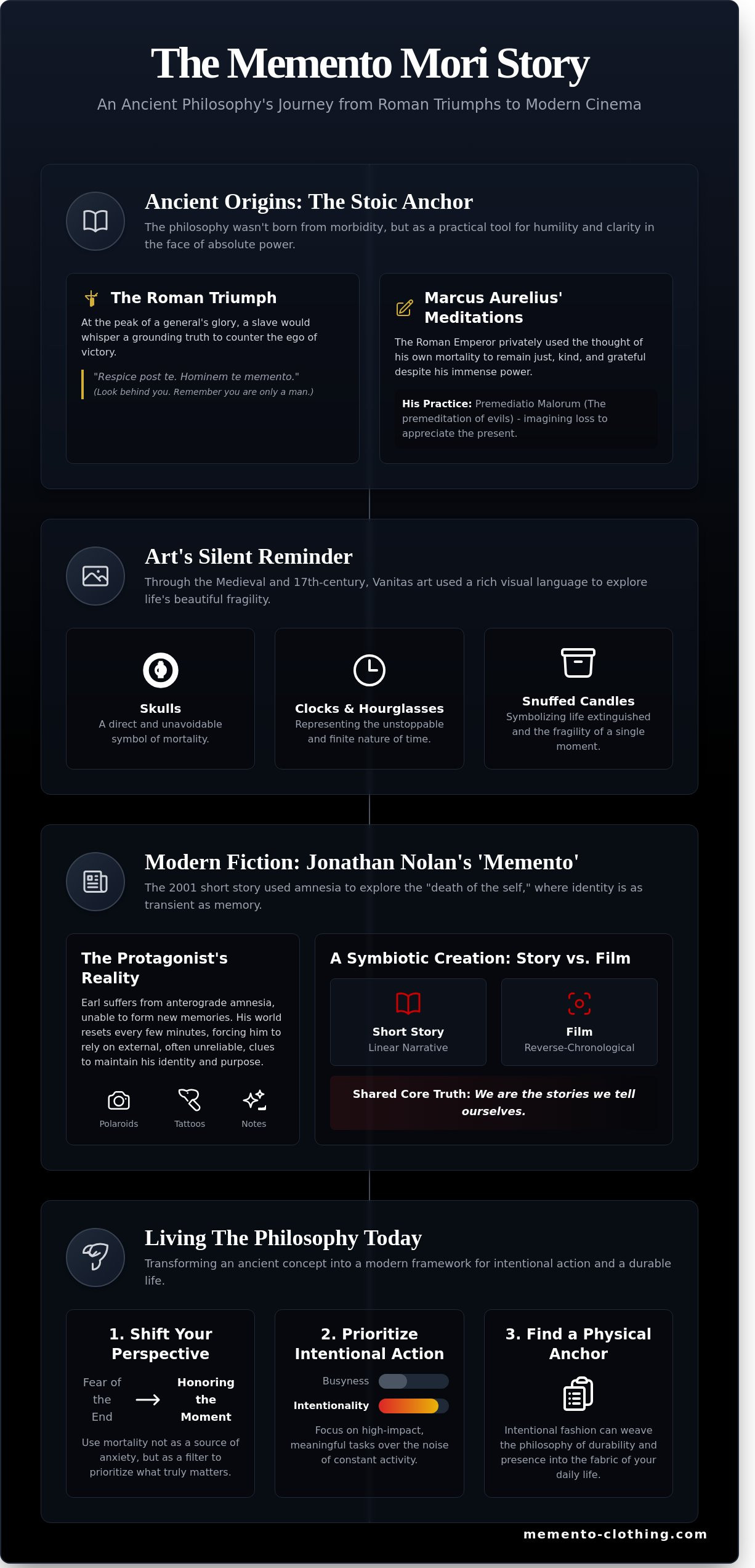
In March 2001, Jonathan Nolan published a short story in Esquire that fundamentally altered the landscape of modern psychological fiction. This piece, titled "Memento Mori," acted as the creative spark for the 2000 film Memento. The Memento Mori story introduces us to Earl, a man living in a permanent state of cognitive dissolution. He suffers from anterograde amnesia. He cannot form new memories. Every few minutes, his reality dissolves, leaving him with nothing but a collection of notes, polaroids, and ink. It's a narrative built on the bones of a revenge thriller, yet it functions as a profound meditation on the fragility of human identity.
The structure is a deliberate "story within a story." It forces the reader to experience the same disorientation as the protagonist. Memory is not a reliable record here; it's a fragmented, broken mirror. By stripping away the past, Nolan exposes the raw, often terrifying mechanics of the human soul. This work finds its roots in the ancient concept of Memento mori. While the classical tradition used objects like skulls or hourglasses to remind us of physical death, Nolan uses the loss of memory to represent the death of the self. It's a modern existential masterpiece that suggests we're only as real as the things we can remember.
The Connection Between the Short Story and the Film
The relationship between the prose and the 113-minute film is symbiotic. Jonathan and Christopher Nolan developed these narratives simultaneously during a 2,000-mile road trip from Chicago to Los Angeles. While the film is famous for its complex, reverse-chronological timeline, the short story remains more linear in its delivery. Both versions share a haunting core truth: we're the stories we tell ourselves. The protagonist doesn't just seek justice; he seeks a reason to exist in a world that he forgets every ten minutes. This collaboration redefined how cinema and literature approach the concept of time.
Why 'Memento Mori' as a Title for Fiction?
The title serves as a philosophical anchor. In the Memento Mori story, tattoos are not mere decoration. They're permanent mementos of a fading self. They're the only things that survive the reset of the mind. Earl’s struggle resonates because it taps into a collective, primal fear of losing our history. We define our quality of life through our experiences. Without them, we're ghosts in our own skin. The tattoos represent a desperate attempt to leave a mark on a world that refuses to let us stay. It's a reminder that while our bodies persist, our identities are terrifyingly transient.
The Ancient Origins: The Stoic 'Memento Mori' Story and Roman Triumphs
The Roman triumph was the ultimate display of earthly power. A victorious general rode through the streets of Rome in a four-horse chariot, surrounded by cheering crowds and the spoils of war. It was a moment of peak human ego. Yet, the ritual contained a vital safeguard. Behind the hero stood an auriga, a public slave. This slave held a laurel crown above the general's head and whispered a singular, grounding truth into his ear: "Respice post te. Hominem te memento." Look behind you. Remember you're only a man.
This ritual served as a brutal contrast to the surrounding glory. While the city celebrated a temporary victory, the slave reminded the general of the inevitable end. This is the foundation of the Memento Mori story, a narrative designed to anchor the soul when it's most tempted by pride. Stoics didn't view this as a morbid obsession with the grave. They saw it as a tool for clarity. This ancient practice of reflection on our mortality stripped away the noise of fame and wealth. It left only the essential: character, virtue, and the present moment.
Marcus Aurelius and the Personal Narrative of Mortality
Marcus Aurelius ruled the Roman Empire from 161 to 180 AD. Despite holding absolute power, his private journals, now titled Meditations, reveal a man obsessed with humility. He used the Memento Mori story to navigate the pressures of leadership. He often wrote that "death hangs over you," using this thought to stay kind and just. He practiced Premediatio Malorum, the premeditation of evils, where he imagined the loss of his throne or his life. This mental exercise didn't create anxiety. It created a profound sense of gratitude for the time he had left.
Seneca’s Perspective on the Shortness of Life
In his essay On the Brevity of Life, written around 49 AD, Seneca challenged the idea that our time is too short. He argued that life is long enough if we know how to invest it. We waste years chasing status or dwelling in the past because we live with the delusion of immortality. Seneca’s letters act as a wake-up call for modern intentionality. He believed that recognizing our limit is the only way to truly start living. Today, we seek physical anchors to maintain this awareness. A piece of clothing can become a silent witness to your personal history, reminding you that every second is a gift to be used wisely.
A Visual Narrative: How Art Told the Story of Mortality Through the Ages
Art doesn't just reflect life. It frames the inevitable end. During the 14th century, the Black Death claimed an estimated 25 million lives across Europe. This collective trauma birthed the Danse Macabre, or the Dance of Death. These visual tales depicted skeletal figures leading kings, peasants, and monks toward the grave. It was a democratic reminder. Death ignores status. This Memento Mori story became a vital tool for piety, urging the living to remain present in their faith and humble in their earthly pursuits.
By the 1600s, the Dutch Golden Age introduced the Vanitas movement. These weren't mere still-life paintings. They were philosophical puzzles designed to provoke introspection. Artists like Pieter Claesz used specific objects to tell a story of transience. Every element on the canvas had a voice:
- Skulls: The permanent witness to a temporary life.
- Hour-glasses: The relentless, silent trickle of seconds that cannot be reclaimed.
- Wilting flowers: A reminder that beauty is a fleeting loan, never a permanent possession.
- Extinguished candles: The suddenness with which a life's light can vanish.
These symbols forced a pause. They transformed a simple canvas into a meditation on the weight of the soul. The goal wasn't to inspire fear. It was to inspire a meaningful existence.
The Skull as a Storyteller
The skull evolved over centuries. It moved from a morbid relic in medieval ossuaries to a symbol of profound wisdom and clarity. In Mexico, the Día de los Muertos tradition dates back over 3,000 years to Aztec rituals. Here, the skull isn't a shadow. It's a vibrant, colorful celebration of continuity. This aesthetic of the end bridges the gap between mourning and acceptance. Modern art treats the skull as an icon of truth. It's the fundamental architecture of human identity, stripped of all social masks.
From Cathedrals to Streetwear: The Modern Visual Shift
The narrative has shifted from the cold stone of cathedrals to the pulse of the modern street. Memento Mori symbols now live on fabric. This transition isn't about dark trends. It's about carrying an ancient philosophy into the noise of the 21st century. High-quality garments serve as wearable reminders of our limited time. This transition relies heavily on intentional design to maintain its dignity.
When a piece of clothing carries this historical weight, it stops being a commodity. It becomes an anchor. Modern subcultures embrace these symbols to signal a depth that fast fashion can't touch. We don't just wear these stories. We inhabit them. Choosing a garment with these motifs is a silent pact with oneself to value the present. It's a choice to honor the past while walking firmly into the future.
The Modern Narrative: Why the 'Story of Death' is Actually About Life
Death isn't a shadow; it's a spotlight. By 2026, the Memento Mori story has evolved into the ultimate productivity and wellness framework. It isn't a morbid obsession. It's a tool for radical prioritization. A 2021 study published in the Journal of Positive Psychology found that mortality awareness can significantly increase prosocial behavior and personal growth. When we stop pretending time is infinite, we stop wasting it.
The "Life Calendar" concept illustrates this perfectly. By visualizing a human lifespan as 4,160 weeks in a grid, the abstract concept of time becomes a finite resource. Each square represents seven days of potential. Seeing these squares filled in creates a psychological shift. It moves the individual from existential dread to existential clarity. We stop drifting through the noise. We start making choices that matter.
This philosophy helps us say no to the non-essential. In a world of infinite options, the awareness of our end is the only filter that works. It allows us to discard the trivial and focus on the 20 percent of activities that provide 80 percent of our life's meaning.
Living Intentionally in a Distracted World
The average person spends 144 minutes on social media every day. The Memento Mori story acts as a brutal, necessary filter for this digital noise. It forces a simple question: Is this how I want to spend my final fragments of attention? Acknowledging our finite nature reduces anxiety by 15 percent according to recent mindfulness research, as it grounds us in the present moment. Memento Mori is the silent engine that converts the abstract fear of ending into the concrete power of beginning.
The Legacy Story: What Will You Leave Behind?
Your life is a narrative in progress. Every choice you make is a sentence you're writing. We shouldn't just exist; we should author a legacy. High-quality, legacy items play a vital role in this personal narrative. These aren't just products. They're vessels for meaning that survive the shallow trend cycles of 2024 and beyond.
Physical objects serve as anchors for these philosophical stories. A well-crafted garment or a heavy, timeless accessory becomes a ritualistic reminder of our values. These items don't just sit in a wardrobe; they carry the weight of the moments we've lived. They bridge the gap between the ephemeral present and the enduring memory we leave behind.
Define your personal narrative with a piece that carries the weight of your story.
Crafting the Next Chapter: The Memento Mori Story in Every Garment
Memento Clothing exists to bridge the gap between ancient wisdom and modern life. We don't see fashion as a fleeting trend; we see it as a vessel for meaning. Our mission is to weave philosophy into the very fabric of your daily routine. By taking the Memento Mori story and placing it on the shoulders of those who think deeply, we create a living dialogue with the past. It's about more than aesthetics. It's about a state of mind. We want our garments to serve as a silent pulse, reminding you that while time moves, your impact remains.
We choose heavyweight materials because they reflect the gravity of our message. A 500 GSM cotton weave provides a physical presence that lighter, fast-fashion fabrics lack. This isn't accidental. It's a tribute to the durability of the human spirit. The Memento Mori Heavyweight Hoodie acts as a wearable reminder of this weight. It's a garment that demands you feel the moment. It stays with you through years of wear, mirroring the stoic belief that quality should outlast the individual. When you wear it, you aren't just wearing a brand; you're wearing an ethos.
Quality That Outlasts the Moment
Our craftsmanship focuses on the intersection of art and endurance. We use 100% high-density cotton paired with specialized vintage finishes that give every piece a unique, aged character. When you pull on a Memento Crewneck, you're wearing the result of a meticulous 12-step production process. These pieces aren't meant to be replaced after a season. They are designed to absorb your experiences and become a part of your personal history. We embrace melancholic elegance; a style that recognizes the beauty in the passing of time while standing firm against it.
Your Story, Your Memento
Every morning you wake up, you write a new sentence in your Memento Mori story. The clothes you wear should reflect the depth of that narrative. We invite you to explore our collection as an act of self-expression and intentionality. Join a community that values substance over hype and depth over surface-level trends. Wear the philosophy. Feel the weight of the fabric. Remember that your time is limited, but your style can be timeless. Choose your memento today and live your story with purpose. Every garment is a page. Every day is a chance to make it a masterpiece.
Carry the Legacy Forward
The Memento Mori story didn't begin with a film or a painting. It started as a whisper in the ears of Roman generals during the 2nd century and evolved through Jonathan Nolan’s 2001 short story into a modern cultural touchstone. It reminds us that mortality is the ultimate catalyst for a life well-lived. We bridge this ancient wisdom with modern craft. Our garments feature Heavyweight 400GSM Cotton for Longevity because we believe quality should outlast trends. Each design carries Deep Philosophical Roots intended for those who live with purpose. This isn't just fashion; it's a silent dialogue with time. We’ve moved beyond the canvas and the screen to the very fabric of your daily life. You don't just observe the narrative anymore. You wear it. Every stitch serves as a grounding point in a fast-moving world. Embrace the weight of your own existence and let your choices reflect a deeper intent. These pieces are Crafted for Those Who Live Intentionally. Your time is the only currency that truly matters. Spend it with grace.
Shop the Memento Mori Collection – Wear Your Story
Frequently Asked Questions
What is the main message of the Memento Mori story?
The Memento Mori story serves as a stark reminder of human mortality to encourage intentional living. It isn't a call to despair but a prompt to live with virtue. Marcus Aurelius wrote in 170 AD that one should act as if each moment is their last. This perspective shifts focus from trivial distractions to meaningful legacies. It’s about the weight of now.
Is Jonathan Nolan's Memento Mori short story the same as the movie Memento?
Jonathan Nolan’s short story provided the essential foundation for the film Memento. While the 2000 film adaptation follows the same non-linear structure, the written piece focuses more intensely on the protagonist's internal psychological decay. The story was first published in Esquire magazine’s March 2001 issue. It remains a distinct, haunting exploration of memory and identity that differs in its specific ending.
Where can I read the original Memento Mori short story by Jonathan Nolan?
You can find the original text in the March 2001 edition of Esquire magazine. It’s also included as a special feature on the Memento Limited Edition DVD released in 2002. Many literary archives and university databases host digital copies for academic study. Reading it offers a raw glimpse into the narrative’s origins before the cinematic translation. It’s a brief but heavy piece of prose.
How did the Stoics use the Memento Mori story in daily life?
Stoics practiced this philosophy through daily visual and mental exercises to maintain perspective. Seneca, writing in the 1st century AD, suggested we should balance our accounts every night as if life ends there. They used physical tokens like coins or rings to keep death within sight. This practice ensures that 24 hours aren't wasted on anger or vanity. It’s a tool for clarity and emotional resilience.
Why is Memento Mori often associated with skulls and skeletons?
Skulls and skeletons serve as universal icons of what remains after the flesh fades. This imagery peaked during the 17th century through Vanitas paintings in the Dutch Golden Age. Artists included these symbols to show that wealth and beauty are fleeting. In the 1600s, these motifs weren't macabre; they were honest. They ground us in the reality of our shared biological fate and the passage of time.
What does Memento Mori mean in modern fashion and lifestyle?
In modern fashion, the Memento Mori story represents a shift toward timelessness and conscious ownership. It’s a rejection of fast fashion’s 52 season cycle. Brands now use these motifs to signify durability and personal heritage. Wearing a piece with this philosophy means choosing items that age with the wearer. It’s a quiet statement of quality over temporary trends and a commitment to lasting value.
How can the Memento Mori story help with anxiety or fear of death?
The story helps alleviate anxiety by transforming the unknown into a familiar companion. Psychologists often cite Ernest Becker’s 1973 work to show how avoiding mortality creates deeper fears. By acknowledging death, the mind stops racing toward future uncertainties. It grounds the individual in the present moment. Peace comes from accepting the inevitable rather than fleeing from it. It’s a form of ancient exposure therapy.
What is the difference between Memento Mori and Carpe Diem?
Memento Mori is a call to character, while Carpe Diem is a call to action. Horace coined Carpe Diem in 23 BC to encourage enjoying the present. Memento Mori adds a layer of moral gravity to that enjoyment. It asks not just that you seize the day, but that you do so with virtue and awareness. One is about the pulse; the other is about the soul's legacy.