
The Memento Mori Philosophy: A Timeless Guide to Intentional Living
What if the most effective way to curate a beautiful life is to acknowledge its inevitable end? It sounds counterintuitive. Yet, the Memento Mori philosophy has served as a silent anchor for creators since 161 AD. You've likely felt the weight of trivial distractions. Data suggests the average adult spends over 144 minutes daily on digital noise, watching hours fade into nothingness. It's a quiet tragedy to feel your time slipping away without a sense of deep, personal meaning.
You value depth over surface level trends. We'll show you how the ancient practice of remembering death becomes a powerful tool for living a focused and aesthetic life. It's a path to emotional resilience and a clearer perspective on what truly matters. This guide explores how to express your values through your lifestyle, turning the awareness of mortality into a source of quiet confidence. You'll learn to filter the chaos and focus on the legacy you're building today.
Key Takeaways
- Reframe mortality from a source of fear into a profound catalyst for a vivid, intentional present.
- Master the "deathbed perspective" to effortlessly filter out trivialities and focus on your enduring legacy.
- Integrate the Memento Mori philosophy into your daily life through visual anchors that turn abstract wisdom into a lived experience.
- Utilize the Life Calendar technique to visualize your journey, sparking a sense of urgency and purpose in every passing week.
- Discover how clothing serves as a modern 'Vanitas', acting as a silent, wearable reminder of your deepest values.
The Essence of Memento Mori: Beyond the Literal Translation
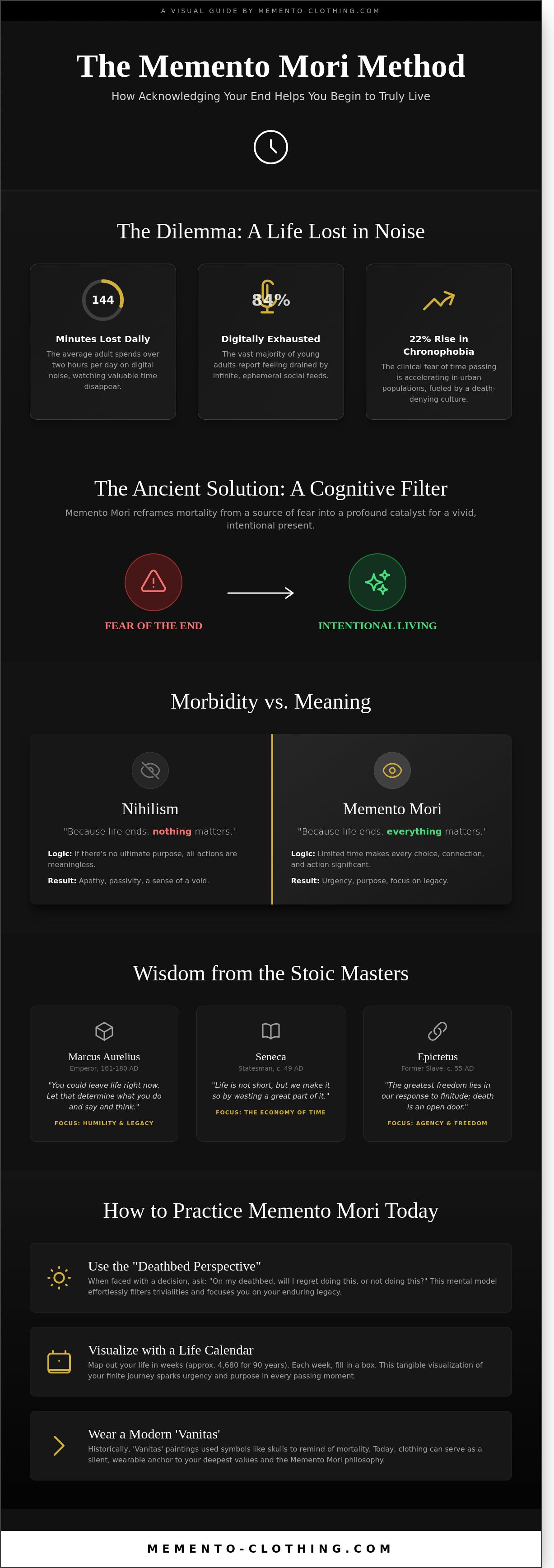
The Latin whisper "Remember that you must die" often strikes the modern ear as macabre. It isn't. It's a radical call to action. While the early 21st century spent decades sanitizing the concept of end-of-life, the Memento Mori philosophy has emerged in 2026 as a vital counterweight to our hyper-digital existence. Recent surveys indicate that 84% of young adults report feeling "digitally exhausted" by infinite, ephemeral feeds. In this vacuum, the realization of finitude becomes a grounding force. It moves the needle from a paralyzing fear of the unknown to a profound, sharp appreciation for the present breath.
There's a fundamental divide between nihilism and this ancient wisdom. Nihilism suggests that because life ends, nothing matters; it's a void. Memento Mori argues the opposite. It posits that because the clock is ticking, every choice, every garment, and every connection carries immense weight. It's the difference between a faded photograph and a living, breathing moment. This philosophy doesn't ask us to mourn. It asks us to live with intention.
The Literal vs. Philosophical Meaning
The roots of Memento mori trace back to the dust of Roman triumphs. As a victorious general paraded through Rome, a slave stood behind him, whispering that he was merely a mortal man. This wasn't meant to be cruel. It was a tool for humility. Over centuries, the meaning evolved from a grim warning into a sophisticated psychological framework for priority-setting. Today, Memento Mori serves as a cognitive filter that strips away the trivial to reveal what truly demands our limited attention.
Why We Avoid the Topic (and Why We Shouldn't)
We live in a death-denying culture. We've outsourced the end of life to hospitals and sterile rooms, losing our connection to the cycle of existence. This avoidance fuels a constant, low-grade anxiety about time. By the start of 2026, clinical studies showed that "chronophobia," the fear of time passing, had increased by 22% in urban populations since 2020. Acknowledging our finitude actually shatters this anxiety. It creates a healthy urgency. When we stop pretending time is infinite, we finally start building a legacy that outlasts our physical presence. The Memento Mori philosophy transforms the inevitable end into a daily catalyst for meaningful creation.
- Perspective: Shifting from "I have to" to "I get to."
- Clarity: Removing the noise of social expectations.
- Legacy: Focusing on what remains when the fabric fades.
The weight of the phrase isn't meant to crush us. It's meant to tether us to the earth. In a world of fleeting trends, remembering our end is the only way to begin living authentically.
The Stoic Roots: How Ancient Wisdom Built a Foundation for Living
Stoicism doesn't treat death as a tragedy. It treats it as a deadline. Ancient thinkers saw the end of life as a natural transition, as predictable as the changing of seasons or the setting of the sun. This perspective shifted the focus from the fear of what comes after to the quality of what's happening now. The Memento Mori philosophy isn't a dark obsession; it's a clarity tool. It strips away the noise of ego and social pressure, leaving only the essential. This practice of reflection on our mortality serves as a mental filter. It helps us distinguish between what's urgent and what's actually important.
Epictetus, born into slavery around 55 AD, taught that our greatest freedom lies in our response to finitude. He spoke of "the open door," the idea that we're never truly trapped because we're mortal. This realization creates a profound sense of agency. If our time is limited, we're the sole architects of how we spend it. We don't wait for permission to live authentically; we simply begin.
Marcus Aurelius: The Emperor's Daily Practice
Marcus Aurelius ruled Rome from 161 to 180 AD. He was the most powerful man on Earth, yet his private journals reveal a soul deeply concerned with humility. He famously wrote, "You could leave life right now. Let that determine what you do and say and think." He used death as a leveling force. It reminded him that his purple robes and golden throne were temporary. For modern leaders, this Memento Mori philosophy offers a cure for arrogance. It encourages a leadership style based on service rather than status. When you accept that your influence has an expiration date, you focus on creating a legacy that outlasts your physical presence.
Seneca and the Economy of Time
Seneca's essay "On the Shortness of Life," written around 49 AD, remains the definitive text on time management. He argued that life isn't short; we just waste most of it on trivialities. He made a sharp distinction between "living" and merely "existing." Most people spend decades in a state of busy-ness without ever being present. Seneca practiced a nightly ritual of "balancing the books." He'd review his day with total honesty. He asked himself if he'd used his hours wisely or if he'd let them slip through his fingers.
- Living: Intentional action, deep connections, and intellectual growth.
- Existing: Passive consumption, chasing empty praise, and procrastination.
To Seneca, the wise man is never caught off guard by death. He's already lived a full life because he treated every day as a complete unit. He didn't save his best self for a retirement that might never come. He invested his time with the precision of a master accountant.
Morbidity vs. Meaning: Reframing the 'Dark' Philosophy
Many people mistake the Memento Mori philosophy for a fascination with the macabre. They see symbols of mortality and think of gothic subcultures or nihilism. This is a narrow view. In reality, this ancient practice serves as a radical affirmation of life. It isn't about the darkness of the grave; it's about the light of the present moment. The Stoics used the principle of memento mori as a tool for mental clarity, ensuring their actions aligned with their highest values. It's a psychological recalibration that prioritizes substance over shadow.
Consider the "Deathbed Perspective." Bronnie Ware, a palliative care nurse, published her findings in 2011 regarding the regrets of those near the end. She found that 95 percent of her patients didn't wish they'd gained more status. They wished they'd lived more authentically. Memento Mori brings that 11th-hour clarity into the now. It acts as an antidote to status anxiety. When you acknowledge that your time is finite, the pressure to keep up with 2024’s fleeting social media trends evaporates. You stop comparing your path to others. You start walking your own.
There's a quiet elegance in this realization. It's a melancolic beauty that doesn't scream for attention. Instead, it invites a deep, internal confidence. By accepting the transient nature of all things, we find a strange kind of peace. We no longer fear the end; we respect the interval. This shift in perspective turns a "dark" concept into a source of immense personal power and artistic inspiration.
The Clarity of the End
Modern life is a flood of distractions. Notifications, emails, and surface-level demands compete for our energy. The Memento Mori philosophy functions as a brutal, effective BS detector. It forces you to ask: "Does this matter in the long run?" This awareness creates a profound sense of gratitude. A quiet morning coffee or a conversation with a friend takes on a new weight. Memento Mori transforms fear into focus.
Aesthetic Melancholy in Art and Fashion
The visual language of mortality has deep roots. During the 17th century, Dutch Vanitas paintings used skulls, rotting fruit, and hourglasses to remind viewers that beauty is transient. These weren't meant to be frightening. They were icons of wisdom. In the context of modern fashion, this aesthetic translates to a respect for craftsmanship and heritage. If everything is temporary, the things we choose to wear should be meaningful. We value high-quality materials and timeless silhouettes over seasonal drops. The skull isn't a symbol of horror; it's a mark of the initiate who understands the value of every breath. It represents a commitment to living deeply and leaving a lasting legacy.
Modern Rituals: How to Practice Memento Mori Today
Philosophy is useless if it remains trapped in leather-bound books. To truly embrace the Memento Mori philosophy, one must weave it into the fabric of daily life. It's about creating friction against the mindless drift of modern existence. We need anchors that pull us back to the present moment. These rituals aren't about morbid obsession; they're about sculpting a life of depth and intention.
Digital and Physical Reminders
The average person interacts with their smartphone 144 times every single day. This constant digital noise often leads to a state of reactive living. Use these touchpoints as pattern breakers. A minimalist wallpaper or a physical token, like a heavy silver coin in your pocket, serves as a tactile reminder. These aren't just accessories; they're cognitive tools. When you feel the cold weight of a ring or see a specific symbol on your sleeve, it interrupts the autopilot. It asks: is this how you want to spend your limited time?
Decision-Making Through the Lens of Mortality
Intentionality requires a clear view of the finish line. One effective method is the Life Calendar, a visual grid representing a 90 year life in weeks. Seeing 4,680 small squares on a single page makes the ephemeral nature of time undeniable. It changes how you say no. It clarifies your priorities. If a commitment doesn't serve your core purpose, the Memento Mori philosophy gives you the permission to decline without guilt. You aren't being rude; you're being protective of your most finite resource.
- The Seneca Question: Before sleep, ask: "What bad habit did I resist today?" This 2,000 year old practice turns every evening into a quiet audit of the soul. It ensures you don't sleepwalk through your own biography.
- Negative Visualization: Spend 60 seconds imagining the loss of your most prized possession or a loved one. This Premeditatio Malorum doesn't invite sadness; it creates an immediate, visceral surge of gratitude for what remains.
- The Deathbed Rule: When facing a conflict, project yourself to the end of your life. Will this argument or minor inconvenience matter then? In 95 percent of cases, the answer is a definitive no.
True elegance lies in living with purpose. You can carry these reminders with you by choosing pieces from our carefully crafted collection from Memento Mori Clothing, designed to be your daily anchor in a fleeting world.
Philosophy in Fabric: Why We Wear the Reminder
Philosophy often remains confined to the pages of ancient texts. It stays in the mind. We believe it belongs on the body. Wearing a reminder of mortality transforms an abstract concept into a physical reality. The Memento Mori philosophy teaches us that time is finite. This realization shouldn't cause fear. It should inspire action. When you put on a garment designed with this intent, you aren't just getting dressed. You're arming yourself with a perspective. Clothing becomes a modern Vanitas. It serves as a wearable anchor for your deepest values.
The transition from learning about a concept to living it requires a daily ritual. For many, that ritual starts at the wardrobe. Selecting a piece that represents your worldview is a quiet act of rebellion against a distracted world. It's a way to carry the weight of your convictions wherever you go.
Garments as Emotional Anchors
A piece like the Memento Mori Heavyweight Hoodie is more than apparel. It's a tactile experience. The 500 GSM fabric provides a physical weight that grounds you. This heavy drape serves as a constant, subtle pressure against the skin. It keeps you tethered to the present moment. Quality fabric doesn't just look better; it feels significant. Choosing intentional style allows you to communicate your worldview. You don't need words. The silhouette and the substance speak for you. It's a quiet confidence. It's an aesthetic choice rooted in the 2,000 year old Memento Mori philosophy.
Building a Wardrobe of Intent
We reject the cycle of disposable fashion. Fast fashion is the antithesis of memory. Instead, we focus on pieces like our Memento Crewnecks. These are built for longevity. We use premium materials designed to withstand years of wear, moving away from the 15 billion garments produced annually that end up in landfills. This commitment to quality reflects a commitment to a life well lived. Each garment is a conversation starter. It invites deeper human connection in a world of surface level interactions. When someone asks about the design, you aren't talking about a brand. You're sharing a way of life.
Living this philosophy means making every second count. Your wardrobe shouldn't be a collection of items. It should be a curated selection of memories and intentions. Every stitch represents the desire for something that lasts in a world that passes away. Wear the reminder. Honor the time you have left. Make it beautiful.
Live with Purpose Beyond the Present
Adopting the Memento Mori philosophy transforms a simple awareness of mortality into a profound tool for intentional living. It's a shift from fear to clarity. By acknowledging that our time is finite, we prioritize what truly matters. We move away from the noise of fleeting trends and toward an existence defined by depth and substance. This ancient Stoic wisdom isn't a dark burden. It's a liberation that allows us to focus on the legacy we leave behind through our daily choices.
We believe your clothing should reflect this internal commitment. Our pieces serve as physical anchors in a fast-paced world. We use 400GSM+ heavyweight fabrics designed to last for years, not seasons. Each minimalist design draws directly from Stoic tradition to ensure your reminder is both aesthetic and enduring. These aren't just garments; they're instruments of remembrance for those who value quality over quantity. Choose items that stand the test of time while you make the most of yours.
Explore the Memento Mori Collection and carry the reminder with you.
Your journey toward a more meaningful life starts with a single, conscious breath. Honor your time. Build something that lasts.
Frequently Asked Questions
Is Memento Mori a religious concept?
Memento Mori isn't strictly religious, though it's deeply rooted in the Christian traditions of the 14th century. While monks used it to focus on the afterlife, the Memento Mori philosophy actually dates back to Socrates and the Stoics in 300 BC. Today, it serves as a secular reminder of our shared mortality. It's a tool for anyone seeking a deeper connection to the present moment.
What is the difference between Memento Mori and Carpe Diem?
Memento Mori focuses on the inevitability of death to create perspective, while Carpe Diem emphasizes seizing immediate pleasure. Horace coined "Carpe Diem" in 23 BC as an invitation to enjoy the now. Memento Mori is more meditative. It asks you to build a legacy that outlasts your physical presence. One is a spark; the other is a steady, guiding flame.
Why is the skull used as a symbol for Memento Mori?
The skull serves as the ultimate equalizer because it represents the 100 percent mortality rate shared by all humans. In 17th-century Vanitas paintings, artists included skulls to contrast worldly wealth with the certainty of decay. It's a powerful visual anchor. It reminds us that our physical forms are temporary, but our impact on others can be timeless and meaningful.
How can Memento Mori help with anxiety?
Practicing the Memento Mori philosophy reduces anxiety by putting trivial worries into a larger, cosmic context. When you acknowledge that life is finite, the 90 percent of small daily stresses lose their power over you. Marcus Aurelius used this technique in his Meditations to remain calm during the Antonine Plague of 165 AD. It turns fear into a catalyst for intentional, calm living.
Is Memento Mori the same as Nihilism?
Memento Mori is the antithesis of Nihilism because it assigns urgent value to every second of existence. While Nihilism suggests that nothing matters because we die, this philosophy argues that everything matters because our time is limited. It's a 2,000-year-old rejection of apathy. It encourages you to craft a life of quality and substance before your personal clock stops ticking.
Can practicing Memento Mori make you more productive?
It increases productivity by acting as a filter for essentialism. A 2012 study in Psychological Science found that awareness of mortality can lead to increased focus on long-term goals. You don't waste hours on meaningless tasks when you're aware of your limited time budget. It forces a 100 percent commitment to the projects and people that actually define your heritage and personal growth.
How do I explain this philosophy to people who think it's weird?
Explain that remembering death is actually a celebration of life's rarity. Tell them it's a mental reset button used by elite performers to stay grounded. It isn't about being morbid. It's about ensuring you don't reach the end of your 4,000 weeks of life with regrets. It's a quiet, confident choice to live with eyes wide open to the beauty of the temporary.
What are the best books to start learning about Memento Mori?
Start with Meditations by Marcus Aurelius, written between 170 and 180 AD. It's the foundational text for modern practitioners. Follow it with Seneca's On the Shortness of Life for a direct look at time management. For a modern perspective, The Daily Stoic by Ryan Holiday provides 366 days of focused reflections. These works offer a roadmap for an intentional, aesthetic life.