
The Memento Mori Philosophy: A Modern Guide to Living Intentionally
What if the awareness of your end is the only thing that can truly begin your life? We spend our days drifting through a sea of trivial digital noise, losing the pulse of our own existence to the next notification. It's easy to feel disconnected from your deeper values when the modern world demands your attention but never your soul. This search for meaning is why many are turning to philosophy inspired clothing as a physical anchor for their intentions. These pieces aren't just fabric. They're quiet reminders that our time here has a weight and a limit.
You likely feel that same pull to live with more urgency, yet the fog of daily life makes it hard to stay focused on what matters. This guide explores how the ancient practice of Memento Mori transforms the shadow of death into a brilliant light for the present. We'll provide a clear framework for intentional living and practical ways to apply Stoic wisdom to your modern routine. You'll learn to find a haunting beauty in impermanence. By the end, you'll see why remembering your mortality is the most powerful tool for crafting a high-quality, meaningful life today.
Key Takeaways
- Reframe Memento Mori as a vital tool for vibrant living rather than a morbid obsession.
- Apply the Stoic wisdom of Marcus Aurelius to filter out trivial modern anxieties and social pressures.
- Learn to use philosophy inspired clothing as a tactile reminder to stay present and aligned with your deepest values.
- Establish daily rituals and visual cues that turn the awareness of mortality into a cure for chronic procrastination.
- Understand how choosing quality and intentionality in every detail creates a legacy that outlasts the temporary.
What is the Memento Mori Philosophy? Beyond the Latin Translation
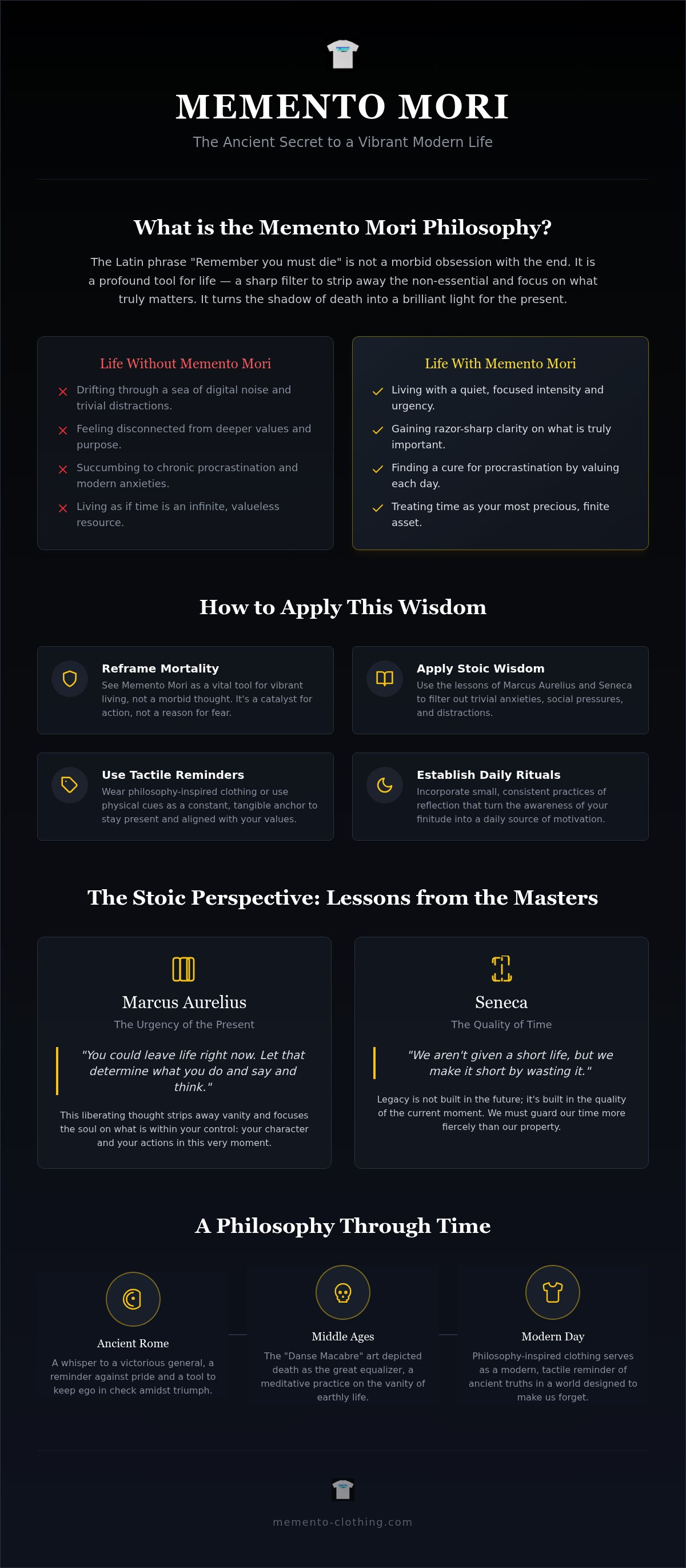
Death isn't a shadow. It's a frame. While the literal translation of Memento mori is "remember you must die," the phrase functions as a profound tool for life. It isn't a morbid obsession with the end. Instead, it's a sharp, cold splash of water to the face of a sleeping world. For the ancients, this practice was a way to strip away the non-essential. It was a filter for the soul. This philosophy asks you to look at the finish line so you can finally see the race.
The history of this concept is as heavy as the garments that now carry its name. In ancient Rome, a slave stood behind a victorious general during his triumph. Amidst the cheering crowds, the slave whispered a reminder of mortality to keep the hero's ego from touching the stars. By the Middle Ages, this evolved into the "Danse Macabre." Art depicted death dancing with kings and peasants alike. It was a visual equalizer. This historical shift moved the phrase from a warning against pride to a meditative practice on the vanity of earthly life. Today, philosophy inspired clothing serves a similar purpose. It acts as a modern, tactile reminder of these ancient truths in a world that tries to make us forget.
The Etymology and Origins of the Phrase
The word "memento" carries a specific linguistic weight. It is an imperative verb. It is a command to the self. Unlike "memor," which suggests a passive state of mindfulness, "memento" requires an active choice. You must reach for the memory. This philosophy found its home in both Stoic and Epicurean thought. The Stoics used it to build resilience. The Epicureans used it to savor the present. Over centuries, the phrase transitioned from a grim warning to a sophisticated meditative practice. It became a way to anchor the wandering mind to the only thing that is certain: the present moment.
Why Mortality is the Ultimate Catalyst for Life
Modern culture is designed to avoid the end. We hide death behind sterile hospital walls and digital distractions. We live as if time is an infinite resource. This avoidance creates a hollow existence. When you acknowledge your finitude, every choice gains gravity. The awareness of the end is the only thing that gives the present its true value. Philosophy inspired clothing often emphasizes durability and weight because these physical traits mirror the weight of an intentional life. Acknowledging mortality doesn't mean living recklessly. It means living with a quiet, focused intensity. It means understanding that because your days are numbered, none of them should be wasted on the trivial.
The Stoic Perspective: Lessons from Marcus Aurelius and Seneca
Stoicism isn't about suppressing emotion. It's about achieving a razor-sharp clarity. For the Roman masters, death wasn't a tragedy to be avoided but a deadline to be respected. They understood that a life without a sense of its end is a life without a sense of its value. This ancient practice of reflection on our mortality served as a vital compass. It helped them navigate the complexities of power and the fragility of the human condition. Today, choosing to wear philosophy inspired clothing is a way to reclaim that same focus in a world designed to distract us.
Marcus Aurelius and the Urgency of the Present
Marcus Aurelius wrote his 'Meditations' while on campaign at the cold edges of the empire. These weren't meant for publication. They were private exercises in maintaining his sanity amidst the crushing weight of absolute power. He famously reminded himself: "You could leave life right now. Let that determine what you do and say and think." This wasn't a morbid thought. It was a liberating one. By recognizing that his time could end at any moment, he stripped away the vanities of his office. He focused only on what was within his control: his character and his actions. His approach was a daily recalibration of the soul.
Seneca on the Quality of Time
Seneca observed that we aren't given a short life, but we make it short by wasting it. We guard our property with locks and guards, yet we let others steal our time without a second thought. He practiced Premeditatio Malorum, or the premeditation of evils. By regularly contemplating the loss of his wealth, his status, and eventually his life, he removed the power that fear held over him. This practice didn't make him cold. It made him intentional. He realized that legacy isn't built in the future; it's built in the quality of the current moment.
The Stoic perspective teaches us that mortality is the ultimate boundary. We don't control the length of the thread, only the pattern we weave with it. This philosophy demands that we treat our time as our most precious asset. Carrying this mindset requires constant effort. A Memento Mori Heavyweight Hoodie can act as a physical anchor for these thoughts, providing a sense of gravity to your daily choices in an increasingly weightless world.
How Memento Mori Improves Modern Life
The modern world is a cacophony of the non-essential. We are buried under digital notifications, social expectations, and the persistent myth that time is infinite. Acknowledging mortality is the only effective defense against this noise. It acts as a brutal, beautiful filter. When you realize your hours are finite, the weight of others' opinions evaporates. Trivial anxieties lose their grip. This isn't a dark realization. It's a clarifying one. It moves you from a state of passive drifting to one of active creation. It demands that you stop living for the gallery and start living for the soul.
Procrastination is often just a symptom of a hidden belief in immortality. We delay our deepest work because we assume there will always be a "later." Memento Mori destroys this illusion. It forces a psychological shift from the vague "someday" to the urgent "today." By looking at the history of memento mori, we see that it was never about fear. It was about fuel. This shift in perspective is why many choose to wear philosophy inspired clothing. It serves as a constant, tactile reminder to spend your limited energy on things that actually matter. It is a physical anchor in a world that tries to make us float away.
The Filter of Finitude: Deciding What Matters
Apply the "Deathbed Test" to your current stressors. Will this argument matter in forty years? Will this missed deadline define your legacy? Usually, the answer is no. This realization provides immediate relief from choice paralysis. When your mission is clear, your decisions become simple. You stop trying to please everyone and start trying to fulfill yourself. It clarifies your personal values by stripping away the decorative and leaving only the structural. It turns your life into a curated masterpiece rather than a cluttered attic.
Cultivating Radical Gratitude
Awareness of the end makes the present glow. This is the essence of radical gratitude. Try the "Last Time" meditation. Realize that every action you take will eventually happen for the final occurrence. The last time you walk through your childhood home. The last time you share a meal with a specific friend. This isn't meant to cause sadness. It's meant to spark presence. It fosters deeper relationships because you stop taking people for granted. You begin to live an emotionally telic lifestyle. You find value in the activity itself, not just the result. Every moment becomes precious because every moment is a countdown. Philosophy inspired clothing acts as an anchor for this mindset, reminding you that while life is ephemeral, your intent can be timeless.
Practical Ways to Practice Memento Mori Daily
Philosophy is a ghost until it finds a body. To live intentionally, you must move the awareness of death from an academic concept into your physical environment. We are naturally designed to forget our finitude. The rush of the mundane acts as a sedative, lulling us back into the illusion of infinite time. Breaking this trance requires more than just thought; it requires physical anchors and rhythmic rituals that pull the soul back to the present moment. To discover how artisanal craftsmanship can support this focus, you can learn more about premium Italian roasting traditions that transform the ordinary.
One such ritual is the slow, deliberate preparation of a high-quality coffee, which can serve as a sensory anchor to the present. To elevate this part of your day, you can explore Kenya AA Supreme from The Roast Haus Coffee Co., where each batch is roasted to order to ensure you savor every second.
Humans have long used external symbols to combat internal forgetfulness. During the late Middle Ages, the "Danse Macabre" appeared in murals and woodcuts as a vivid reminder that death joins every dance. Skull imagery and hourglasses weren't meant to inspire terror. They were tools for mindfulness. Today, philosophy inspired clothing serves as a modern evolution of these symbols. It transforms your wardrobe into a walking meditation. When you catch your reflection or feel the substantial weight of a 13.5oz fabric, you aren't just wearing a garment. You are engaging with a physical anchor that grounds your wandering mind in the reality of your limited time. This intentional fashion acts as a silent, persistent signal to the self, keeping your values front-of-mind amidst the digital noise.
Journaling Prompts for the Memento Mori Practitioner
Setting intent in the morning and reviewing it in the evening creates a structural integrity for your day. Use these three prompts to sharpen your focus:
- Urgency: If this were my final sunset, would I be satisfied with how I spent my light today?
- Perspective: What trivial anxiety am I currently treating as a catastrophe?
- Legacy: If I am remembered for only one action from this day, what should it be?
To deepen this practice, employ the "View from Above" meditation. Visualize yourself from the ceiling, then from the clouds, and finally from the stars. See the tiny, ephemeral nature of your problems within the vastness of time. In your journal, track your "intentional hours" against your "wasted hours." This data doesn't lie. It reveals where you are trading your life for nothing. By reviewing your day through the lens of impermanence, you stop being a victim of your schedule and start becoming the architect of your existence.
The most effective reminders are the ones you carry with you. To begin integrating these practices into your daily life, you can shop the Memento Mori Collection and find the physical anchor that resonates with your journey. Every time you put on a piece of philosophy inspired clothing, you make a conscious choice to live with gravity and grace.
Crafting a Legacy: Why Quality and Intentionality Matter
We exist in a profound paradox. Our lives are fleeting, yet we yearn for the eternal. This tension is where true quality is born. In a world of fast trends and disposable objects, choosing something built to last is a quiet act of rebellion. It is a statement that your time and your values are not for sale. This is why philosophy inspired clothing must transcend simple fashion. It must become a physical manifestation of the wearer’s internal world. When you choose a garment designed with longevity in mind, you are choosing to respect the limited hours you have left. You are seeking an anchor in a sea of impermanence.
The aesthetic of melancholic elegance isn't a celebration of sadness. It is a recognition of truth. It is the quiet confidence of knowing who you are and that your time is precious. This mindset creates a different kind of relationship with the objects we own. They stop being mere commodities and become companions on a philosophical journey. They help us maintain a Stoic lifestyle by reminding us that while the body is temporary, the impact of our character can be timeless.
The Philosophy of the Heavyweight Garment
Durability is a form of respect for the wearer's time and resources. When we choose materials that endure, we honor the effort spent acquiring them. The density of the Memento Mori Heavyweight Hoodie is not accidental. It is a deliberate metaphor. The 13.5oz fabric provides a literal weight that mirrors the gravity of the mindset required for intentional living. It is a tactile reminder that your presence in the world has substance and weight. Quality serves as a silent, powerful resistance to the disposable, hollow culture of modern times. It represents a commitment to the permanent over the ephemeral, ensuring that your physical anchors last as long as your convictions.
Wearing the Story: The Memento Mori Vintage Tee
The Memento Mori Vintage Tee functions as a subtle, daily ritual. It is a softer reminder, yet no less potent in its message. Intentional design in philosophy inspired clothing ensures that every seam and every print carries a narrative weight. These pieces are emotional anchors that bridge the gap between ancient wisdom and your personal history. They help you stay grounded when the world tries to sweep you away into triviality. This commitment to depth is central to the Memento Mori story. It is a mission to transform a classical foundation into a modern guide for living, where every choice carries the weight of a life well-lived.
Craft Your Legacy in the Present Moment
Living with the awareness of mortality doesn't darken your days; it illuminates the path forward. You've seen how the Stoics used this lens to filter out the trivial and how daily rituals can transform procrastination into purposeful action. By acknowledging that your time is a finite resource, you reclaim the power to spend it on what truly resonates. Every choice you make is a brushstroke on the canvas of your life. Your story is still being written, and the ink is your attention.
Integrating this mindset requires more than just intellectual agreement. It demands physical reminders that ground you in reality. Since 2020, we've focused on creating philosophy inspired clothing that serves as a tactile anchor for this journey. Our pieces are crafted with intentionality in the USA, using heavyweight 13.5oz fabrics designed for lifelong wear. These aren't just garments; they're echoes of a timeless wisdom. It's time to stop drifting and start building something that carries weight. Explore the Memento Mori Collection and find your physical anchor. Make every word count.
Frequently Asked Questions
Is Memento Mori supposed to be depressing or morbid?
Memento Mori is fundamentally an invitation to live more fully, not an invitation to despair. While the concept centers on mortality, its purpose is to act as a psychological catalyst for joy and intentionality. By acknowledging that your time is limited, you naturally begin to prioritize the people and projects that truly matter. It transforms the fear of the end into a vibrant respect for the current moment.
How do I start practicing Memento Mori without feeling anxious?
Begin by focusing on the "Last Time" meditation, but apply it to positive experiences. Realize that the meal you are eating or the conversation you are having is a unique, unrepeatable event. This shift moves the focus from the loss of life to the richness of the experience. Using philosophy inspired clothing can also provide a gentle, passive reminder that builds comfort with the concept over time.
What are some common symbols associated with Memento Mori?
Historical art frequently uses specific motifs to represent the fleeting nature of existence. Common symbols include the skull, which represents the equalizer of all humanity; the hourglass, which marks the silent passage of time. You might also find clocks, extinguished candles, or butterflies in traditional Memento Mori works. Each symbol serves as a visual shorthand for the complex truth that every beginning contains an inevitable conclusion.
Can Memento Mori actually help with productivity and procrastination?
Procrastination often stems from the subconscious belief that we have infinite time to finish our work. Memento Mori shatters this illusion by providing a healthy sense of urgency. When you realize that "later" is never guaranteed, you stop delaying your most important goals. It helps you focus on deep work and meaningful output rather than getting lost in the trivial distractions that consume so much of our modern energy.
How does Stoicism differ from Nihilism in its view of death?
Nihilism suggests that because we die, nothing we do has any inherent meaning. Stoicism takes the opposite path. It argues that because our time is limited, our actions and character have immense value. To a Stoic, death is a natural boundary that defines the scope of our duty. We don't live for the result; we live for the quality of the effort we put into every passing hour.
What is a Memento Mori coin or physical reminder?
A physical reminder is a tactile object designed to trigger a specific philosophical reflection. While coins and medallions are popular, many practitioners find that philosophy inspired clothing offers a more integrated experience. These items act as emotional anchors that stay with you throughout your daily movements. They bridge the gap between abstract thought and the physical world, ensuring your values remain present even when your mind wanders.
How often should I meditate on my mortality?
Consistency is more important than intensity when it comes to these reflections. A brief morning meditation or a quick evening review is often enough to maintain your perspective. The goal isn't to dwell on death for hours, but to keep the awareness of it as a quiet background frequency. Regular contact with visual cues or intentional garments helps make this awareness a natural, effortless part of your worldview.
Is Memento Mori a religious concept or a secular one?
The concept has roots in both ancient classical philosophy and various religious traditions. While it was a central theme in medieval Christian art, its origins in Stoic and Epicurean thought are entirely secular. Today, it functions as a universal framework for anyone seeking a more intentional life. It doesn't require a specific faith; it only requires an honest acknowledgment of the human condition and the desire to live well.