
The Memento Mori Lifestyle: A Guide to Living with Intentionality in 2026
What if the most effective way to truly feel alive was to keep your own ending in plain sight? You likely feel the weight of a culture that moves too fast; a blur of digital noise and disposable goods that leaves your days feeling uncelebrated. It's a quiet, persistent dissatisfaction. We chase the next distraction while the moments that actually matter slip away. Adopting a memento mori lifestyle isn't about a morbid obsession with the end. It's about using the certainty of mortality as a sharp, clear filter to prioritize the enduring over the fleeting.
You're seeking a sense of priority that the modern world rarely offers. This guide reveals how an ancient philosophy translates into a 2026 lifestyle of purpose, quality, and profound presence. You'll learn practical habits for intentional living and how to curate an aesthetic that reflects your inner values. We'll look at how physical anchors, like the objects we keep and the clothes we wear, can ground us in the present. It's time to stop letting life happen to you and start living with the quiet confidence of someone who knows their time is precious.
Key Takeaways
- Redefine your relationship with time by viewing mortality as a catalyst for presence rather than a source of fear.
- Adopt a memento mori lifestyle through disciplined rituals that filter out trivial distractions and focus on what truly endures.
- Master the distinction between temporary pleasure and lasting value using a framework built on intentional choice.
- Create an aesthetic sanctuary that honors the imperfect and the essential through minimalist design and natural materials.
- Discover how wearable reminders serve as silent, physical anchors to ground your mindset in the weight of each moment.
Defining the Memento Mori Lifestyle: Beyond the Latin Phrase
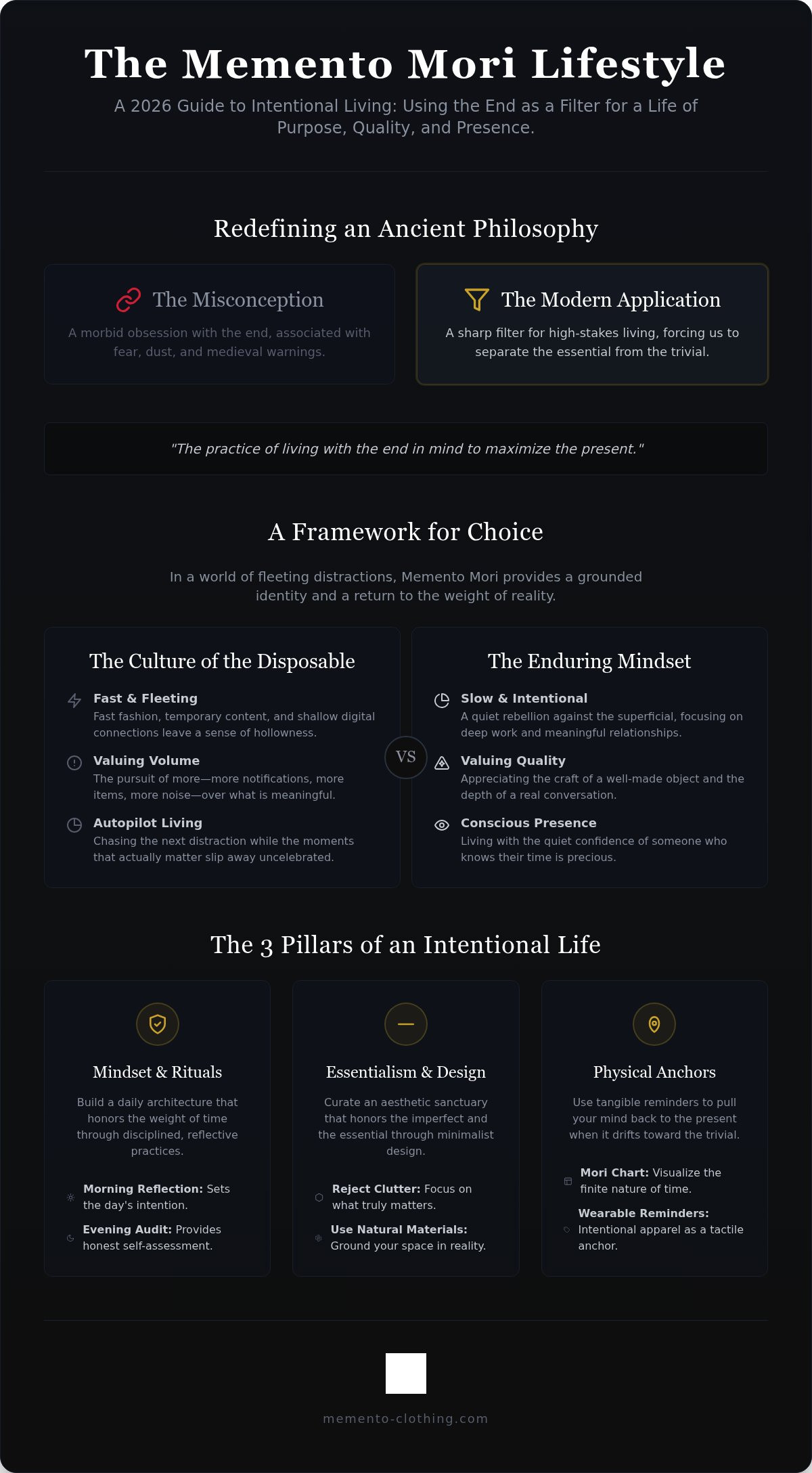
Most people hear the phrase and immediately envision dust, shadows, and medieval warnings. They see it as a dark obsession with the grave. However, the modern Memento mori tradition has evolved into something far more luminous. It's no longer just a religious deterrent. Instead, it has become a sophisticated strategy for high-stakes living. The memento mori lifestyle acts as a sharp filter; it forces us to separate the essential from the trivial noise that clutters our days. When the reality of our finite time becomes clear, the distractions of digital vanity and hollow arguments simply lose their grip. We stop chasing the wind and start holding onto what remains.
The Memento Mori lifestyle is the practice of living with the end in mind to maximize the present.
The Stoic Roots of Mindful Mortality
Marcus Aurelius didn't write his meditations to be morbid. He wrote them to stay awake. For the Stoics, time was the only currency we couldn't earn back. Seneca often reminded his students that we're dying every day, as every hour that passes is already in death's possession. They practiced the "view from above," a mental exercise where one looks at their life from the perspective of the stars. This shift in scale makes daily frustrations feel small and manageable. By using Premeditatio Malorum, or the premeditation of evils, they built a modern resilience. They didn't fear the shadows; they invited them in to understand their shape. This wasn't about pessimism. It was about being unshakable in the face of a changing world.
Why Memento Mori is Trending in 2026
Why is this ancient idea resurfacing with such intensity in 2026? We're exhausted by a culture of the disposable. Everything feels fleeting. Fast fashion, temporary content, and shallow connections have left many of us feeling hollow. People are searching for slow living and values that actually endure. The memento mori lifestyle provides a grounded identity in a world that moves too fast to be felt. It's a quiet rebellion against the superficiality of the digital age. By acknowledging that our time is limited, we begin to value the craft of a well-made object, the depth of a real conversation, and the legacy of our own footprint. It provides a return to the weight of reality. It's a choice to seek quality over the sheer volume of a life lived on autopilot.
The Pillars of an Intentional Life: Mindset and Rituals
Living with purpose requires more than a passing thought. It demands a rhythm. To adopt a memento mori lifestyle is to build a daily architecture that honors the weight of time. This isn't about productivity hacks. It's about a profound realignment of your attention toward things that will outlast you. It's a commitment to a cadence that favors the profound over the popular.
The Morning Reflection serves as your first anchor. Before the digital world demands your focus, sit with the quiet truth that this day is a finite gift. Ask yourself: If this were my final opportunity to act with integrity, how would I treat the people I encounter? This mortality lens doesn't create anxiety. It creates a sharp, crystalline clarity. It makes the shallow obligations of the day look exactly like what they are: noise. You begin to see that most "emergencies" are merely distractions in disguise.
As the sun sets, the Evening Audit closes the circle. This is a moment of radical honesty. Examine your actions without judgment. Which moments held lasting value? Where did you trade your life force for a fleeting dopamine hit? By auditing your time, you learn to say "no" with quiet confidence. You stop apologizing for protecting your deep work and your most meaningful relationships. You realize that every "yes" to the trivial is a "no" to the essential.
Ritualizing the Reminder
Abstract thoughts are easily forgotten in the heat of a busy afternoon. You need physical triggers to stay grounded. Many practitioners use a "Mori Chart" or a Life Calendar, where each week is a single block on a page. Seeing the finite rows of your life provides a visual weight that a digital clock cannot replicate. Journaling also plays a vital role. Prompts like "What would I regret not saying today?" turn vague intentions into actionable grace. Even the objects we carry can serve this purpose. A simple coin or a piece of intentional apparel can act as a tactile anchor, pulling you back to the present when your mind begins to drift toward the trivial.
Mindful Consumption and the 'Enduring' Mindset
The memento mori lifestyle extends to how we interact with the material world. It's a rejection of the fast and the disposable. In 2026, the global mindfulness market is projected to reach 2.81 billion dollars, reflecting a widespread search for substance. This mindset asks us to choose items that age with grace. We look for natural materials and timeless designs that don't bow to fleeting trends. This commitment to quality also applies to how we fuel our bodies; choosing premium support like MitoStack ensures our cellular health aligns with our intention to live each day with full presence. When we consume mindfully, we aren't just buying products. We're selecting companions for our journey. We choose the enduring over the ephemeral, finding a deep, quiet satisfaction in the things that remain long after the hype has faded.
Memento Mori vs. Modern Distraction: A Framework for Choice
The modern world screams for your attention. It offers a thousand tiny escapes, each promising a temporary relief from the weight of existence. Most of these distractions fall under the banner of "YOLO" (You Only Live Once). While this phrase was born from a desire to seize the day, it has mutated into a justification for reckless consumption and shallow impulsivity. The memento mori lifestyle offers a different path. It doesn't ask you to burn through your days in a frantic search for pleasure. Instead, it invites you to build something that lasts. It's a framework for choice that values legacy over the loud, immediate "now."
Critics often mistake this philosophy for nihilism. They see the skull and assume the message is that nothing matters. The truth is exactly the opposite. If nothing mattered, we wouldn't care how we spent our time. Because our time is finite, every choice carries an immense weight. This awareness is inherently optimistic. It's a declaration that your life is too precious to be wasted on trivialities. By keeping the end in sight, you gain the power to say no to the noise. You simplify complex decisions by asking a single, piercing question: Will this matter when the clock stops?
The 'YOLO' Trap vs. Intentional Presence
YOLO is often an excuse for escape. It's the "buy it now" button and the mindless scroll. It treats life like a resource to be depleted. Intentional presence, rooted in memento mori, treats life like a craft to be mastered. You can enjoy a glass of wine or a quiet sunset without the desperate need to "consume" the experience for social validation. You seek meaning rather than just pleasure. This shift allows you to enjoy the moment deeply precisely because you aren't sacrificing your future self to a fleeting whim. It's the difference between a firework and a steady flame.
Escaping Toxic Productivity
We're conditioned to measure our worth by the length of our to-do lists. This is the grind. Mortality acts as the ultimate antidote to toxic productivity. It forces us to redefine success as time well spent rather than tasks completed. Many of the things we stress over in our professional lives won't even be footnotes in our personal histories. There's a profound peace in accepting the "unfinished" state of life. You don't have to do everything. You only have to do what's essential. This realization allows you to step away from the noise and return to the work that truly reflects your values, leaving the rest to fade away.
Curating a Memento Mori Aesthetic: Environment and Design
A philosophy that remains only in the mind is a ghost. To truly embody a memento mori lifestyle, one must translate these internal convictions into the physical world. Your environment shouldn't be a collection of random acquisitions. Instead, it should act as a curated sanctuary of meaning. Minimalism plays a vital role here, but it's not the cold, sterile minimalism of a gallery. It's the intentional removal of the trivial to make room for the essential. When you strip away the clutter, you're left with objects that possess weight, history, and purpose.
This aesthetic finds its soul in the Japanese concept of Wabi-Sabi; the appreciation of the imperfect and the aging. Natural materials like raw wood, stone, and heavy cotton don't hide the passage of time. They celebrate it. A scratch on a desk or the fading of a well-worn fabric becomes a narrative of use and existence. These are silent teachers. They remind us that while we're ephemeral, the values we weave into our surroundings can endure. By choosing items that age with grace, we learn to do the same.
The Philosophy of Fabric
The clothes we choose are our most intimate environment. In a world of disposable fast fashion, choosing heavyweight, high-quality materials is a radical act of intentionality. Heavyweight fabric provides more than just longevity; it offers a physical weight that grounds the wearer. It serves as a modern "Vanitas" symbol, a wearable reminder that substance matters more than fleeting trends. When you pull on a garment designed for endurance, you're making a statement about your own timeline. You're rejecting the "now" for the "always." Explore our collection of intentional apparel to find pieces that serve as a daily uniform for a life of purpose.
Creating a Memento Mori Space
Your living space should prompt reflection without being overwhelming. Visual anchors like a simple hourglass, a mechanical clock, or even a single dried flower can pull your attention back to the present moment. The importance lies in tactile quality. The way a ceramic cup feels in your hand or the texture of a heavy rug under your feet provides a sensory grounding that digital interfaces cannot offer. These objects aren't merely decor. They're ritualistic tools. They help you navigate the tension between the temporary nature of our days and the timeless quality of our values. Design becomes a tool for grounding yourself in the reality of the present.
Wearable Reminders: Integrating the Philosophy into Your Wardrobe
Clothing is more than a shield against the elements. It's an intimate environment we choose to inhabit every day. In the context of a memento mori lifestyle, your wardrobe becomes a daily uniform for the mind. We call this intentional apparel. It's a rejection of the fast, the flimsy, and the forgettable. When you choose garments with physical weight and historical depth, you're anchoring your consciousness in the present. You're deciding that what you wear should reflect the gravity of how you live. Every thread becomes a silent prompt to remain awake to your own existence.
The Memento Mori Heavyweight Hoodie stands as a primary symbol of this endurance. Crafted from dense, high-quality cotton, it offers a tactile reminder of substance in a world of digital ghosts. It doesn't follow the frantic cycle of seasonal trends. Instead, it's built to age with you, gaining character through the years. For those seeking a lighter but equally meaningful staple, the Memento Mori Vintage Tee serves as a timeless foundation for the modern minimalist. These pieces aren't just fashion; they're physical anchors for a philosophy that demands quality over quantity.
The Memento Mori Clothing Narrative
Our brand exists to bridge the gap between ancient philosophy and modern narrative. We believe that objects should carry stories. The Memento Crewnecks are designed for those who value the quiet strength of a well-made garment. Every stitch represents a choice to favor the enduring. This commitment to intentional design is an act of self-remembrance. It's a way to carry the lessons of the Stoics into the streets of 2026. By wearing these reminders, you're participating in a community of individuals who refuse to let their lives slip away uncelebrated.
Next Steps: Cultivating Your Own Memento Mori
Adopting this path doesn't require a radical overhaul of your life overnight. Start small. Pick one morning ritual to set your intent and one physical anchor to ground you when the noise gets too loud. Audit your environment. Look at the items you own and ask if they're fleeting or enduring. Replace the disposable with things that possess weight and meaning. The memento mori lifestyle is a journey of gradual refinement. It's a slow, deliberate process of removing the clutter until only the essential remains. The goal isn't to dwell on the end. It's to ensure you never forget to live with every ounce of presence you possess.
Engaging with the arts is a powerful way to cultivate this presence. If you're looking to host a meaningful event or gathering, you can explore Performance and Appearance Booking Fees to see how the Maori collective incorporates these philosophical themes into music and dance.
Embracing the Weight of a Meaningful Present
Adopting a memento mori lifestyle is a quiet rebellion against the superficial. You've explored how mortality acts as a sharp filter; helping you discard the trivial in favor of what truly endures. By integrating intentional rituals and curating an environment of substance, you transform the awareness of time into a profound source of presence. It's a shift from merely passing through the days to crafting a life that carries actual weight. You stop chasing the fleeting and begin to invest in the eternal.
Your journey toward intentionality deserves physical anchors that match your conviction. Our collection features 10oz+ heavyweight fabrics built for longevity, with an aesthetic rooted in over 2,000 years of philosophical tradition. We provide national US shipping on all our intentional garments to ensure your wearable reminder is always within reach. Explore the Memento Mori Collection and find your wearable reminder. Trust the clarity that comes from remembering your time is precious. Every moment is a chance to leave a footprint that reflects your deepest values. Live with the quiet confidence of someone who knows exactly why they're here.
Frequently Asked Questions
Is a Memento Mori lifestyle depressing?
It is not depressing; rather, it's a profound celebration of existence. By acknowledging the finite nature of our time, we strip away the trivial and focus on what truly matters. This awareness acts as a luminous filter for the present moment. Instead of dwelling on the end, it encourages us to live with a sharp, vibrant intensity that most people overlook. It's about finding light in the clarity of the truth.
How do I start living a Memento Mori lifestyle today?
Begin by establishing a morning reflection to set your intent through the lens of mortality. Ask yourself what actions would hold lasting value if today were your final opportunity. Additionally, introduce a physical anchor into your space, such as a life calendar or intentional apparel. These small, consistent shifts in perspective help you cultivate a memento mori lifestyle that prioritizes depth over distraction. Consistency is more important than grand gestures.
What are the common symbols of Memento Mori in modern fashion?
Modern fashion often utilizes the skull as a visceral reminder of our shared human condition. Other symbols include hourglasses, wilting flowers, or mechanical clocks, which represent the steady passage of time. Beyond imagery, the use of heavyweight, enduring materials serves as a structural symbol of longevity. These elements act as wearable reminders that ground the wearer in the reality of the present moment. They turn the act of dressing into a ritual of remembrance.
Can Memento Mori help with anxiety?
It can significantly reduce anxiety by providing a "view from above." When we view our daily stressors against the backdrop of mortality, they often lose their power and shrink to a manageable scale. This philosophical shift helps us distinguish between genuine concerns and the shallow noise of modern life. It fosters a sense of calm resilience by focusing our energy only on what we can control. The end of time makes the small worries fade.
What is the difference between Memento Mori and Memento Vivere?
Memento Mori translates to "remember you must die," while Memento Vivere means "remember to live." They aren't opposing forces but complementary truths. The awareness of the end is the very thing that gives the act of living its urgency and beauty. You cannot truly embrace the fullness of life without first acknowledging its inevitable conclusion. One provides the necessary context, while the other provides the action. They are two sides of the same coin.
Why is heavyweight cotton associated with the Memento Mori lifestyle?
Heavyweight cotton is preferred because it rejects the fast and disposable nature of modern culture. In a memento mori lifestyle, objects are chosen for their ability to endure and age with grace. Fabrics that possess physical weight provide a tactile grounding for the wearer. This choice reflects a desire for lasting value and meaningful consumption. It favors pieces that serve as long-term companions rather than fleeting trends that end in a landfill.
Do I need to be a Stoic to follow this lifestyle?
You don't need to identify as a Stoic to adopt these practices. While the philosophy has deep roots in Stoicism, the awareness of mortality is a universal human experience found across many cultures. Anyone seeking more intentionality, focus, and depth can benefit from these principles. It's a personal worldview centered on presence rather than a rigid set of academic rules. It is an invitation to anyone who values the weight of their own history.
How does Memento Mori influence minimalist design?
It influences minimalist design by shifting the focus from "less is more" to "only the essential matters." This approach encourages the removal of clutter that distracts from the present moment. It favors natural materials that show the passage of time and objects that prompt reflection. The result is a space that feels grounded, intentional, and deeply resonant with the owner's values. Design becomes a tool to help the mind stay focused on the enduring.