
The History of the Graphic T-Shirt: A Legacy of Intentional Expression
Every garment we wear is a choice between the ephemeral and the eternal. We often settle for the hollow noise of mass production, yet we crave something that carries the weight of a lived story. You've likely felt the frustration of a thin, soulless shirt that loses its shape before the season even ends. To find meaning in what we wear, we must look back at the history of the graphic t-shirt, a journey that began with functional military undergarments and transformed into a profound medium for human expression.
This article explores that evolution, showing how a simple cotton canvas became a vessel for personal philosophy. We'll examine technical milestones like the 1959 introduction of plastisol ink and the shift toward the $12.44 billion sustainable fashion market of 2026. By the end, you'll understand how to identify high-quality apparel that serves as a lasting artifact of your own identity. We will move beyond the saturation of the modern market to find the intentionality hidden within the fibers and the quiet strength of a legacy that refuses to fade.
Key Takeaways
- Trace the evolution of an icon from 19th-century military utility to a philosophical canvas by exploring the history of the graphic t-shirt.
- Identify the technical turning points in garment durability. We examine the 1913 US Navy undervest and the 1959 introduction of plastisol ink.
- Learn to distinguish between disposable fast fashion and heavyweight staples. Fabric weight and construction are the foundations of a lasting garment.
- Discover how the Memento Mori philosophy transforms a simple tee into a meaningful artifact. It serves as a physical reflection of your personal history.
- Understand why intentional design is the antidote to modern saturation. These pieces are choices, not just products.
The Genesis of the T-Shirt: From Hidden Layers to Military Identity
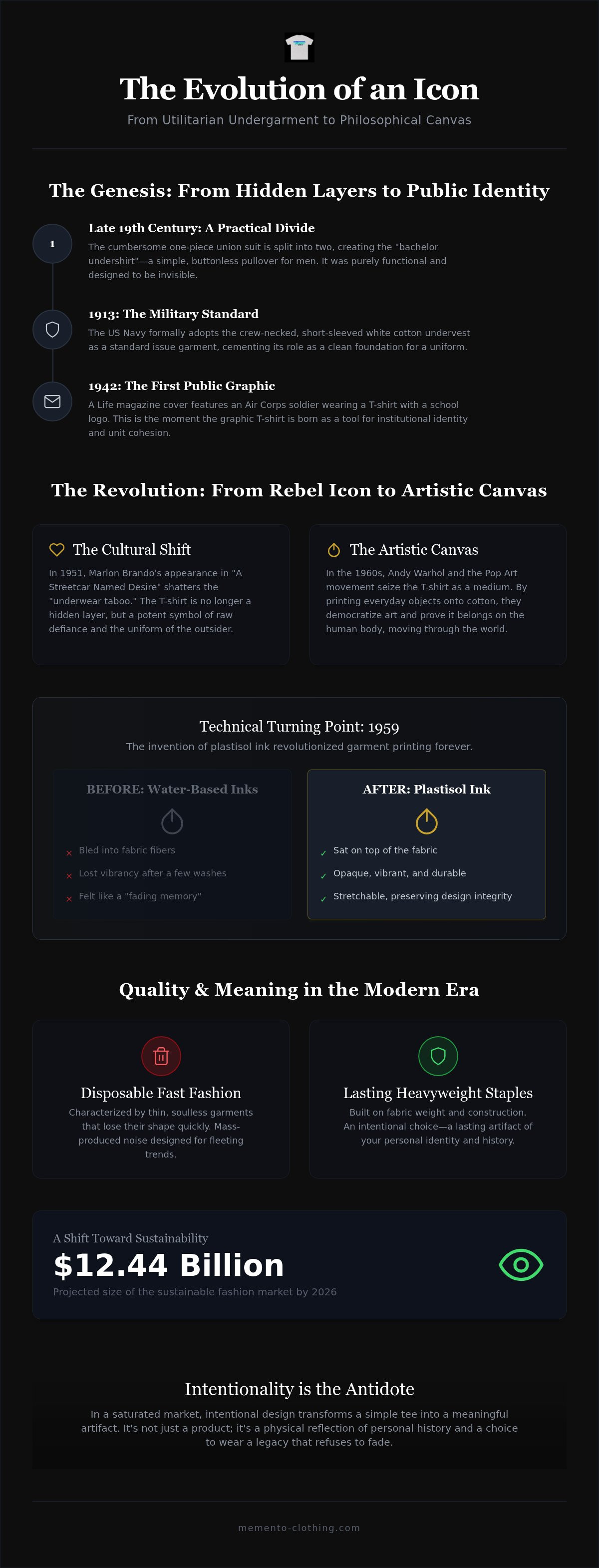
The t-shirt began as a quiet necessity. It was a secret kept beneath layers of heavy wool and formal tailoring. In the late 19th century, the cumbersome union suit was divided into two separate pieces. This created the "bachelor undershirt," a simple, pull-over garment for men who lacked the skill or the time to mend broken buttons. It was a utilitarian solution born from the silence of a domestic void. It was functional, invisible, and entirely devoid of ego.
By 1913, the US Navy formally adopted the crew-necked, short-sleeved white cotton undervest. It was a stark, clean foundation for the sailor's life. Looking into the history of the T-shirt, we see it wasn't yet a medium for art. It was a ghost in the wardrobe. The shift toward the history of the graphic t-shirt required a global conflict to bring it into the light. In 1942, Life magazine published a cover featuring a soldier from the Air Corps Gunnery School. He wore a t-shirt emblazoned with a school logo. This wasn't just clothing. It was institutional identity. The military understood that shared symbols on fabric could forge unit cohesion. It transformed a private layer into a public declaration of belonging. This is where the history of the graphic t-shirt truly finds its voice.
The 1939 Wizard of Oz and Early Promo Tees
Before the military made it a staple, Hollywood experimented with the form. In 1939, promotional shirts for "The Wizard of Oz" appeared. They were fleeting. These early graphics were rare. The technology of the era made production difficult and the results fragile. At this stage, the t-shirt was a souvenir. It was a fragile reminder of a cinematic experience rather than a daily expression of self. The graphics were ghosts, haunting the cotton for a brief moment before fading into the wash.
Post-War Transition: The Veteran's Influence
Soldiers returned from the front lines and brought their habits with them. They wore their military undershirts as casual outer garments in their own backyards. This was a radical act. To the older generation, seeing a man in his "underwear" on the street was a cultural shock. It felt like a breach of decorum. However, for the veterans, it was a symbol of practical, masculine utility. It was a garment that had survived the weight of history. This transition laid the groundwork for the t-shirt to become a philosophical canvas. It moved from the barracks to the streets, carrying the quiet gravity of a life lived with intent. The fabric became a witness to the passage of time.
The Screen Printing Revolution and the Rebel Icon (1950s-1960s)
In 1951, Marlon Brando appeared in A Streetcar Named Desire. He wore a sweat-soaked, tight-fitting white t-shirt. This single cinematic moment shattered the underwear taboo forever. The garment was no longer a hidden layer; it became a symbol of raw, masculine defiance. Soon after, James Dean solidified this status in Rebel Without a Cause. The t-shirt became the uniform of the outsider. But it was still largely a blank slate. The real transformation in the history of the graphic t-shirt occurred when technology finally caught up with the human desire for self-expression.
The year 1959 marked a silent revolution with the commercial viability of plastisol ink. Unlike previous dyes, plastisol sat on top of the fabric. It was durable, vibrant, and stretchable. This technical breakthrough allowed the evolution of the graphic tee to move beyond simple military stamps and into the realm of high art. Andy Warhol and the Pop Art movement seized this opportunity. They turned everyday objects into icons. By printing soup cans and celebrity faces onto cotton, they proved that art didn't belong solely in galleries. It belonged on the human body, moving through the world. It was a democratization of aesthetics that changed how we perceive clothing.
The Technical Evolution of T-Shirt Decoration
Early water-based inks were poetic but flawed. They bled into the fibers, losing their vibrancy after only a few washes. They felt like a fading memory. Plastisol changed everything by offering opaque, lasting designs that survived the passage of time. This coincided with the development of the multi-color rotary screen printing press. This machine allowed for complex, layered designs to be produced at scale. It turned the t-shirt into a mass-produced masterpiece, capable of carrying detailed narratives without sacrificing the integrity of the fabric.
Tie-Dye, Rock, and The Beatles
The 1967 Summer of Love brought an explosion of expressive color. Tie-dye became a visual protest against the grey conformity of the post-war era. Music fans began wearing their allegiances. The first band tees appeared, shifting the focus from institutional logos to personal artistic choices. It was a shift toward the individual. Wearing a shirt became an act of curation. It was a way to signal one's place in the counter-culture. Today, we honor this era of rebellion by focusing on that same enduring quality. Our Memento Mori Vintage Tee captures that mid-century spirit through heavyweight construction and intentional design, ensuring the story you wear lasts as long as the memory itself.
The T-Shirt as a Cultural Billboard: Music, Politics, and Brands
The 1970s transformed the t-shirt from a rebel's garment into a linguistic event. It became a public diary. A powerful logo from 1977 proved that a simple slogan could revive civic spirit. This era redefined the history of the graphic t-shirt by proving that fabric could carry the weight of a shared identity. Suddenly, every chest was a billboard for a cause. Protesters used cotton to scream for peace, civil rights, and environmental protection. It was a democratization of the message. The garment was no longer just about the wearer; it was about the world they wanted to build.
By the 1980s, corporations noticed the power of this walking billboard. Brands like Coca-Cola and Nike turned the individual into a volunteer advertiser. This era moved away from personal philosophy and toward commercial saturation. A brief history of the t-shirt shows how this period traded depth for visibility. However, beneath the corporate noise, streetwear was taking root. In skate parks and across diverse urban scenes, hip-hop and skate culture reclaimed the graphic tee. They used it to signal membership in an underground tribe. It was a return to the garment's roots as a marker of identity.
Band Merchandise: More Than a Souvenir
The 1970s rock scene turned the concert tee into a holy relic. It was a physical record of a moment in time. To wear a band shirt was to say, "I was there." It was an emotional anchor. This connection between an object and a personal timeline is central to the Memento Mori story of intentional narrative. We believe a garment should hold a story. It should act as a bridge between your history and your present self. A band tee wasn't just merchandise. It was a piece of a soul caught in cotton, surviving the passage of years.
The Designer T-Shirt and High Fashion
Vivienne Westwood brought the punk aesthetic to the runway in the late 70s. She used the graphic tee to shock the establishment. This marked the birth of the designer t-shirt. Luxury brands eventually followed, attempting to capture the energy of the streets. This created a lasting conflict. Mass production often strips away the individual expression that made the t-shirt vital. In the history of the graphic t-shirt, we see a constant struggle between the authentic voice and the corporate echo. We choose the voice. We value the quiet strength of a design that serves a purpose beyond mere consumption.
The Evolution of Quality: From Disposable Trends to Heavyweight Staples
The 1990s marked a quiet erosion of craftsmanship. As fast fashion accelerated, the structural integrity of the garment collapsed. Production shifted toward thin, synthetic blends designed to be replaced rather than remembered. This was a dark chapter in the history of the graphic t-shirt. The focus moved from the veteran’s rugged utility to the consumer’s fleeting whim. The result was a market saturated with ephemeral noise. We lost the connection between the object and the earth it came from.
By the 2020s, a counter-movement emerged. People grew tired of clothing that disintegrated after three washes. There is a renewed craving for "heavyweight" cotton. This isn't just about warmth. It's about a structured canvas. A denser fabric provides a stable foundation for screen printing. It prevents the ink from stretching and cracking. It ensures the graphic ages with the wearer, developing a patina of life rather than a mask of decay. Quality is not loud. It is silent. It is felt in the drape and the resistance of the weave.
Why Fabric Weight Matters for Longevity
Most mass-market shirts hover around 150 GSM. They are thin. They are temporary. A premium garment starts at 250 GSM or higher. This density prevents garment distortion. It keeps the silhouette sharp through years of wear. Heavyweight fabric doesn't just last longer; it carries the print with more grace. For those seeking the pinnacle of this structural philosophy, our Memento Mori Heavyweight Hoodie sets the standard for tactile permanence. It is a garment built to survive the seasons.
Choosing a Graphic Tee That Lasts
Look at the construction. Tubular bodies offer a classic, vintage fit, but side-seamed garments provide a more tailored, lasting structure. Pay attention to the ribbing at the neckline. It should be tight and resilient, refusing to sag. The the history of the graphic t-shirt teaches us that the best pieces are those that refuse to fade. Our Memento Mori Vintage Tee is designed with these exact details in mind. It represents the "new vintage" standard, combining historical soul with modern durability.
Choosing quality is an act of resistance. It is a refusal to participate in the cycle of the temporary. To wear a garment that lasts is to honor your own timeline. Explore our collection of intentional staples and find a piece that carries your story forward.
Memento Mori: Continuing the Legacy of Meaningful Design
We've reached a vital turning point. The loud, corporate branding of previous decades is losing its resonance. In its place, a new era of intentionality has arrived. Looking back at the history of the graphic t-shirt, we see a garment that has always mirrored our collective psyche. In 2026, it serves as a tool for mindful living. It's no longer just about where you've been or what you've bought. It's about what you believe. The shirt has become a quiet reflection in a world of static.
The Memento Mori philosophy transforms a simple garment into a profound reminder. It's a call to recognize the value of each moment. We don't design for the fleeting season. We craft future vintage. Our goal is to create pieces that'll be pulled from a drawer thirty years from now, still carrying the weight of their original intent. This is the ultimate evolution of the form. It's a shift from the disposable to the eternal. It's a legacy of permanence.
Philosophy in Fabric
Aesthetic minimalism is our anchor. We believe that a design should speak softly but with great weight. This philosophical approach shouldn't be reserved for adults alone. Our Youth Graphic T-Shirts introduce this sense of meaningful style to the next generation. We're teaching them that clothing can be a choice of character, not just a trend. It's about planting the seeds of quality and intentionality early. It's an inheritance of value.
Your Personal History, Written in Cotton
Every crease and every fade tells a story. Your t-shirt is a vessel for memory. It's an individual narrative that grows richer with every wear. Investing in heavyweight, high-quality cotton is an act of respect for your own history. It's a refusal to let your experiences be ephemeral. We invite you to move beyond the noise of fast fashion. The history of the graphic t-shirt is still being written, and you're the author of the next chapter. Explore our collection of intentional vintage tees and find a piece that resonates with your own journey through time.
Wear the Weight of Your Story
We've traced a path from the hidden seams of the 19th century to the bold, philosophical declarations of the modern day. The history of the graphic t-shirt is a testament to our enduring need to be seen and understood. It's a journey that moved from military necessity to cultural rebellion, eventually finding its soul in the quiet strength of intentional design. You now recognize that a garment's value isn't found in a fleeting trend. It lives in the integrity of its construction and the depth of its message.
True expression requires a foundation that survives the passage of time. By prioritizing premium heavyweight fabrics and philosophically driven designs, you choose a legacy of permanence over the hollow noise of disposability. These pieces are built for longevity, serving as tactile anchors for your personal history. It's time to move beyond the temporary and embrace a wardrobe that reflects your deepest values. Your choices should be as enduring as the stories you tell.
Shop Intentional Graphic Tees at Memento Mori Clothing and find a piece that carries your narrative forward with grace. Step into a legacy that honors every moment.
Frequently Asked Questions
When was the first graphic t-shirt ever made?
The first recorded promotional graphic t-shirt was produced in 1939 for the film "The Wizard of Oz". While the military used basic stamps for unit identification earlier, this cinematic souvenir marked the birth of the t-shirt as a marketing medium. These early pieces were rare and technically fragile. They laid the foundation for the expressive culture we see today, moving the garment from a hidden layer to a public statement.
What is the history of screen printing on t-shirts?
T-shirt screen printing evolved from labor-intensive manual methods to a global industry following the 1959 introduction of plastisol ink. This breakthrough allowed for vibrant, stretchable designs that didn't crack easily under stress. The subsequent invention of the multi-color rotary press enabled mass production at a level previously unseen. This technical journey is a core part of the history of the graphic t-shirt, turning a simple garment into a diverse artistic canvas.
Why did the t-shirt transition from underwear to outerwear?
The transition was driven by returning World War II veterans who wore their undershirts casually at home for comfort and utility. This practical shift gained cultural momentum in the 1950s when actors like Marlon Brando portrayed the look as a symbol of raw rebellion. What was once a private, hidden layer became a public statement of masculine identity and defiance, forever altering the landscape of modern fashion and social decorum.
How did band t-shirts become so popular in fashion history?
Band t-shirts rose to prominence in the late 1960s and 1970s as fans sought physical relics of their musical experiences. These garments served as vital cultural identifiers, signaling membership in a specific subculture or tribe. By wearing a concert tee, fans transformed a piece of merchandise into a personal history. It became a way to carry the energy of a performance into daily life, bridging the gap between art and identity.
What is the difference between vintage and modern graphic tees?
True vintage tees are often defined by their unique wear patterns, single-stitch construction, and the specific patina of aged plastisol ink. Modern tees, particularly those in the fast fashion sector, often prioritize low-cost synthetic blends and disposable trends that lack structural integrity. However, high-end modern designs aim to reclaim that vintage soul by using heavyweight cotton and intentional, philosophical graphics that are built to survive for decades rather than weeks.
Why is heavyweight cotton better for graphic designs?
Heavyweight cotton, typically exceeding 250 GSM, provides a stable, structured canvas that prevents the garment from distorting over time. This density is crucial for the longevity of the print, as it minimizes the stretching that leads to graphic cracking. A thicker weave absorbs ink more effectively, ensuring the design remains a permanent part of the fabric's story rather than a temporary surface layer that fades into obscurity.
Can a graphic t-shirt be considered high fashion?
The graphic t-shirt entered the realm of high fashion through the provocative work of designers like Vivienne Westwood in the late 1970s. Today, luxury houses use the medium to blend streetwear energy with premium craftsmanship. When a tee is produced with artisanal care and carries a profound narrative, it transcends its humble origins. It becomes a legitimate piece of wearable art, valued for both its aesthetic beauty and its underlying message.
What does the Memento Mori philosophy mean in fashion?
In fashion, the Memento Mori philosophy is a call to intentionality. It's a reminder of life's transience, urging us to choose objects that hold genuine meaning and lasting value. This perspective rejects the hollow cycle of fast fashion. Instead, it views each garment as an emotional anchor and a witness to our personal history. To wear such a piece is to acknowledge the weight of time and the quiet beauty of permanence in a fleeting world.