
The Best Way to Fold and Store Sweatshirts: A Guide to Intentional Garment Care
What if the quiet ritual of tidying your wardrobe was actually a profound act of preservation for your personal history? Most of us view garment care as a mundane chore, yet for those who appreciate the weight and texture of a premium piece, it's a practice of respect. We've all felt the disappointment of a beloved hoodie losing its shape to a wire hanger or the frustration of a cluttered shelf that hides the very items we love. Finding the best way to fold and store sweatshirts is the essential bridge between simply owning a garment and truly honoring its craftsmanship.
You deserve a closet that functions as a curated sanctuary rather than a chaotic storage unit. By adopting a more intentional approach, you can ensure your Memento Crewnecks and heavyweight hoodies retain their structural soul and aesthetic depth for years. This guide explores professional folding techniques and strategic storage solutions designed to maximize your space without compromising fabric integrity. We'll show you how to maintain that "new" feeling, ensuring every piece remains a crisp, ready vessel for your next chapter.
Key Takeaways
- Understand why gravity is the silent enemy of heavyweight cotton and how to eliminate the permanent distortion caused by traditional hangers.
- Master the best way to fold and store sweatshirts using professional techniques like the KonMari file fold to maximize drawer space and visibility.
- Shield your collection from environmental stressors like humidity and light exposure to prevent musty scents and premature fabric fading.
- Learn how investing in high-GSM garments simplifies care, as premium materials possess the inherent memory to retain their shape after folding.
- Reframing garment organization as a meditative ritual that preserves the craftsmanship and the stories woven into your favorite pieces.
The Art of Preservation: Why Sweatshirt Care is an Investment
A garment is more than a product. It's a witness to our movements, a layer between our skin and the world. When we talk about The Art of Preservation, we're discussing a silent dialogue between the owner and the object. Intentional care is the highest form of respect for the hands that crafted the fabric. Seeking the best way to fold and store sweatshirts isn't merely an exercise in organization; it's a commitment to the item's future. Without this focus, even the finest materials succumb to garment distortion. Fiber fatigue sets in. The structural integrity of the cotton begins to fail under the weight of its own existence.
Heavyweight cotton presents a unique paradox. It's incredibly durable, yet its mass makes it vulnerable to gravity. A sweatshirt left on a thin hanger will eventually develop "shoulder bumps," those unsightly protrusions that ruin a silhouette. If left on the floor, the fibers lose their memory. This results in a garment that feels tired and lacks its original drape. Proper storage ensures the fabric remains resilient and the shape stays true to its design.
The Anatomy of a Heavyweight Hoodie
Density defines the character of a premium hoodie. We measure this through GSM, or grams per square meter. A high GSM indicates a thick, substantial fabric that offers superior warmth and longevity. However, this density also creates bulk. Traditional folding methods often fail because they don't account for the sheer volume of the material. The hood and ribbed cuffs are particularly vulnerable. If they're crushed or stretched during storage, the garment loses its architectural balance. High-quality cotton needs breathing room. Even when folded, fibers require a small amount of space to prevent moisture buildup and maintain their natural softness. Finding the best way to fold and store sweatshirts means balancing this need for space with the constraints of your closet.
Philosophy of Ownership: Memento Mori in the Closet
Choosing a Memento Mori Heavyweight Hoodie is a rejection of the ephemeral. It's an investment in an artifact that's meant to age with you. The ritual of folding becomes a moment of mindfulness. It's a pause in a fast-paced world to appreciate the texture of the weave and the weight of the thread. This practice pushes back against the destructive cycles of fast fashion. When we care for what we own, we need less. We choose quality over quantity. We embrace the idea that our possessions should last, carrying our stories into the years to come. Proper care is how we ensure those stories don't fade.
Folding vs. Hanging: The Science of Garment Longevity
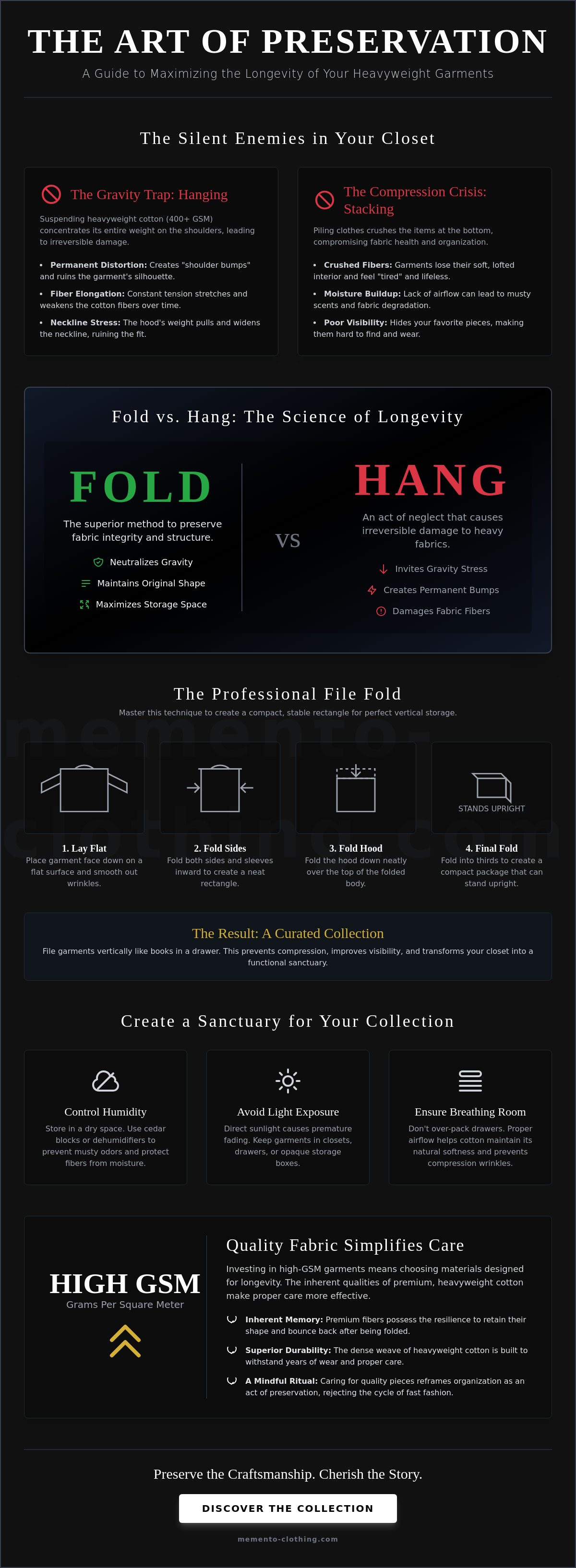
Gravity is a slow thief. It works against the structural integrity of our clothes while they rest in the dark of the closet. For heavyweight pieces, the choice between a hanger and a shelf is a choice between distortion and preservation. Heavyweight cotton carries significant mass. When you suspend a 400+ GSM hoodie from a narrow point, gravity concentrates the entire weight of the garment on the shoulders. This is the "Gravity Trap." Over months, this constant tension causes permanent fiber elongation. The hood, often the heaviest component, acts as a weight that pulls at the neckline. It slowly widens the opening until the original silhouette is lost forever. To truly understand the science of fabric care, one must recognize that every fiber has a limit where its natural elasticity fails under sustained stress.
The Case Against the Wire Hanger
Wire hangers are tools of convenience, not care. They offer zero support for the dense weave of a premium sweatshirt. They create "hanger nipples," those sharp, unsightly peaks at the shoulder that refuse to smooth out even after hours of wear. These distortions ruin the drape of the garment. If you must hang a piece temporarily, perhaps to air dry, only wide-shoulder "suit" hangers provide enough surface area to distribute the weight. Even then, it's a compromise. For permanent storage, hanging is an act of neglect that eventually breaks the spirit of the fabric.
Space Efficiency vs. Fabric Health
Many believe horizontal stacking is the only alternative to hanging. However, traditional stacking creates its own set of problems. The bottom sweatshirt in a pile of ten bears the weight of everything above it. This heavy compression crushes the soft, lofted interior of fleece-lined pieces. It makes them feel thin and less insulating over time. Vertical filing, often called the KonMari method, is frequently cited as the best way to fold and store sweatshirts because it eliminates this downward pressure. It allows each piece to stand on its own, maintaining its "loft" and softness.
The verdict is clear. Folding is the superior path for anyone seeking to honor the longevity of their collection. It respects the fabric's natural state and prevents the slow decay of the garment's shape. When you transition your Memento Crewnecks from hangers to a dedicated shelf, you choose the best way to fold and store sweatshirts to ensure they remain timeless artifacts in your personal history.
Three Master Folding Techniques for Every Space
Mastering the best way to fold and store sweatshirts requires a shift in perspective. It's not a race toward completion. It's a study of symmetry and a way to honor the physical space your garments occupy. Depending on whether you use deep drawers, open shelving, or a suitcase, your technique must adapt to the architecture of your storage. Each method below serves a specific purpose, ensuring that your heavyweight pieces remain unblemished by the passage of time.
Step-by-Step: The KonMari File Fold for Hoodies
The file fold is the gold standard for visibility. It allows each piece to stand on its own, preventing the bottom-of-the-pile neglect discussed previously. To begin, lay your hoodie face down on a clean, flat surface. Smooth the fabric to remove any trapped air. Imagine a vertical line running down the center. Fold one side toward this line, then lay the sleeve flat across the back. Repeat with the other side to create a long, uniform rectangle. Fold the hood down into the center of the rectangle. Finally, fold the garment into thirds or quarters until it forms a small, stable "filing" unit. If done correctly, the hoodie should stand upright on its own. This is the ultimate test of balance and intentionality.
The Professional Retail Fold for Crewnecks
Open shelving demands a different aesthetic. Here, the goal is a curated, gallery-like appearance. This method is particularly effective for showcasing the craftsmanship of Memento Crewnecks. To achieve perfectly uniform squares, use a large hardcover book as a temporary folding board. Place the book just below the collar on the back of the garment. Fold the sides and sleeves over the edges of the book, then fold the bottom up. Slide the book out from the top. This creates a crisp, professional edge that looks intentional on any shelf. Aligning logos or embroidery consistently across your stack transforms a simple closet into a sanctuary of order.
The Travel Roll: Protecting Your Gear on the Move
When space is a luxury, the roll is your greatest ally. High-density cotton is prone to deep creases when compressed in a suitcase. Rolling minimizes these "stress lines" by distributing pressure evenly across the fabric. For hoodies, the hood itself acts as a protective envelope. Lay the garment flat and fold the sleeves inward. Starting from the bottom, roll the sweatshirt tightly toward the neckline. Once you reach the top, tuck the entire roll into the hood. This "hood-tucked" method creates a secure, compact bundle that won't unravel in transit. It's the best way to fold and store sweatshirts when you're moving between worlds, ensuring your artifacts arrive as pristine as they left.
- Visibility: Use the file fold for drawers to see every option at a glance.
- Symmetry: Use a folding guide for shelves to maintain a clean aesthetic.
- Protection: Use the travel roll to prevent hard creases during transit.
Strategic Storage: Protecting Your Collection from the Elements
The closet is a sanctuary for our personal history, yet it's often a battlefield where nature silently erodes the things we value. Time and environment are persistent. Humidity is the quiet enemy of heavyweight cotton. It seeps into the weave, inviting musty scents and weakening the bond between fibers. Sunlight is equally destructive. It acts as a slow erasure, bleaching the depth from dark garments through "shelf fade." The best way to fold and store sweatshirts must account for these invisible forces. True preservation requires a space that respects the material's need for stability and breathability.
The Ideal Closet Environment
Natural fibers thrive in consistency. Aim for a room temperature around 65 to 70 degrees Fahrenheit with a relative humidity near 50 percent. Many rely on plastic bins for long-term storage, but these are often prisons for moisture. Plastic traps stagnant air and can lead to "off-gassing," where chemicals from the container transfer to your clothes. Choose breathable cotton bags instead. These allow air to circulate while providing a barrier against dust. To maintain a fresh, intentional scent, avoid toxic mothballs. Use cedar blocks or dried lavender sachets. These natural deterrents protect your investment without the harsh, synthetic odors of traditional pest prevention.
Light exposure is a common oversight. If your shelving is open, ensure it's positioned away from direct windows. UV rays will eventually create visible lines on the edges of folded hoodies. This permanent discoloration ruins the aesthetic of a premium collection. Rotate your garments regularly. The "Rotation Rule" ensures that no single piece remains buried and forgotten. Movement prevents the fibers from becoming brittle and allows the fabric to air out naturally.
Seasonal Transitions
As the seasons shift, your storage strategy must evolve. Never store a sweatshirt that hasn't been recently cleaned. Even if it looks pristine, unseen skin oils and microscopic organic matter act as a beacon for pests. These oils also oxidize over time, leading to yellowing that's nearly impossible to remove. Follow a strict "Wash Before Store" rule. Ensure every piece is completely dry before folding. Any residual moisture trapped in a folded Memento Mori Heavyweight Hoodie will lead to mildew. When you finally retrieve your gear after months of rest, give it a gentle shake to re-activate the fibers and restore its natural loft.
Caring for your collection is an ongoing dialogue with the objects you own. It's a refusal to let the ephemeral nature of the world dictate the lifespan of your wardrobe. By controlling the environment, you ensure your artifacts remain ready for the next chapter of your story. Explore our full range of Memento Mori apparel to find pieces worth this level of devotion.
Investing in Quality: The Relationship Between Fabric and Longevity
The success of any preservation ritual depends on the integrity of the object itself. You can master the best way to fold and store sweatshirts, but if the material lacks substance, the effort is transient. High-GSM fabrics, like those found in Memento Mori Clothing, possess a structural soul that lighter alternatives lack. These garments don't just occupy space; they command it. Their density provides a natural resistance to permanent creasing. When you unfold a heavyweight piece, the fibers exhibit a remarkable "memory," returning to their intended shape with minimal intervention. This is the hallmark of quality. It's a silent promise that the item will endure.
Sustainable fashion is often discussed as a future goal, but it truly begins with the care of the artifacts you already own. By choosing pieces designed for longevity and treating them with intentionality, you break the cycle of disposable consumption. A well-folded closet isn't just a display of organization. It's a testament to a philosophy that values the permanent over the fleeting. Building a wardrobe that outlives trends requires a discerning eye and a commitment to the slow, steady practice of maintenance. The best way to fold and store sweatshirts is ultimately a reflection of how much you value the stories woven into them.
Spotting Quality Before You Buy
Longevity is written into the details of a garment long before it reaches your closet. Look for dense, tight ribbing at the cuffs and hem. This ensures the sweatshirt retains its "grip" and doesn't become shapeless after repeated wear. Examine the stitching. Double-needle coverstitching is a sign of a piece built to withstand tension. There's a vital difference between surface-level softness and true structural integrity. Many fast-fashion items use chemical washes to mimic softness, but they lack the internal density required to survive years of folding. Quality feels substantial. It has a weight that suggests it could carry your history without fraying.
The Memento Mori Wardrobe
Curating an intentional collection involves more than just selecting heavyweight hoodies. It's about finding resonance in every layer, from essential basics to Youth Graphic T-Shirts designed with the same rigorous standards. There's a profound peace of mind that comes from a well-ordered closet. Each piece sits in its place, respected and ready. This order reflects an internal clarity. It's a refusal to let the chaos of the world dictate the state of your most personal environment.
Your journey toward a more intentional style starts with a single choice. Choose pieces that deserve your care. Explore our collection and discover artifacts designed to age with grace and remain timeless in an ever-changing world.
A Legacy Preserved in the Fold
Transitioning from a cluttered closet to a curated archive is a shift in mindset. You now understand that gravity is a slow thief. The best way to fold and store sweatshirts involves techniques that respect the fiber's natural memory and reject the destructive pull of the hanger. By embracing the file fold and controlling your environment, you protect the architectural silhouette of your collection from the silent erosion of time. Your wardrobe is no longer a mere storage unit; it is a living history.
True style isn't found in the fleeting. It's built on a foundation of quality and intentionality. Our garments are crafted for those who see clothing as a vessel for personal history. Featuring premium 400+ GSM heavyweight cotton and designs inspired by timeless philosophy, each piece is made for longevity and aesthetic depth. Discover the Memento Mori Heavyweight Hoodie Collection and begin curating a wardrobe that speaks to your values. Let your closet become a sanctuary where every garment is honored. Every fold is a promise to the future.
Frequently Asked Questions
Is it better to roll or fold sweatshirts in a drawer?
Folding is the superior choice for drawer storage, particularly when using the vertical filing method. While rolling is ideal for travel, the best way to fold and store sweatshirts in a home environment is a technique that allows the fabric to breathe without being crushed. Vertical folding ensures every piece is visible, preventing the neglect that often occurs at the bottom of a traditional stack.
How do I get rid of shoulder bumps from hangers?
Steam is the most effective way to erase the distortion caused by hangers. The heat and moisture relax the fibers, allowing the cotton to return to its original state. If a steamer is unavailable, lightly misting the area with water and using a hair dryer on a low setting can also smooth the fabric. Prevention, however, remains the most elegant solution for maintaining a garment's silhouette.
Should I zip up or button my sweatshirts before folding?
Always secure zippers and buttons before you begin the folding process. This simple ritual maintains the garment's symmetry and prevents metal teeth from snagging the delicate weave of neighboring items. A closed garment is a stable garment. It allows you to create sharper edges and a more uniform rectangle, which is essential for achieving a professional, curated look in your closet.
How many sweatshirts can I safely stack on top of each other?
Limit your horizontal stacks to no more than four heavyweight pieces. Heavyweight cotton is dense; the cumulative weight of a tall pile will eventually crush the loft of the fleece lining at the bottom. To maintain the soul and softness of your collection, consider vertical filing instead. This ensures each item carries only its own weight, preserving the fabric's structural integrity over long periods.
Do folding boards actually help with sweatshirt organization?
Folding boards are invaluable tools for those seeking a precise, retail-inspired aesthetic. They provide a consistent template that ensures every hoodie and crewneck occupies the exact same footprint on your shelves. While the best way to fold and store sweatshirts can be mastered by hand, a board removes human error and brings a sense of mathematical order and calm to your personal wardrobe.
How do I prevent my heavyweight hoodies from smelling musty in the closet?
Prevention of musty odors begins with ensuring every garment is completely dry before it enters the closet. Stagnant air is the primary cause of unwanted scents. Use cedar blocks or lavender sachets to provide a gentle, natural fragrance. These alternatives are far superior to synthetic sprays, as they respect the organic nature of the cotton while deterring pests without harsh chemicals.
What is the best way to store vintage sweatshirts without damaging the print?
Fold your vintage pieces inside out to shield the screen print from friction and light exposure. This practice prevents the graphic from sticking to itself or cracking over time. Vintage garments are artifacts of a specific moment; protecting the print is essential to maintaining their history. Use acid-free tissue paper between the folds if you intend to store them for an extended season.
Can I use vacuum seal bags for my thickest winter hoodies?
Avoid using vacuum seal bags for long-term storage of heavyweight hoodies. The extreme pressure removes all air from the fibers, which can permanently damage the loft and warmth of the fabric. Once released, the cotton may feel thin and lack its original, substantial drape. Use breathable cotton garment bags instead to protect against dust while allowing the premium material to live and breathe.