
The Art of Intentionality: How to Avoid Fast Fashion Regret in 2026
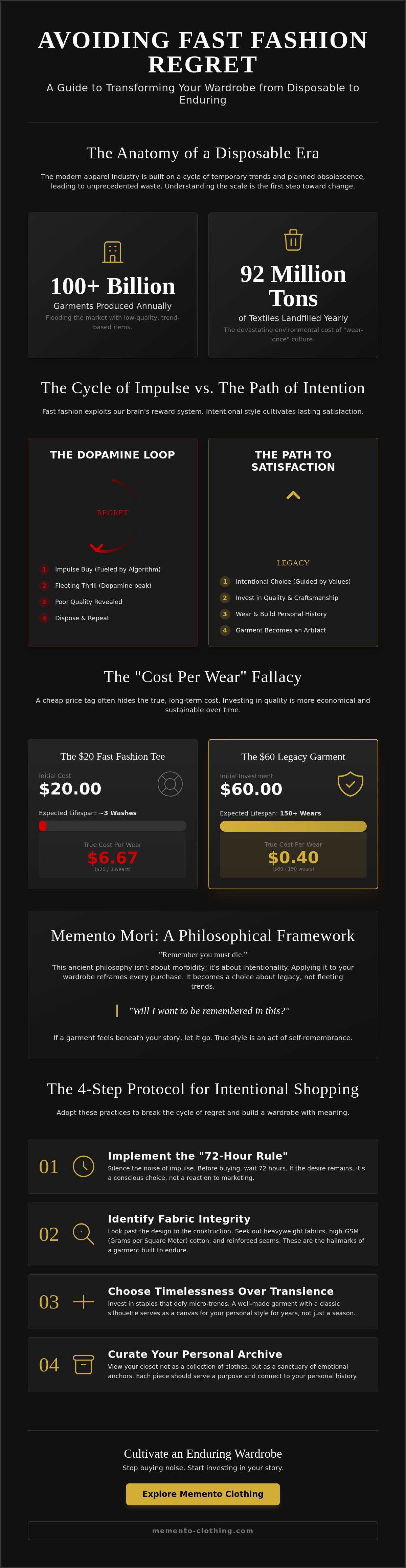
Over 100 billion garments are birthed into existence every year, yet most are destined to be forgotten before the season turns. You've felt that sting before. The "new" feeling fades. The seams pull apart. You're left with a closet full of noise but nothing that speaks your name. It's an exhausting cycle of impulse and apology that leaves your space cluttered and your spirit drained. Learning how to avoid fast fashion regret isn't just about saving money; it's about reclaiming your identity from the machinery of the disposable.
You deserve pieces that age with you, not garments that fall apart after three washes. This guide will show you how to transform your relationship with clothing by applying philosophical intentionality to every choice you make. We'll help you move past the hollow thrill of the trend and toward a wardrobe that feels like a second skin.
We'll explore how to distinguish marketing hype from true garment quality. We'll look at the 2026 regulatory shifts, like the California Responsible Textile Recovery Act, and how they're forcing a return to accountability. You'll gain the tools to curate a collection of pieces that carry personal meaning and finally find freedom from the constant cycle of buyer's remorse.
Key Takeaways
- Adopt the Memento Mori philosophy to view your clothing as a meaningful legacy rather than a fleeting trend.
- Implement the "72-Hour Rule" to master how to avoid fast fashion regret by silencing the noise of the impulse-buy cycle.
- Identify the integrity of heavyweight fabrics and high-GSM construction to ensure every piece you own is built to endure.
- Transform your closet into a curated sanctuary of garments that serve as emotional anchors for your personal history.
The Anatomy of Buyer’s Remorse in a Disposable Era
Regret is a quiet mourning for wasted potential. In the world of modern apparel, this feeling often manifests as a hollow gap between the fleeting dopamine of the "drop" and the actual utility of the piece. You've likely experienced it. The package arrives, the plastic crinkles, and the garment inside feels like a ghost of the image you saw online. This is the core of fast fashion regret. It's the realization that you’ve traded your resources for a temporary trend that won't survive the season.
Social media algorithms have weaponized our natural desire for belonging. They fuel a "wear-once" culture that makes repeating an outfit feel like a social failure. To understand what is fast fashion is to understand a system designed for disposal. When over 100 billion garments are produced annually, the industry relies on you feeling dissatisfied with what you already own. Breaking this cycle requires a shift from being a passive consumer to an intentional curator.
The Dopamine Loop vs. Long-Term Satisfaction
Shopping has become a neurochemical game. Your brain releases dopamine during the anticipation of the purchase, not the act of wearing the item. This is why the "high" often vanishes before the delivery truck reaches your door. Trend-chasing is a frantic race against an ever-moving finish line. In contrast, style-building is a meditative act of choosing pieces that deserve to age alongside you. Intentional style serves as the ultimate antidote to algorithmic consumption.
The "Cost Per Wear" Fallacy
Cheap clothing is deceptively expensive. A $20 shirt that pills, shrinks, or twists after three washes carries a hidden tax on your wallet and the planet. With 92 million tons of textiles ending up in landfills every year, the "bargain" becomes a burden. Consider the math over a 24-month horizon. A high-quality, heavyweight cotton tee might cost $60, but its durability ensures it remains a staple for years. The true cost per wear drops to pennies, while the $20 alternative requires constant replacement. Learning how to avoid fast fashion regret means looking past the price tag to see the integrity of the craftsmanship. Stop buying items. Start investing in companions that hold the weight of your memories without falling apart.
Memento Mori: A Philosophical Framework for Your Closet
Memento Mori. Remember you must die. This ancient whisper isn't a shadow over life. It's a clarity. It forces us to ask what truly matters before our time is gone. When we apply this philosophy to our wardrobes, the shallow allure of the weekly "drop" begins to dissolve. Understanding The Memento Mori Story: From Ancient Philosophy to Modern Narrative allows us to see our clothing as more than mere fabric. They become artifacts of our existence. If our time is finite, why spend it on garments designed to be forgotten? Why fill your life with noise?
This awareness changes your perspective on consumption. It's the most profound method for understanding how to avoid fast fashion regret. Instead of buying for a single Saturday night, you buy for a decade. You begin to seek the "Legacy Garment." These are pieces built with enough physical and aesthetic integrity to outlive a single season. They carry the weight of your history. They aren't meant for the incinerator. By choosing quality, you directly combat the devastating environmental impact of fast fashion that currently poisons our landscapes. Every intentional purchase is a quiet rebellion against the culture of the disposable.
Choosing Pieces that Carry a Narrative
A blank, mass-produced shirt says nothing. It has no history. A vintage-inspired tee with a thoughtful message carries a soul. It acts as an emotional anchor. This anchor keeps you grounded when the next algorithm tries to pull you toward an impulse buy. Before you tap "checkout," pause. Ask yourself: "Will I want to be remembered in this?" If the garment feels beneath your story, let it go. True style is an act of self-remembrance. It's a way to ensure your outside matches the depth of your inside. It's the ultimate secret of how to avoid fast fashion regret in a world that wants you to keep buying.
Transience vs. Timelessness
Micro-trends are whispers. They disappear as soon as they are heard. Timelessness is a steady pulse. It's a resilience to the passage of time. Heavyweight staples don't fear the calendar. They embrace it. At Memento Clothing, we design for this specific intersection of philosophy and fabric. Our pieces aren't just clothes. They are witnesses to your journey. They are designed to age, to fade gracefully, and to remain relevant. You can explore our heavyweight essentials to find a piece that truly deserves your time. Choose what lasts. Reject what rots.
Quality Over Quantity: Identifying Fabric Integrity and Craftsmanship
Quality is the physical manifestation of respect. It's a choice to honor the materials we pull onto our skin and the hands that shaped them. In a world of paper-thin garments, choosing substance is a quiet act of rebellion. The most effective way to understand how to avoid fast fashion regret is to look past the aesthetic and feel the weight of the truth. Fabric integrity isn't a luxury. It's the difference between a garment that becomes a witness to your life and one that dissolves after three washes.
The antidote to the disposable era is high-density fabric. When a garment has structural integrity, it holds its shape. It resists the frantic pilling that plagues mass-produced items. It feels substantial, providing a sense of security that flimsy alternatives can't replicate. This physical weight serves as a reminder of the piece's permanence. You aren't just wearing a trend. You're wearing an artifact designed to endure the passage of time.
Understanding GSM and Fabric Weight
Grams per square meter, or GSM, is the objective metric of a fabric's soul. Most standard retail hoodies hover around 250 to 300 GSM. They feel light because they are light. They lack the density required for a proper drape. A true heavyweight hoodie, like those explored in The Definitive Guide to the Memento Mori Heavyweight Hoodie, reaches 400 GSM or higher. This density creates a superior silhouette and provides natural insulation. To identify quality, look for a tight knit rather than a loose weave. A tight knit prevents the fibers from rubbing together, which is the primary cause of pilling. If you can see light through the fabric when held up to the sun, it's likely a regret in the making.
The Details of Durability
Craftsmanship lives in the margins. It's found in the double-needle stitching on a neckline and the reinforced ribbing on a cuff. Fast fashion brands often cut corners here, using single-needle stitches that unravel at the first sign of tension. When you examine a piece, look for "disposable" seams: loose threads, uneven tension, or thin ribbing that feels like it will stretch after one wear. Vintage-style construction often prioritizes these "overbuilt" details because they were meant to last decades, not weeks. You can find this commitment to longevity in our Memento Mori Vintage Tee: A Buyer’s Guide to Intentional Style in 2026. Choosing these details is how you ensure your wardrobe remains a collection of memories rather than a pile of waste. True style doesn't shout; it endures.
The Intentional Shopping Protocol: 5 Steps to End the Cycle
The cycle of impulse is a relentless noise. To silence it, you need a protocol. This isn't about restriction. It's about clarity. Learning how to avoid fast fashion regret requires a deliberate pause between desire and possession. By moving with intention, you reclaim the power that algorithms try to steal. You stop being a target and start being a curator of your own history.
- The 72-Hour Rule: When the dopamine of a new "drop" hits, wait. Give the feeling three days to breathe. If the piece doesn't feel essential after 72 hours, it was never a need. It was just a ghost.
- The Three-Outfit Test: A garment must earn its place. If it doesn't harmonize with at least three pieces you already own, it will sit in the dark. Don't buy a problem. Buy a solution.
- The Tactile Audit: In a physical space, let your hands lead. Feel the density. If the fabric feels thin or the seams look fragile, walk away. Quality has a weight that cannot be faked.
- Evaluating the Mission: Does this piece serve who you are today? Or does it serve a fantasy version of a life you don't lead? Wear your truth, not a costume of a fleeting trend.
- The End-of-Life Check: Consider the end at the beginning. Is this piece worthy of being passed down? If it isn't a legacy garment, it's future waste.
Audit Your Current Wardrobe
Look at your "Regret Pile." These are the items that failed you. You'll likely see a pattern: thin fabrics, fleeting colors, and poor fits. These are the symptoms of the disposable era. To heal your closet, identify the "Heavyweight" gaps. You need foundations that make styling effortless. Explore our Memento Crewnecks: A Guide to Heavyweight Quality and Intentional Style to see how a single, well-made piece can anchor an entire wardrobe. This is the first step in understanding how to avoid fast fashion regret by building on solid ground.
Mastering the Online Fit
Digital shopping is a risk when you rely on generic labels. S, M, and L mean nothing across different brands. Use garment measurements. Compare the chest width and length to a piece you already love. Check the fabric composition. Avoid thin, synthetic blends that lose their shape after one wash. Heavyweight garments offer a more predictable fit. They have the structure to drape as intended, regardless of the camera angle. Choose substance over the shimmer of a filtered image. You can begin your journey toward a more intentional closet by browsing our collection of enduring essentials today.
Cultivating an Enduring Wardrobe with Memento Clothing
Possession is a heavy responsibility. When you graduate from the cycle of the disposable, you seek a sanctuary. Memento Clothing exists for those who have finally answered the question of how to avoid fast fashion regret by choosing the permanent over the fleeting. Our garments aren't just products. They're anchors. We don't follow the frantic rhythm of the trend cycle. Instead, we offer a meaningful lifestyle built on the conviction that what you wear should reflect the depth of your journey. It's a transition from owning clothes to possessing artifacts.
The Memento Mori Vintage Tee serves as the quintessential foundation for this new way of living. It's a piece designed to be lived in, washed, and worn until it carries the unique map of your own history. By prioritizing heavyweight construction and intentional messaging, we ensure that your closet is no longer a source of guilt, but a collection of memories. You're no longer buying for a moment. You're buying for a lifetime.
The Memento Mori Aesthetic
Our palette is one of melancholic elegance. We use tones that whisper rather than shout. The graphics are more than decoration; they're invitations to contemplate the beauty of the moment. Memento is a community for those who value intentional design. We invite you to view every piece as a memento. It's a physical reminder of where you've been and who you're becoming. When your wardrobe is built on meaning, the urge to consume for the sake of consumption simply fades away. You find peace in the few things that truly matter.
National Craftsmanship, Universal Philosophy
We believe in the weight of domestic craftsmanship. Our design process is rooted in the United States, utilizing heavyweight materials that respect the wearer. While our production is local, the Memento Mori philosophy belongs to everyone. It's a global human truth that our time is precious. We reject the "disposable" label because your life isn't disposable. Every stitch in our Memento Crewnecks or heavyweight hoodies is a testament to this belief. By investing in these foundations, you master the art of how to avoid fast fashion regret once and for all. Build a wardrobe that reflects your awareness of life’s beauty and brevity. Buy once, wear forever, remember your time.
Reclaiming Your Narrative Through Intentional Style
The choice to live intentionally starts with the objects you carry through time. You've discovered that the secret of how to avoid fast fashion regret lies in the pause. It's the quiet space between seeing a fleeting trend and deciding if a garment deserves a place in your personal story. By prioritizing heavyweight 400+ GSM fabrics and embracing the Memento Mori philosophy, you move from a cycle of disposal to a practice of preservation. This shift isn't just about fashion; it's about reclaiming your identity from the noise of the algorithm.
True style doesn't need to shout to be remembered. It simply needs to endure. Your wardrobe should be a curated collection of emotional anchors rather than a cluttered pile of pilling fabric and broken promises. Every piece you choose acts as a witness to your journey. It's time to invest in craftsmanship that respects both the planet and the gravity of your own narrative. Choose pieces that are designed for longevity, not for the landfill.
Shop our collection of intentional, heavyweight essentials at Memento Mori Clothing and begin building a closet that honors the beauty and brevity of life. Choose what lasts. Remember your time.
Frequently Asked Questions
What is fast fashion regret and why does it happen?
Fast fashion regret is the emotional fallout that occurs when the excitement of a new purchase dissolves into the reality of a poor quality garment. It happens because modern retail prioritizes the speed of the "drop" over the integrity of the object. You're left with a piece that doesn't survive the season. This cycle is fueled by social media algorithms that make outfit repeating feel like a failure, leading to a closet full of noise but no substance.
How can I tell if a garment is high quality before I buy it?
You can identify quality by examining the technical specifications and the physical structure of the piece. Look for high-density fabrics with a GSM of 400 or more for hoodies and heavyweight ratings for tees. Inspect the necklines for reinforced ribbing and double-needle stitching. If the fabric feels thin or the seams appear fragile, it's a sign of a disposable garment. True quality has a physical weight that you can feel immediately.
Does "heavyweight" clothing mean it will be too hot to wear?
Heavyweight cotton provides structure and insulation without sacrificing breathability. While the fabric is denser, 100% cotton remains a natural fiber that allows air to circulate. A heavyweight garment drapes better on the body, creating a silhouette that doesn't cling or lose its shape in the heat. It's about the substance of the weave, which often feels more secure and comfortable than thin, synthetic blends in various climates.
What is the Memento Mori philosophy in fashion?
The Memento Mori philosophy is a reminder of life's finitude, which translates into a call for meaningful consumption. In fashion, it means choosing garments that act as emotional anchors and witnesses to your journey. Instead of chasing micro-trends, you invest in pieces that deserve to age alongside you. It's a shift from seeing clothes as temporary costumes to viewing them as artifacts of your individual history and legacy.
Is it possible to build a capsule wardrobe on a budget in 2026?
Building an intentional wardrobe on a budget requires a shift toward the "cost per wear" mindset. In 2026, investing in one high-quality piece is more economical than buying multiple cheap alternatives that require constant replacement. By focusing on foundational heavyweight essentials, you reduce the long-term financial burden of the impulse-buy cycle. Quality is an investment that pays dividends in both style and durability over the years.
How do I stop impulsively buying clothes online?
Silencing the impulse to buy starts with implementing the 72-hour rule before any purchase. This cooling-off period allows the initial dopamine hit to fade, giving you space to evaluate the garment's true utility. Ask yourself if the piece passes the "Three-Outfit Test" with items you already own. Mastering these pauses is essential for anyone seeking how to avoid fast fashion regret and reclaim control over their personal aesthetic.
Why is heavyweight cotton better for the environment?
Heavyweight cotton is environmentally superior because it stays out of the waste stream for longer periods. With 92 million tons of textiles reaching landfills annually, durability is the most effective form of sustainability. Natural cotton fibers also avoid the microplastic pollution associated with thin polyester blends. By choosing garments that endure, you reduce the demand for the overproduction that drives 10% of global carbon emissions.
What are the most important foundation pieces for an intentional wardrobe?
Foundation pieces should be versatile, durable, and structurally sound. A heavyweight hoodie, a vintage-inspired tee, and a structured crewneck are the pillars of an intentional wardrobe. These items provide the physical integrity needed to survive years of wear while remaining aesthetically timeless. They serve as the canvas for your personal style, ensuring you always have something meaningful to wear. These essentials are the primary tools for how to avoid fast fashion regret.