
Stoic Philosophy on Clothing: A Guide to Intentional and Virtuous Style
What if the fabric resting against your skin served as a silent exercise in virtue rather than a pursuit of passing trends? Research suggests the average person only wears 20 percent of their wardrobe, leaving the rest to sit as a heavy reminder of impulsive decisions and wasted resources. It's natural to feel a sense of fatigue when facing the relentless cycles of modern fashion. You aren't shallow for wanting to look well; you're simply seeking a harmony between your internal world and your external presence.
Applying stoic philosophy on clothing offers a path toward this balance. By adopting principles that have guided thinkers for over 2,000 years, you can transform your morning ritual into a tool for character building. You'll learn to view garments as "preferred indifferents" and understand why choosing quality is a moral act. This guide provides a clear framework for building a minimalist, durable wardrobe that acts as an emotional anchor, allowing you to dress with purpose while honoring the quiet legacy of your own values.
Key Takeaways
- Redefine your style by understanding clothing as a "preferred indifferent," where quality serves as a silent reflection of your pursuit of virtue.
- Shift your focus from vanity to character, learning to remain indifferent to the fleeting gaze of others while maintaining a dignified presence.
- Embrace the stoic philosophy on clothing to move beyond disposable trends and invest in enduring pieces that honor the brevity of time.
- Master a practical 2026 wardrobe audit to eliminate ego-driven choices and prioritize heavyweight basics designed for longevity.
- Discover how intentional design transforms a garment from a mere product into a philosophical statement and a tool for mindful living.
The Stoic Framework: Clothing as a 'Preferred Indifferent'
Virtue is the only true good. Vice is the only true evil. Everything else exists in the quiet, expansive space of the indifferent. In the foundational teachings of Stoic philosophy, clothing sits firmly in this third category. It doesn't define your soul. It doesn't dictate your moral worth. Yet, the choices we make at our wardrobes reflect our inner clarity. A garment is a memento of our intent. Within the Stoic trichotomy, we recognize that while a coat cannot make us virtuous, the way we choose and use it reveals our character.
Stoics didn't demand that we wear rags or neglect our appearance. They sought freedom from the chains of external validation. To be enslaved by a silk robe is as foolish as being prideful of a tattered tunic. The goal is living in accordance with nature. This requires choosing what is functional, durable, and simple. Your clothes should serve your life, not consume your thoughts or your currency. This perspective on stoic philosophy on clothing transforms a mundane daily routine into a deliberate ritual of mindfulness and self-respect. We dress to be ready for the world, not to hide from it.
Understanding Preferred vs. Dispreferred Indifferents
A well-made coat is a preferred indifferent. It offers warmth. It survives the seasons. A flimsy, disposable shirt is dispreferred because it fails its primary purpose and creates unnecessary distraction. Quality aligns with the virtue of wisdom. It respects the craft of the maker and the limited resources of our world. We choose the better item because it's rational to do so, not because we're emotionally attached to the label. Preferred indifferents in 2026 fashion sustainability represent garments that balance ethical production with a refusal to participate in the cycle of seasonal waste.
The Role of Function in Stoic Choice
Epictetus viewed the body as a tool for the mind. Clothing is the casing for that tool. If the casing hinders the tool, it's a failure of logic. Function must always precede form in a Stoic wardrobe. A heavy wool sweater is chosen for its 100% natural insulation, not for the status of its brand name. This intersection of utility and the virtue of temperance creates a quiet confidence. It's about restraint. It's about knowing exactly what is enough to meet the day. We don't dress to impress the crowd. We dress to support the work of being a virtuous human. Every stitch should have a reason to exist. Stoic philosophy on clothing teaches us that when we strip away the vanity, only the essential remains.
Virtue Over Vanity: Navigating the Gaze of Others
A common misconception paints the Stoic as a figure of drab austerity, draped in rags and indifferent to aesthetics. This image misses the nuance of the philosophy. Stoicism doesn't demand that you become unnoticeable or intentionally unkempt. Instead, it asks you to examine your motives. When you dress, are you seeking the approval of what Seneca called "the gaze of foolish people," or are you expressing an internal order? The stoic philosophy on clothing centers on the distinction between Philotimia, a vain love of honor, and Prepon, the art of being appropriate.
True elegance isn't a performance for others. It's a reflection of a mind that's already at peace. If your self-worth fluctuates based on the compliments you receive, you've handed your happiness to the crowd. Stoics remain indifferent to the opinions of those who value shadows over substance. This shift in perspective moves the focus from the ego to the essence. You can explore this transition in depth through The Memento Mori Story: From Ancient Philosophy to Modern Narrative, which details how embracing our mortality strips away the need for superficial validation.
Avoiding the Trap of Social Signaling
Status symbols are often nothing more than expensive noise. In a 2023 consumer study, data suggested that luxury branding often serves as a "costly signal" to establish hierarchy rather than provide utility. Stoics reject this. If a garment's only value is its price tag or a visible logo, it's a burden, not an asset. Choosing clothes that reflect internal values creates a simplified, intentional aesthetic. This approach offers immense psychological freedom. You're no longer competing in a race that has no finish line. You wear the clothes; the clothes don't wear you.
- Function over Flash: Prioritize durability and texture over trends.
- Value Alignment: Select pieces that resonate with your personal history.
- Minimalist Intent: Reduce the mental load of choice by curating a timeless wardrobe.
Appropriateness (Prepon) in Modern Society
The concept of Prepon suggests that we should dress in a way that's fitting for our role and our community. Marcus Aurelius, ruling Rome in 161 AD, wore the purple robes of an emperor because it was his duty, not because he craved the cloth. Dressing with dignity is a sign of respect for the social environments we inhabit. It's possible to look sharp and professional without seeking unearned admiration. It's about being a harmonious part of the whole.
Balancing personal comfort with social respect requires a keen sense of awareness. You don't dress to "flex" on your peers; you dress to show that you're present and prepared for the task at hand. This quiet confidence is the hallmark of a virtuous style. To find pieces that embody this balance of tradition and modern utility, you might look toward a thoughtfully curated collection that prizes longevity over the temporary buzz of the new.
Memento Mori and the Philosophy of Fabric Longevity
Life is a brief flicker. Stoicism asks us to spend this finite time with purpose. Applying stoic philosophy on clothing means rejecting the frantic, hollow cycle of disposable culture. Fast fashion brands produced over 100 billion garments in 2023. Most of these items end up in landfills within 12 months. This waste is a rejection of the present moment. It's a pursuit of a future "newness" that never satisfies. If life is short, we shouldn't spend it managing a wardrobe of ghosts—clothes that fall apart before they've even been lived in.
Heavyweight fabrics serve as a physical manifestation of Fortitude. A 12-ounce cotton jersey doesn't just feel better; it endures. It resists the friction of daily life. When a garment lasts a decade instead of a single season, it aligns with the Stoic preference for things that are stable and reliable. Endurance is a virtue. This applies to our character and our belongings alike. A faded, well-worn shirt tells a story of survival. It's a testament to a life lived intentionally.
The Ethics of Quality and Sustainability
Justice requires us to consider our impact on the collective. Buying less, but choosing better, is a form of Stoic justice toward the environment. High-density construction reduces microplastic shedding and slows the cycle of consumption. It respects the resources of the earth and the labor of the artisan. For those seeking this balance, the Memento Mori Vintage Tee: A Buyer’s Guide details how durable design serves a higher purpose. Quality is a moral choice.
Clothing as a Mnemonic Device
Stoics used physical anchors to stay present. Wearing stoic philosophy on clothing transforms a simple garment into a mnemonic tool. The weight of heavy cotton provides a grounding sensory experience. It's a constant, subtle pressure against the skin. This tactile feedback pulls the mind away from anxious future-thinking and back to the body. It's a reminder of the here and now.
- Tactile Presence: The weight of the fabric keeps you anchored in your physical form.
- Visual Reminders: Symbols of mortality act as a silent signal to live virtuously.
- Intentional Ritual: Choosing a garment for its longevity is a daily exercise in wisdom.
A graphic reminding us of mortality isn't a decoration. It's a ritual. It's a silent signal to live virtuously while the clock still ticks. Your wardrobe shouldn't be a distraction. It should be an anchor for the mind.
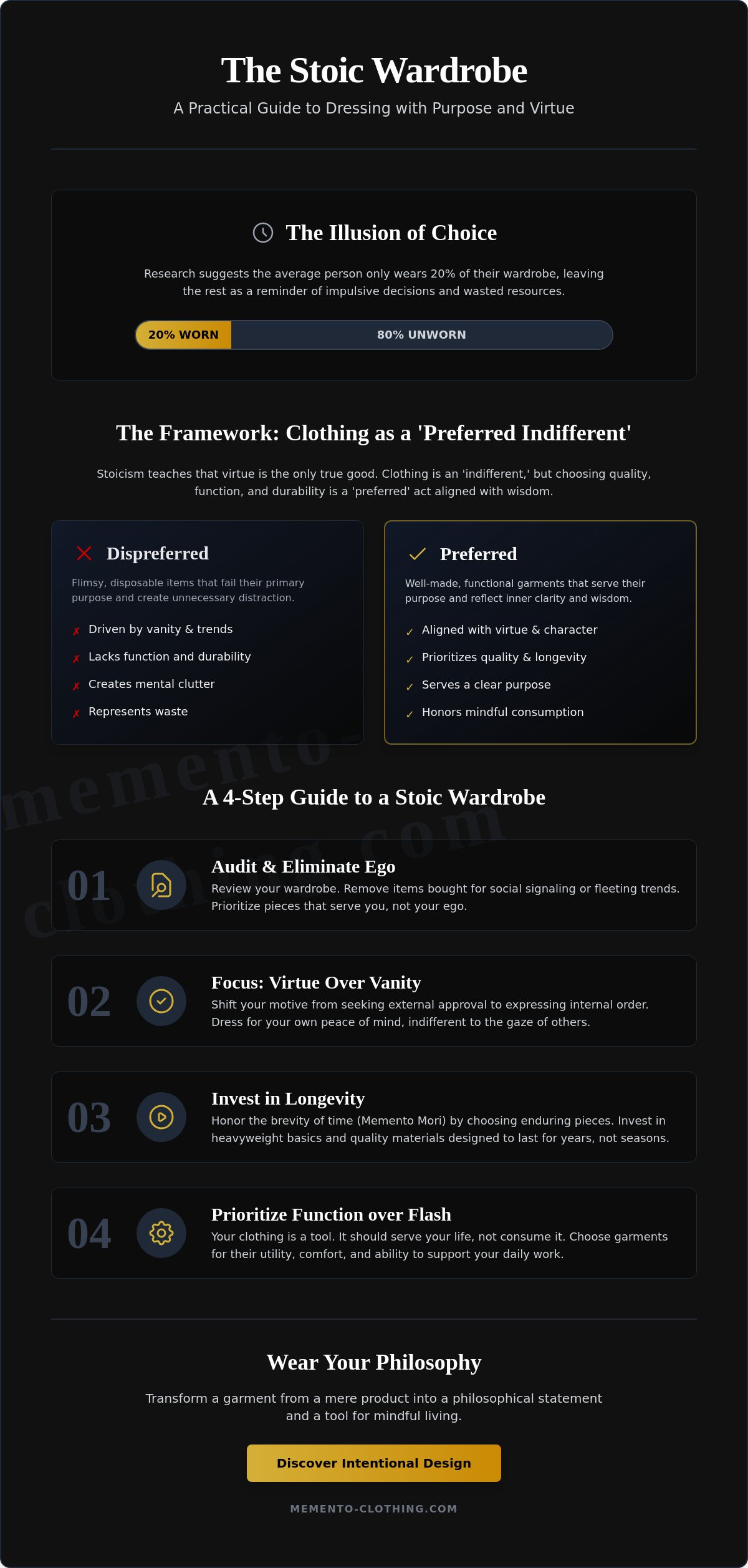
Building a Stoic Wardrobe: A Practical 2026 Guide
Building a wardrobe through the lens of stoic philosophy on clothing isn't about deprivation. It's about clarity. Most closets are graveyards of impulsive desires. By 2026, the average consumer buys 60% more clothing than in 2000, yet keeps garments for half as long. A Stoic breaks this cycle by treating clothing as a tool for virtue rather than a billboard for status.
- Step 1: Audit for ego. Empty your closet. Identify pieces bought solely to impress others or to satisfy a fleeting dopamine hit. If a garment's value depends on someone else's gaze, it's a burden.
- Step 2: Prioritize heavyweight basics. Seek items that promise longevity. A high-quality garment should withstand years of wear, mirroring the Stoic ideal of endurance.
- Step 3: Adopt a neutral palette. Stick to black, charcoal, olive, or navy. This eliminates the chaos of matching and preserves your mental energy for meaningful work.
- Step 4: Narrative over logos. Choose pieces with a story of craftsmanship. A logo is a loud claim; quality construction is a quiet truth.
- Step 5: Practice voluntary discomfort. Don't upgrade your style just because a new trend arrives. Wear your well-loved pieces until they truly reach the end of their life cycle.
The Minimalism of Decision Fatigue
Every choice we make consumes a finite amount of mental energy. Marcus Aurelius wrote his Meditations to find internal order amidst external chaos. He would've appreciated the logic of a reliable hoodie. By adopting a "uniform" approach, you silence the morning noise. You don't wonder what to wear; you simply dress. This intentionality allows stoic philosophy on clothing to manifest as a practical mental hack. You trade the vanity of variety for the peace of consistency.
Evaluating Fabric and Construction
Quality is a form of respect for the materials and the wearer. When selecting a Stoic garment, look at the GSM (grams per square meter). A standard t-shirt might hover around 150 GSM, but a Stoic investment looks for 300 to 500 GSM. This weight offers a tactile reminder of the present moment.
High-density stitching and reinforced seams aren't just technical details; they're promises of permanence. For instance, Memento Crewnecks represent this intentional end of the spectrum. They use heavyweight cotton that develops character over time. Investing in these pieces provides a long-term ROI that fast fashion cannot match. You aren't just buying fabric. You're securing a reliable companion for your daily life.
Begin your journey toward a more disciplined and meaningful style. Explore our collection of intentional essentials designed for the modern Stoic.
Wear Your Philosophy: The Intentionality of Memento Mori Clothing
Memento Mori Clothing isn't just another label in a crowded marketplace. It's a philosophical statement. It rejects the loud, frantic noise of modern consumerism to embrace the stoic philosophy on clothing by focusing on essential truths. The 2026 collection is built on a foundation of "Intentional Design." This philosophy dictates that every seam and fabric choice serves a specific purpose. It isn't about following a fleeting trend. It's about creating pieces that last longer than the seasons of fast fashion. When you wear these clothes, you're choosing a quiet, melancholic elegance over hollow vanity. The design process follows three core pillars:
- Durability over novelty: Fabrics are chosen for their ability to withstand the passage of time.
- Utility over ornamentation: Every detail serves the wearer's daily needs without unnecessary distraction.
- Timelessness over trends: The aesthetic remains relevant regardless of the current fashion cycle.
The Memento Mori Heavyweight Hoodie stands as the pinnacle of this Stoic-inspired apparel. It's designed for those who seek substance in a world of shadows. The heavy fabric provides a grounding weight that serves as a tactile reminder of the present moment. In Stoicism, the mind is a citadel, and the body is its vessel. We don't dress to impress the crowd; we dress to prepare for the day's challenges. This hoodie is more than cotton and thread. It's armor for the soul's daily battle for virtue, protecting the wearer from external chaos while keeping the focus inward.
From Ohio Roots to National Philosophy
The brand's journey began with deep roots in Ohio. This origin isn't just a point on a map. It's a foundation of craftsmanship. Ohio's history of industry and resilience is woven into every garment. Even as the brand reaches a national audience, it maintains a local focus on quality and community. Supporting a brand that prioritizes the "why" behind the "what" is a conscious choice. It means rejecting the 80% of the fashion industry that relies on planned obsolescence. Every purchase is a commitment to a more intentional life. It's an investment in a legacy that respects the passage of time and the value of hard work.
Final Call to Action
Stoicism teaches us that external things don't define our character. However, the objects we surround ourselves with can influence our focus. The right clothes don't make the person, but they can remind the person who they want to be. They act as a physical anchor in a world that tries to pull you in a thousand directions. Explore the collection as a starting point for your own Stoic journey. Let your style be a reflection of your pursuit of wisdom and temperance. Take the first step toward a more virtuous wardrobe by viewing the Memento Mori Heavyweight Hoodie and the rest of the 2026 collection today. Your clothing should be as enduring as your principles.
Dress for Permanence in a Fleeting World
Your wardrobe shouldn't be a collection of fleeting trends. It's a statement of character. By embracing a stoic philosophy on clothing, you transform daily dressing into a ritual of intentionality. You prioritize virtue over vanity. You recognize that while garments are preferred indifferents, their quality reflects your respect for the present moment. Choosing pieces that endure isn't just a practical decision; it's a philosophical one.
The 2026 approach to style demands more than mere aesthetics. It requires substance. Every thread should tell a story of longevity. Our collection honors this through heavyweight 13.5oz fabrics designed to outlast the season. These aren't just clothes. They're anchors for your personal history. We offer philosophically driven designs that serve as quiet reminders of what truly matters. With national shipping across the US, your journey toward a virtuous style starts today. Wear your values. Let every garment be a memento of a life lived with purpose.
Build your intentional wardrobe with Memento Mori Clothing
Frequently Asked Questions
Does Stoicism mean I shouldn't care about fashion at all?
Stoicism doesn't demand you ignore your appearance; it asks you to detach your internal worth from it. Marcus Aurelius noted in his Meditations, written around 170 AD, that we should avoid ostentation while maintaining simple decency. Fashion becomes a tool for virtue when it serves a practical purpose rather than seeking external validation. Your wardrobe should reflect your internal order and respect for the present moment.
What did the ancient Stoics actually wear?
Most ancient Stoics wore a simple wool tunic and a rough, undyed cloak known as a tribon. Musonius Rufus, a prominent teacher in the 1st century AD, argued that clothing should protect the body without being decorative or distracting. They chose functional garments that didn't require excessive care. This minimalist approach reduced decision fatigue and allowed them to focus their energy on character and logic.
Is it 'Stoic' to buy expensive, high-quality clothes?
Investing in high-quality items aligns with Stoic principles of temperance and long-term sustainability. Seneca suggested that we should live according to nature; choosing one garment that lasts 10 years is more virtuous than buying 50 fast-fashion items annually. Stoic philosophy on clothing prioritizes the utility and longevity of a piece over the brand name. Quality is a form of respect for the resources used.
How does Memento Mori relate to my daily wardrobe choices?
Memento Mori serves as a filter to strip away the superficiality of modern, fleeting trends. When you acknowledge your mortality, the 52 micro-seasons of the fast-fashion industry lose their power over your desires. You choose garments that act as anchors to the reality of your existence. This awareness transforms getting dressed into a daily ritual of intentionality and quiet, philosophical reflection.
Can clothing help me practice Stoicism in 2026?
Clothing acts as a physical mnemonic for your values in an increasingly digital and distracted world. By 2026, the average person will be exposed to over 10,000 advertisements daily; wearing a curated, intentional uniform creates a barrier against this noise. It's a silent declaration of your autonomy. Every time you feel the weight of your garment, you're reminded to focus only on what you can control.
What is the most 'Stoic' color to wear?
There isn't one specific color, but muted, natural tones like charcoal, olive, and navy best reflect Stoic modesty. Epictetus often spoke against bright dyes that required excessive labor and wealth to produce. Natural hues don't demand the gaze of others or seek unearned attention. They allow the wearer to blend into the background of a busy city while maintaining a sharp, disciplined presence.
How do I deal with people judging my simple style?
Stoicism teaches that other people's opinions are "indifferents" that shouldn't disturb your inner peace. If someone critiques your minimalist aesthetic, remember that their perception belongs to them, not to you. Marcus Aurelius practiced this daily by reminding himself that he'd meet meddling and ungrateful people. Your style is a personal commitment to truth and simplicity, not a performance for the crowd.
Why is heavyweight fabric considered better in Stoic philosophy?
Heavyweight fabrics like 400 GSM cotton represent the Stoic virtue of endurance and physical permanence. These materials resist the planned obsolescence that defines 90% of the modern textile industry. Choosing substantial fabrics is a rejection of throwaway culture and an embrace of things that age with grace. Stoic philosophy on clothing suggests that a heavy garment offers a sense of grounding in a fleeting world.