
Slow Fashion Men's Clothing: A Guide to Intentional Style in 2026
What if the most radical thing you could wear is a garment that refuses to change as quickly as the world around it? In a landscape of fleeting aesthetics, slow fashion men's clothing offers a quiet rebellion against the disposable. You've likely felt the frustration of a favorite shirt losing its shape after three washes or the weight of guilt that comes with the industry's massive carbon footprint. It's exhausting to chase trends designed to die. We believe clothes shouldn't just be fabric; they should be anchors for your personal history.
You deserve a wardrobe built on permanence rather than the frantic pace of the modern market. This guide will show you how to transition to a meaningful collection of heavyweight staples, such as our Memento Mori Heavyweight Hoodie, that respect both the wearer and the planet. We'll explore the technical markers of durability and how 2026's new EU regulations against greenwashing are finally holding the industry accountable. From understanding the Materials Matter Standard to curating high-density essentials, you're about to discover how to dress with intention and soul.
Key Takeaways
- Learn to identify the difference between disposable fast fashion and the intentional "design-endure-remember" model of slow fashion men's clothing.
- Master the technical markers of durability, specifically how high-density GSM fabric ensures your hoodies and tees maintain their silhouette for years.
- Understand the long-term economic value of investing in heavyweight quality over the hidden costs of cheap, recurring replacements.
- Discover the blueprint for a 15-piece capsule wardrobe that prioritizes versatility and timelessness over fleeting seasonal trends.
- Explore how the Memento Mori philosophy transforms a simple garment into a meaningful tool for self-expression and intentional living.
What is Slow Fashion Men's Clothing? Beyond the Labels
Slow fashion men's clothing is not a seasonal aesthetic. It's a quiet refusal to participate in the cycle of obsolescence. For years, the industry thrived on a "take-make-waste" model, where garments were designed to fail and trends were engineered to expire. Today, that model is crumbling. We embrace a "design-endure-remember" philosophy instead. This approach views every garment as a long-term companion rather than a temporary convenience.
2026 marks a definitive shift in how we dress. With the EU ban on destroying unsold goods and strict anti-greenwashing rules in full effect, the era of disposable apparel is ending. This is the year of "intentional essentials." Men are no longer looking for more; they are looking for better. Slow fashion provides the framework for this transition. It's an intentional approach to manufacturing that prioritizes the lifecycle of the product over the speed of the sale.
The math of intentional style is found in cost-per-wear. It's both a financial and ethical metric. A cheap, flimsy shirt might cost little upfront, but it fails after a few washes. A high-quality piece, like a Memento Mori Vintage Tee, represents a higher initial investment but offers years of service. When a garment lasts, its cost-per-wear drops to pennies, and its environmental footprint shrinks alongside it.
The Three Pillars of Intentional Apparel
Quality begins with the physical. Fiber origin and density are the true indicators of value. A brand name is a whisper, but fabric weight is a statement. High-density cotton ensures a garment keeps its structure. Ethical production is equally vital. We focus on US-based manufacturing where fair wages and safe conditions aren't just goals; they are standards. Finally, timeless design protects you from aesthetic obsolescence. We avoid micro-trends that look dated within months, focusing instead on silhouettes that remain relevant for a lifetime.
Philosophy as a Fabric: Why Your Clothes Should Tell a Story
Every item you own should have a reason to exist. We connect the Memento Mori philosophy to the items we create. "Remember you must die" is not a morbid thought. It's a reminder to value the present and the objects that ground us in it. A garment becomes a memento of a specific life stage or a significant moment. Owning fewer, better things provides a psychological benefit. It reduces decision fatigue and creates a sense of clarity. When your wardrobe is built on permanence, you aren't just wearing clothes. You're wearing your values.
The Anatomy of Quality: Why Heavyweight Cotton Matters
Quality is a tactile truth. It's the weight you feel when you lift a garment from its hanger. In the context of slow fashion men's clothing, this weight is the primary indicator of a piece intended to last. While mass-market retailers prioritize thin, cost-effective fabrics that lose their integrity after a few laundry cycles, intentional design starts with density. A garment with substance doesn't just feel better; it behaves differently over time. It resists the urge to shrink, twist, or thin, remaining a constant in an ever-changing world.
Understanding GSM: The Technical Side of Durability
To understand fabric density, we look at GSM, or Grams per Square Meter. This metric defines the weight of the fabric and serves as a roadmap for longevity.
- Lightweight (Under 150 GSM): Often found in mass-produced undershirts; prone to transparency and pilling.
- Midweight (150-250 GSM): The standard for most quality retail apparel.
- Heavyweight (300+ GSM): The gold standard for durability and structure.
The aesthetic benefit of high-density cotton is found in the drape. Heavyweight fabric doesn't cling to the body. Instead, it creates a clean, structured silhouette that complements the male frame. It offers a sense of armor. Using 100% cotton instead of synthetic blends ensures breathability and a natural aging process. Synthetics trap heat and break down into microplastics. Pure cotton softens with age, absorbing the history of the wearer without sacrificing its structural core. It's an honest material for an honest wardrobe.
The Vintage Feel: Why 'Old School' Construction is the Future
In 2026, we're seeing a profound resurgence of vintage-inspired textures. This isn't about nostalgia for an era, but a craving for the permanence that defined heritage workwear. Heavyweight construction mimics the pieces our grandfathers wore, items that were mended rather than discarded. Our Memento Mori Vintage Tee exemplifies this return to substance. It captures the rugged, lived-in feel of a legacy piece from the first wear. Choosing these materials is a rejection of the flimsy and the fleeting. If you seek a garment that carries weight both literally and philosophically, consider starting with a Memento Mori Heavyweight Hoodie to experience the difference of intentional density.
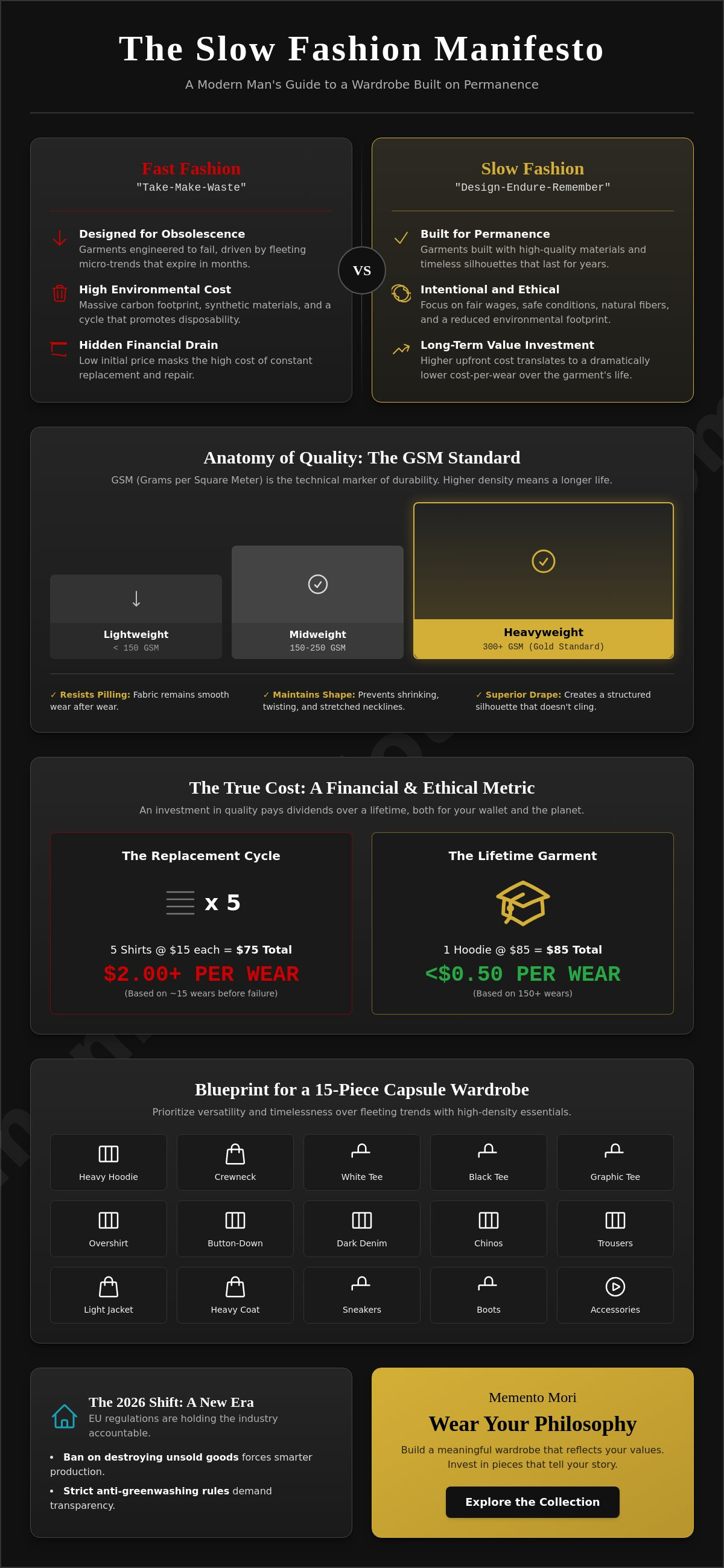
Fast Fashion vs. Slow Fashion: A Comparison for the Modern Man
The ephemeral choice is often the loudest. Fast fashion relies on your amnesia, hoping you'll forget the shirt that shrank last month in favor of the one on the screen today. It's a cycle of planned obsolescence. Slow fashion men's clothing asks for your memory instead. It's a framework built on intentional investments rather than disposable distractions. When you choose a garment, you aren't just buying fabric. You're choosing which shadow you'll leave behind.
Price is the most common barrier, yet it's often a mathematical illusion. You might pay $30 for a hoodie every six months as it pills and thins. Or, you could invest in a piece designed for permanence. A $100 investment that lasts five years is objectively cheaper than a recurring $30 expense that ends in a landfill. Quality isn't a luxury. It's a strategy for the patient man. It's the difference between owning a collection and merely managing a pile of waste.
The emotional fatigue of the constant search is real. There's a quiet exhaustion in chasing micro-trends that expire before the shipping label is printed. Fast fashion creates a hunger that it can never satisfy. By contrast, slow fashion offers a sense of arrival. You stop looking because you've already found the standard. You own the anchor. Your wardrobe becomes a source of calm rather than a list of chores.
The True Cost of a $10 T-Shirt
A $10 price tag hides a heavy burden. It represents environmental degradation and low-quality fibers that fail the first time they see a washing machine. Most of these garments are part of the industry responsible for 10% of global carbon emissions. We choose a different path. By using high-quality US cotton and domestic production, we ensure every stitch supports a community. Choosing Urbana Hillclimbers Apparel isn't just a style choice. It's an investment in local heritage and durable craftsmanship that refuses to exploit the world for a temporary look.
Longevity Comparison Table
| Feature | Fast Fashion Staple | Slow Fashion Essential |
|---|---|---|
| Average Lifespan | 3 to 6 months | 5 to 10+ years |
| After 50 Washes | Thin, faded, lost shape | Softened, structural integrity intact |
| Environmental Impact | High waste, synthetic microplastics | Low waste, natural biodegradable fibers |
| Value Over Time | Disposable waste | A memento with resale potential |
Transparency is the new standard for 2026. With 67% of consumers now willing to pay more for sustainable products, the market is finally rewarding the durable. Your clothes should be as honest as the life you lead. Don't settle for the temporary. Build a foundation that stays.
How to Build a Slow Fashion Capsule Wardrobe in 2026
Curation is an act of discipline. It's the deliberate choice to own less so that you can experience more. A capsule wardrobe is the practical manifestation of this philosophy. By limiting your collection to 10-15 versatile, high-quality pieces, you remove the noise of the temporary. This foundational shift toward slow fashion men's clothing isn't about restriction. It's about the freedom that comes from knowing every item in your closet serves a purpose and carries a story.
The architecture of a capsule wardrobe relies on a cohesive color palette. Focus on neutrals, earth tones, and muted aesthetics that allow for effortless layering. When your clothes speak the same visual language, the utility of every garment increases. A single heavyweight tee becomes a base layer in winter and a standalone statement in summer. You aren't just buying clothes; you're building a modular system of self-expression that survives the shifting winds of 2026.
Essential Pieces for the Intentional Man
Every archive needs its anchors. Start with the foundation: the heavyweight tee and the perfect hoodie. These are the items that see the most frequent use and require the highest structural integrity. The Memento Mori Heavyweight Hoodie serves as a year-round staple, offering a density that provides both physical warmth and psychological comfort. For a more refined, understated silhouette, Memento Crewnecks bridge the gap between casual comfort and intentional elegance. Complete the minimalist aesthetic with high-quality Memento Hats. These pieces don't compete for attention. They work in silence to create a unified, timeless look.
Maintenance: Caring for Your Investment
A garment's life is extended through respect. Slow fashion items don't need the aggressive cleaning cycles required by cheap, synthetic blends. Wash your clothes less frequently to preserve the natural fibers. When cleaning is necessary, use cold water and avoid the high heat of a dryer. Air drying is a meditative practice that prevents the breakdown of the cotton's core. To maintain the shape of your heavyweight garments, fold them instead of using wire hangers that can stretch the shoulders over time. Proper storage is the final step in ensuring your wardrobe remains a memento of quality for decades.
Your wardrobe should be a curated archive of your intentions, not a graveyard of impulse purchases. Begin your curation with our collection of intentional essentials and experience the permanence of slow fashion.
Memento Mori Clothing: Wearing the Philosophy of Time
Time is a silent architect. It shapes our experiences, our memories, and eventually, our legacy. At the heart of our brand lies the Memento Mori story, an ancient wisdom recontextualized for the modern man. This philosophy doesn't dwell on the end. It celebrates the substance of the now. When we say "remember you must die," we're really asking you to remember to live. This realization changes how you interact with the world, including the very fabric you choose to place against your skin.
Dressing with intention is a quiet form of mindfulness. In the rush of 2026, where digital noise and fleeting trends compete for your attention, slow fashion men's clothing offers a point of stillness. It's a commitment to items that don't just occupy space in a closet but hold weight in a life. We believe that a garment should be a companion. It should witness your days, weather your seasons, and remain steadfast as the years pass. This is why we refuse the hollow shortcuts of mass production.
Our commitment to US-made quality is a reflection of this value system. We choose heavyweight construction because durability is the physical manifestation of respect. By producing locally, we maintain a transparent chain of custody that honors the craft and the person behind the machine. Every Memento Mori Heavyweight Hoodie or Vintage Tee is an argument for permanence. It's a rejection of the ephemeral in favor of the eternal.
Beyond Apparel: A Lifestyle Choice
Choosing intentional clothing ripples into other areas of existence. It encourages a slower pace of consumption and a deeper appreciation for the tactile. Our garments are designed to be emotional anchors. They are the pieces you reach for when you need to feel grounded. By supporting local spirit wear, such as Urbana Hillclimbers or Marysville Monarchs gear, you also invest in the collective memory of your community. It's apparel that bridges the gap between personal history and national pride.
Join the Movement Toward Intentionality
The journey away from disposable culture doesn't require a total upheaval. It begins with a single, considered choice. Start your slow fashion journey with a piece that speaks to your standard of quality. As a leader in this space, Memento Mori Clothing Ohio represents a national brand that hasn't forgotten its roots or its reasons. We invite you to join a community that values depth over speed and soul over status. Browse our collection today and choose an essential that's built to last a lifetime. Your future self will thank you for the memento.
The Future of Your Archive
The transition from disposable trends to a permanent wardrobe is a journey toward clarity. You've seen how technical markers like 300+ GSM heavyweight cotton and US-made construction define the true lifespan of a garment. Choosing slow fashion men's clothing isn't just about the planet; it's about the permanence of your personal narrative. It's the decision to own pieces that don't just occupy space, but hold meaning. Since 2020, we've focused on creating these emotional anchors, merging ancient wisdom with modern durability. Every stitch is a refusal to be forgotten.
Your clothes should be as enduring as the memories you create while wearing them. By prioritizing substance over speed, you're building a collection that resists the noise of the temporary. It's time to invest in items that soften with age and carry the weight of your history. We invite you to Shop the Memento Mori Collection: Intentional Style Built to Last and discover the difference of philosophically driven design. Dress for the person you intend to become. Build a legacy that stays, one intentional piece at a time.
Frequently Asked Questions
What exactly is slow fashion and why is it important for men?
Slow fashion is a mindful approach to style that prioritizes quality, ethical production, and timeless design over the frantic pace of trend cycles. For men, this shift is vital because it replaces a cluttered closet of failing garments with a curated archive of reliable staples. It's a choice to value the permanence of your personal narrative over the hollow promises of disposable retail culture.
Is slow fashion really more sustainable than fast fashion?
Yes, slow fashion is fundamentally more sustainable because it addresses the root cause of industry waste: overproduction. By creating garments intended to last for a decade, we drastically reduce the volume of apparel ending up in landfills. It favors natural fibers that don't shed microplastics, ensuring your footprint on the world is as intentional as your style.
Why is heavyweight cotton considered better for slow fashion?
Heavyweight cotton is the physical foundation of durability. Fabrics with a density of 300+ GSM provide the structural integrity needed to survive hundreds of laundry cycles without losing their silhouette. This weight ensures that slow fashion men's clothing maintains its drape and opaque quality, offering a sense of physical and psychological comfort that flimsy alternatives can't match.
How can I tell if a brand is truly 'slow fashion' or just greenwashing?
Authentic brands lead with transparency and technical data rather than vague environmental buzzwords. Look for specific details like manufacturing locations, fabric weight, and fiber origin. By late 2026, new regulations make it easier to verify these claims, but the truest sign is a brand's focus on timeless essentials rather than a constant stream of new, seasonal collections.
Does slow fashion mean I have to wear boring, plain clothes?
Minimalism isn't synonymous with boredom; it's an invitation to appreciate depth. Intentional style focuses on the texture, the wash, and the philosophy behind the design. Pieces like our Memento Mori Vintage Tee use classic aesthetics to create a look that feels grounded and unique. You aren't wearing a trend. You're wearing a statement of character that remains relevant as years pass.
How do I care for my heavyweight garments to make them last longer?
Respect the fibers by washing your clothes only when necessary and always using cold water. High heat from a dryer is the primary cause of fabric degradation, so air drying is the best way to preserve the cotton's core. Fold your heavyweight hoodies and tees instead of hanging them. This simple act prevents the weight of the fabric from stretching the shoulders and neck over time.
Why are slow fashion clothes more expensive?
The price reflects the honest cost of US-based labor, premium materials, and small-batch production. You're investing in a living wage for the maker and the longevity of high-density US cotton. While the upfront cost is higher, the long-term value is superior. A single intentional piece replaces several cheap items that would have failed within months, lowering your total cost over time.
Can I find slow fashion items for my children?
Yes, we offer Youth Graphic T-Shirts built with the same commitment to durability as our adult line. Children's apparel often faces the most rigorous wear, making the strength of heavyweight cotton a practical choice. Starting them with slow fashion is a way to pass down the values of quality and mindfulness, ensuring their first mementos are built to endure.