
Shaka Wear Max Heavy vs. a Ring-Spun Vintage Graphic Tee: How to Choose
The heavier tee isn’t automatically the rougher one, and “ring-spun” doesn’t mean lightweight. That’s the distinction behind the shaka wear max heavy vs ring spun vintage graphic tee question: one label points to fabric weight, while the other describes how the cotton yarn is made.
It’s easy to compare them as rival styles when product listings often leave out the details that shape how a shirt feels and falls. The Shaka Wear Max Heavy is a 7.5-ounce heavyweight tee; ring-spun, by contrast, describes yarn construction, not a set fabric weight. A shirt can be both heavyweight and ring-spun, and “vintage graphic” alone doesn’t confirm its fabric or printing method.
This guide separates those details so you can weigh structure against softness, consider how the graphic affects the look, and know which specifications to verify before choosing. You’ll come away with a clearer way to compare comfort, drape, and likely wear characteristics, without relying on vague labels. We’ll also introduce the Memento Mori Vintage Tee as a brand-specific option, while keeping its unverified specifications distinct from what the name suggests.
Key Takeaways
- In the shaka wear max heavy vs ring spun vintage graphic tee comparison, separate fabric weight from yarn construction before deciding which profile suits you.
- Use weight as one clue to a tee’s structure and drape, not as a guarantee of comfort or quality.
- Compare verified listing details side by side, and treat missing information about fit, finish, or graphics as unknown rather than assuming.
- Before choosing, consider when you’ll wear the tee, the climate, how you’ll layer it, and the drape you prefer.
- Explore the Memento Mori Vintage Tee as a brand-specific graphic option, then check its current product details to see whether it fits your preferences.
Shaka Wear Max Heavy vs. ring-spun vintage graphic tee: what is actually being compared?
The names point to different things. Heavyweight describes how much the fabric weighs; ring-spun describes how the cotton yarn is made. A “vintage graphic tee” usually signals a visual style or finish, not a standardized fabric recipe. These qualities can overlap: a tee can be heavyweight, ring-spun, and vintage-styled at the same time.
That distinction makes the shaka wear max heavy vs ring spun vintage graphic tee comparison easier to read. One side names a specific third-party garment; the other describes a broad category that could include tees with very different weights, fits, and graphics. For context on the garment’s wider history and materials, see this overview of the history of the T-shirt.
What does Shaka Wear Max Heavy mean?
Shaka Wear Max Heavy is a third-party T-shirt, not a Memento Mori Clothing product. The verified product information identifies it as a 7.5-ounce tee made from 100% USA cotton, with polyester blends used for heather colors. That weight indicates a substantial fabric, but it doesn’t by itself establish how a particular wearer will find the shirt comfortable.
Keep specifications separate from impressions. A seller’s description may summarize the garment, while buyer comments may describe personal experiences with feel or fit. Treat those impressions as useful context, not a substitute for the manufacturer’s stated details. Check the listing for the specific color and version you’re considering; don’t assume every specification applies across variations.
What does ring-spun mean in a vintage graphic tee?
Ring spinning twists and draws cotton fibers into yarn. Compared with open-end yarn, ring-spun yarn is finer and is described as softer and stronger. Those qualities relate to the yarn, though, not to a fixed finished-shirt weight or a guaranteed feel on every garment.
Ring-spun alone doesn’t tell you the tee’s fabric weight, fit, surface finish, or graphic method. “Vintage” may refer to a faded-looking print, a garment treatment, or simply the design’s styling. Check the product details for each one. A graphic can suggest a memory or era, but its appearance doesn’t prove that the shirt has been washed, distressed, or made with a particular construction.
Read the labels as separate clues: weight helps describe the fabric’s substance, yarn construction describes how its fibers were formed, and vintage styling describes the intended look. The product details fill in the rest.
How fabric weight and ring-spun yarn shape a tee’s feel and drape
Weight describes the amount of fabric; yarn construction describes how its fibers become yarn. They answer different questions, so neither label alone predicts how a finished tee will feel on your body. In the shaka wear max heavy vs ring spun vintage graphic tee comparison, treat these as separate clues, then look at the garment’s full specifications.
What fabric weight can tell you, and what it cannot
Listings may state fabric weight in ounces per square yard, written as oz/yd², or grams per square meter, abbreviated GSM. Check the unit before comparing numbers. A value in ounces isn’t directly comparable to a GSM figure unless you convert it, and listings may not always explain how the measurement was determined.
Within a clear, consistent unit, greater fabric weight can suggest a more substantial material. That may translate to a shirt that feels less fluid or holds its shape differently, but weight is only one part of the experience. Cut, fiber content, and finishing also affect drape and perceived heft. A heavier tee may feel reassuring to one person and too warm or rigid to another. The number isn’t a comfort rating, nor proof of quality.
How yarn construction and graphic treatment affect the result
Ring-spun cotton is made by twisting and drawing cotton fibers into yarn. The resulting yarn is finer than open-end yarn and is often described as softer and stronger, but those are general tendencies, not guarantees about a specific finished tee. The fabric’s weight, blend, knit, and finishing all matter. Look for product-specific evidence rather than assuming “ring-spun” means a particular hand feel or lifespan.
The graphic adds another layer. Its printing method, placement, and finish can change the way the design reads, whether crisp and bold or deliberately aged. But “vintage” in a product title doesn’t confirm a washed garment, a distressed print, or a specific treatment. Check the listing or manufacturer details for those claims. If they aren’t stated, regard them as unknown.
A practical comparison starts with the information you can verify: weight and units, fiber content, garment measurements, and documented finish. Then consider the less measurable question: do you want a tee with more substance, a particular yarn construction, or a graphic that carries a specific mood? If personal meaning matters alongside material details, take a look at the Memento Mori Vintage Tee and review its current product information before deciding.
Side-by-side comparison: Shaka Wear Max Heavy or a ring-spun vintage graphic tee?
The key difference in the shaka wear max heavy vs ring spun vintage graphic tee comparison is that one option is a named garment and the other is a broad category. The Shaka Wear Max Heavy has a listed fabric weight and fiber content. A ring-spun vintage graphic tee could vary widely by brand and product. Its label alone doesn’t fill in the missing specifications.
| Attribute | Shaka Wear Max Heavy | Ring-spun vintage graphic tee |
|---|---|---|
| Weight | 7.5 oz, according to the supplied product information | Unknown; depends on the specific tee |
| Fiber content | 100% USA cotton; heather colors use polyester blends | Unknown; check the individual listing |
| Construction | Exact yarn construction not established here | Ring-spun describes the yarn construction, but the full garment details vary |
| Fit | Unknown; check measurements and fit notes | Unknown; check measurements and fit notes |
| Finish | Unknown | “Vintage” doesn’t confirm a particular wash or finish |
| Graphic | Unknown; graphic details depend on the specific listing | Graphic style and printing details vary by product |
Which tee may suit a preference for substantial structure?
The Max Heavy’s listed 7.5-ounce weight gives you a concrete starting point if you’re drawn to a more substantial fabric. But weight alone can’t tell you exactly how the shirt will drape or feel. Look for garment measurements and fit notes, too. A tee’s cut and proportions matter, especially if you plan to wear it loose or layer it.
Which tee may suit a preference for a vintage-inspired graphic?
Choose by the design and its documented details, not the word “vintage” alone. Review the graphic’s placement, appearance, and any stated printing or garment treatment. A vintage-inspired image may have a worn look without the shirt itself being washed or distressed. And the style doesn’t reveal whether the fabric is heavyweight or ring-spun.
There’s no universal winner. Compare confirmed specifications with your priorities: fabric substance, fit, and the visual character of the graphic. If a detail isn’t listed, treat it as unknown and seek product-specific information before relying on it.
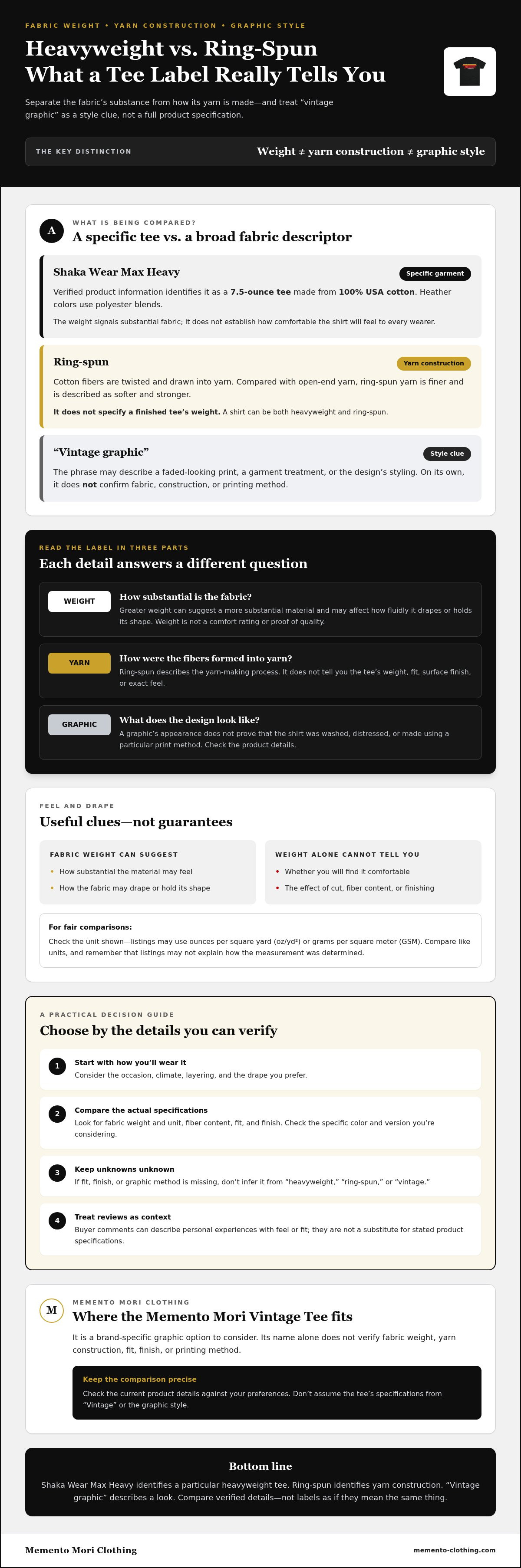
A practical checklist for choosing between heavyweight and ring-spun graphic tees
A product page is most useful when its details help you imagine the shirt in your actual routine. Use this checklist to move past labels and compare what’s documented, what you prefer, and what still needs clarification.
- Start with intended use, climate, layering, and preferred drape. Think about where you’ll wear the tee, the conditions you expect, what you’ll wear over it, and whether you prefer a closer or more relaxed silhouette.
- Confirm fiber content. Check whether the garment is cotton or a blend, and make sure the information applies to the specific color you’re considering.
- Read the fabric weight carefully. Look for the number and its units, such as oz/yd² or GSM. Confirm that it refers to the garment’s fabric, not a general category or another item in the listing.
- Compare garment measurements. Use the listed size chart, including length and width where available, rather than relying on a size label alone.
- Inspect the graphic details. Note its placement and appearance, and look for documented printing or finishing information instead of inferring a process from a vintage look.
- Check fit notes and care instructions. These can help you understand how the seller describes the cut and how the specific tee should be cared for.
How to read a graphic tee product listing
Give priority to specific material descriptions and measurements over unqualified words such as “premium,” “heavy,” or “vintage.” If the listing gives a weight, check its units and what garment it describes. When details conflict across a product page and its size chart, or key information is missing, ask for clarification rather than treating an assumption as a specification.
How to match the tee to your wardrobe and routine
Think about how often you’ll wear the shirt and how it needs to work with the rest of your wardrobe. Compare its size chart with a tee you already like, measuring that garment the same way if possible. Follow the care label for the item you choose. Don’t assume every cotton tee responds alike to washing or drying.
Quick rule: Compare intended use, fiber, weight and units, measurements, fit, graphic details, and care instructions. If a detail matters to your choice but isn’t documented, verify it before deciding. For a graphic tee with a considered, reflective design perspective, explore the Memento Mori Vintage Tee and review its current product details.
Choosing a meaningful graphic tee: where the Memento Mori Vintage Tee fits
Fabric specifications help answer practical questions. A graphic can carry a different kind of weight: a symbol, phrase, or image may reflect what you value and what you want to remember. Memento Mori Clothing offers the Memento Mori Vintage Tee as a brand-specific option for readers drawn to intentional design and reflective meaning.
It isn’t a direct specification match for the Shaka Wear Max Heavy or for ring-spun tees as a category. Its name alone doesn’t confirm its fabric, weight, fit, yarn construction, or graphic method. The shaka wear max heavy vs ring spun vintage graphic tee comparison is most useful as a framework: use verified garment details for comfort and fit, then decide whether the graphic feels personally resonant.
What to verify before choosing the Memento Mori Vintage Tee
Before deciding, check the current product page for fiber content, fabric weight and units, fit notes, garment measurements, graphic method, care instructions, and availability. If a detail isn’t listed, don’t infer it from the word “vintage.” The Memento Mori Vintage Tee buyer’s guide offers another place to consider the tee’s intentional-style perspective. Use confirmed product information, rather than the name or mood of the design, to judge how it may feel and wear.
Choose the garment that reflects how you want to wear the image
If a substantial feel is your priority, focus on a documented weight and measurements. If yarn construction matters, look for it to be stated explicitly. If the graphic is what draws you in, consider its imagery and placement, while checking any claims about printing or garment treatment. These are distinct considerations, not a contest in which one brand or fabric label must be better for everyone.
Clothing can become part of a personal record: worn through ordinary days, attached to places and moments, and remembered for more than its material. Memento Mori Clothing, founded in 2020, brings an intentional and reflective perspective to its apparel. Let the verified details guide the practical choice, and let the design speak to your own sense of meaning. If that approach feels right, take a quiet look through Memento Mori apparel.
Choose the tee that fits your day and your point of view
The key to the shaka wear max heavy vs ring spun vintage graphic tee decision is knowing what each label tells you. Fabric weight and yarn construction describe different qualities, while “vintage” may speak to the graphic’s look rather than the garment’s build. Compare confirmed details such as measurements, fiber content, care instructions, and documented print treatment before deciding how a tee may suit your wardrobe.
Then consider what you want the graphic to carry. Memento Mori Clothing offers the Memento Mori Vintage Tee, shaped by an intentional approach to design and meaningful expression. Its product details can help you assess whether it aligns with your preferences, without assuming specifications that aren’t listed.
Explore the Memento Mori Vintage Tee and choose with care. The right garment can be more than something you wear; it can hold a thought, a feeling, or a moment worth carrying forward.
Frequently Asked Questions
Is Shaka Wear Max Heavy made from ring-spun cotton?
The product information available here doesn’t confirm that the Shaka Wear Max Heavy is ring-spun. It identifies the tee as 7.5 oz and 100% USA cotton, with polyester blends for heather colors, but fiber content and yarn construction are separate specifications. Check the current manufacturer details for the exact version and color you’re considering. Don’t infer ring-spun construction from the heavyweight label or from the cotton content alone.
What is the difference between heavyweight and ring-spun cotton?
Heavyweight describes fabric weight, while ring-spun describes how cotton fibers are twisted and drawn into yarn. One points to the fabric’s mass; the other to its yarn-making process. That distinction is central to the shaka wear max heavy vs ring spun vintage graphic tee comparison. Neither term alone tells you a shirt’s fit, finish, or overall comfort. Check a product’s listed weight, fiber content, measurements, and construction separately.
Is a heavyweight graphic tee more durable?
Not automatically. Heavier fabric may feel more substantial, but weight alone doesn’t prove a tee will last longer. Fiber content, yarn, stitching, garment finishing, print quality, and care can all affect how it wears over time. For a better assessment, look for product-specific construction details and follow the care label. Treat “heavyweight” as a material clue, not a durability guarantee or a substitute for documented specifications.
Does ring-spun cotton feel softer than regular cotton?
Ring-spun yarn is made by continuously twisting and thinning cotton fibers, producing finer yarn than the open-end process. It’s commonly described as softer and stronger than open-end cotton yarn, but that doesn’t guarantee a particular feel in every finished shirt. Fabric weight, blend, knit, and finishing also matter. If softness is important, look for product-specific descriptions and, when possible, assess the garment itself rather than relying on the term alone.
What does vintage mean in a vintage graphic tee?
“Vintage” can describe the graphic’s visual style, such as an aged-looking design, or a garment finish if the listing specifically says so. The word alone doesn’t confirm that a shirt is genuinely old, garment-dyed, washed, or distressed. Nor does it reveal the fabric weight or yarn construction. Check the product description for stated treatment and printing details, and judge the graphic’s appearance separately from the garment’s material specifications.
How do I choose the right size in a heavyweight or ring-spun tee?
Use the specific tee’s size chart rather than assuming the same labeled size will fit across brands or fabric types. Compare listed chest width and body length with a shirt you already like, measured flat in the same way. Read fit notes for guidance on the intended silhouette, and check care instructions for any stated washing or drying guidance. If measurements or shrinkage information aren’t provided, ask the seller instead of guessing.
Can a tee be both heavyweight and ring-spun?
Yes. The labels describe different properties, so a shirt can use ring-spun yarn and still have a heavyweight fabric. A product title that mentions only one quality doesn’t confirm the other. Look for separate, explicit details about fabric weight and yarn construction in the manufacturer’s information or product listing. If one specification is missing, treat it as unknown. That’s more reliable than assuming the terms are mutually exclusive or interchangeable.