
Psychology of a Daily Uniform and Its Effects on Focus
The most useful wardrobe choice may be the one you no longer have to make each morning. The psychology of adopting a daily uniform is about reducing repeated clothing decisions while giving your appearance a consistent, intentional shape. It may ease fashion pressure, but it doesn’t guarantee sharper focus or greater confidence.
It’s easy to think of clothing as simply a matter of taste. Yet what you wear can influence how you see yourself and how others respond to you. A familiar outfit may quiet the daily debate over what looks right, while a consistent style can express confidence, belonging, or authority. Those signals depend on context, not clothing alone.
This article explores how a personal uniform can conserve mental effort, influence the attention people give you, and shape impressions without erasing individuality. You’ll also learn where consistency can help, where it may carry unintended social meaning, and how to treat a uniform as a flexible choice rather than a strict dress code. The goal isn’t to dress the same for its own sake. It’s to understand what a repeated choice can make room for.
Key Takeaways
- Choose a consistent style to make dressing feel less shaped by trends and other people’s expectations.
- Notice which clothing decisions occupy your morning, then consider how a familiar outfit could simplify that routine.
- Use consistency to express confidence and purpose, while remembering that authority depends on context as well as appearance.
- Consider how a uniform may shape the attention you receive and the assumptions others make about you.
Independence from fashion trends and social signals
A personal uniform can help you step back from changing trends by making a familiar style your default. That consistency may reduce one source of social scrutiny without requiring you to wear identical clothes every day.
Distance from Fashion Trends
A daily uniform is a repeatable approach to dressing, built around a chosen aesthetic instead of each new trend. Familiar pieces can make getting dressed feel less like a public performance. A simple palette, such as black, white, gray, and navy, also makes clothes easier to mix and match. The aim isn’t to reject fashion, but to let your priorities guide what you wear.
Uniforms and Social Perception
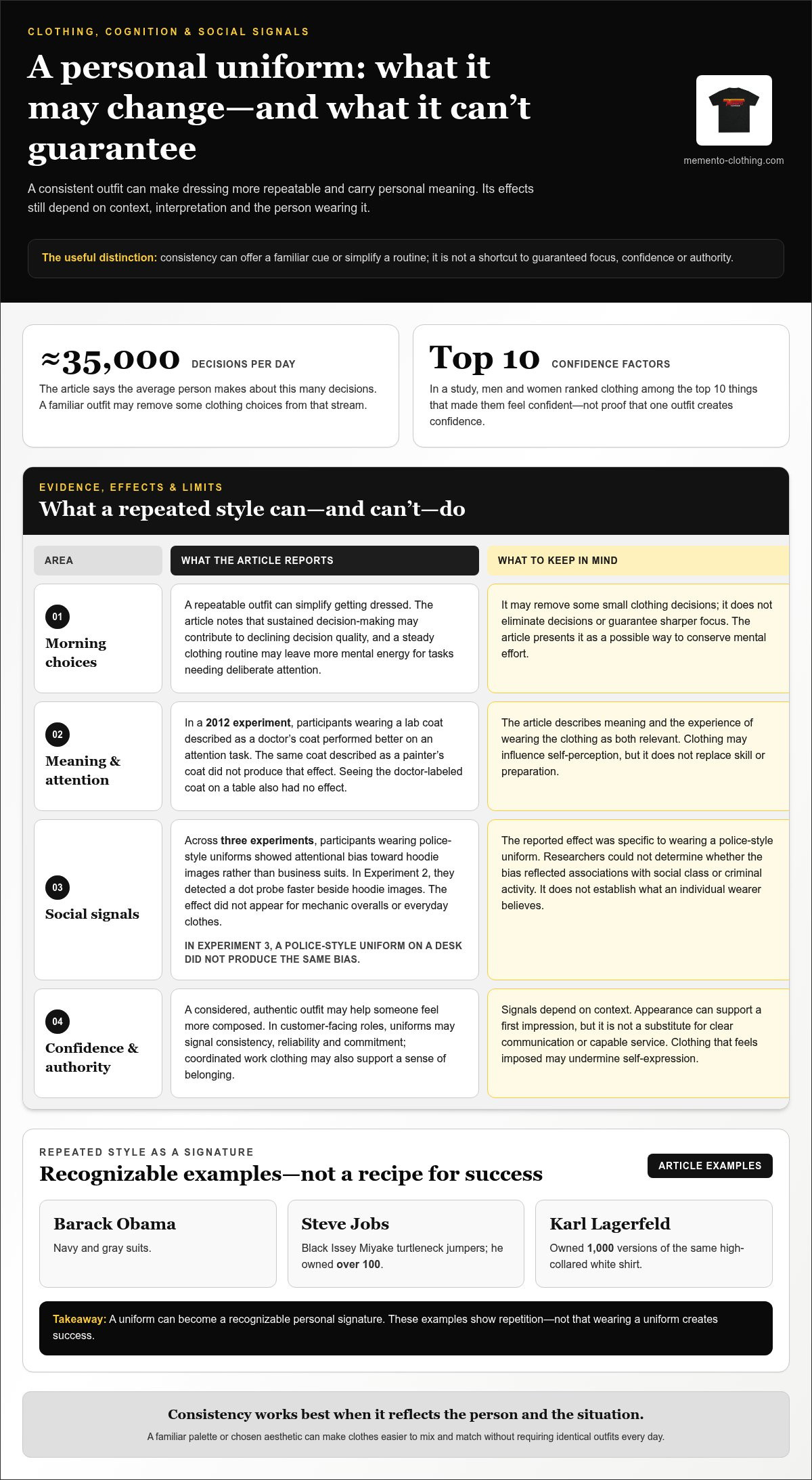
Uniforms can shape the social signals people notice, sometimes directing attention in unexpected ways. Across three experiments, participants wearing police-style uniforms showed attentional bias toward people wearing hoodies rather than business suits. In Experiment 2, they detected a dot probe faster beside hoodie images than beside business-suit images. In Experiment 3, seeing a police-style uniform on a desk did not produce the same bias.
The effect was specific to wearing a police-style uniform. It didn’t emerge among participants wearing mechanic overalls or everyday clothes. Researchers couldn’t determine whether the bias reflected associations with social class or criminal activity. That distinction matters: clothing can influence attention, but one study doesn’t establish what any individual wearer believes.
Daily Uniforms Worn by Successful People
Examples of daily uniforms worn by successful people include Barack Obama’s navy and gray suits and Steve Jobs’s black Issey Miyake turtleneck jumpers. Jobs owned over 100 of those jumpers. Karl Lagerfeld owned 1,000 versions of the same high-collared white shirt. These examples show how a repeated outfit can become a recognizable personal signature, not proof that a uniform creates success.
Uniforms can also act as shared signals: coordinated workplace clothing may soften distinctions that divide a team and support a sense of belonging. For an individual, the useful question is whether a chosen style feels authentic in its setting. Casual clothes may communicate something different from a suit, so consistency works best when it reflects both the person and the situation.
Personal uniforms as a way to conserve cognitive resources
A personal uniform can cut down the clothing choices competing for your attention each morning. It can also support your identity: choosing a silhouette, palette, or graphic that reflects your values makes repetition feel like self-expression, not sameness.
Reducing Cognitive Choices
A personal uniform is a repeatable set of clothing choices that simplifies getting dressed. The average person makes about 35,000 decisions per day, and a familiar outfit can remove some small decisions from that stream. Social psychologist Roy F. Baumeister has shown that sustained decision-making may contribute to declining decision quality. A steady clothing routine may leave more mental energy for tasks that need deliberate attention.
Enclothed Cognition
Enclothed cognition describes how clothing’s symbolic meaning and the experience of wearing it can influence the wearer’s thinking. In a 2012 experiment by Hajo Adam and Adam D. Galinsky, participants wearing a lab coat described as a doctor’s coat performed better on an attention task; presenting it as a painter’s coat did not produce the same effect. Merely seeing the doctor-labeled coat on a table also had no effect. Meaning mattered alongside appearance.
This helps explain why clothing can shape self-perception, not just other people’s impressions. Dr. Karen Pine has said that clothes can prime wearers to act in line with the qualities associated with them. A uniform chosen for comfort, focus, or creative identity can become a cue for the state you want to bring to a task. It doesn’t replace skill or preparation, but it can give a routine a clear beginning.
For example, someone who wants to feel composed during focused work might choose a familiar outfit that feels comfortable and intentional. Someone entering a creative session might prefer clothing that expresses their visual identity. The useful test is practical: does the outfit help you settle into the work, or does it distract you? A consistent appearance can also make that choice easier to repeat. Explore clothing with a personal point of view as one way to make daily dress feel more intentional.
Consistency, confidence, and authority
Clothes can influence both self-perception and the impressions others form. In a study, men and women ranked clothing among the top 10 things that made them feel confident. That finding doesn’t mean one outfit creates confidence. It shows that appearance can be part of how people prepare to meet a moment, alongside their experience, purpose, and sense of identity.
Consistency gives that preparation a familiar shape. Someone who chooses a considered outfit for client meetings, for example, may feel more composed because the choice reflects how they want to take part. The effect comes partly from personal meaning: a garment associated with readiness can become a cue to adopt that mindset. Clothes still need to suit the setting. A uniform that feels authentic can reinforce self-expression; one that feels imposed may do the opposite.
Authority also depends on what clothing communicates in context. A cohesive, professional appearance can reinforce a workplace’s identity and help build customer trust. In customer-facing roles, uniforms may signal consistency, reliability, and commitment to the work. These are social signals, not substitutes for clear communication or capable service. A polished appearance can support a first impression, while behavior gives people evidence to judge over time.
Imagine a university student preparing to present a project. Clothes chosen to feel composed and appropriate may help them enter the room with a clearer sense of purpose. In a workplace, a consistent approach to dressing can connect employees with a shared identity and the organization’s story. Neither example requires identical outfits. Repeated colors, silhouettes, or practical choices can create continuity while leaving room for individual expression.
To make consistency useful, ask what you want your clothes to express, then choose pieces that suit the setting and feel like you. Confidence and authority aren’t stitched into a garment. They emerge through the relationship between appearance, intention, and action.
Potential real-world consequences of uniform-induced attention
Wearing the same outfit can feel restrictive or invite assumptions when a style carries strong social meaning. Studies also show that uniforms can direct attention and affect how people interact.
Attention Drawn by a Uniform
Uniform-induced attention describes how recognizable clothing can shape what people notice about its wearer. It matters because those reactions may influence everyday encounters, not just first impressions. In experiments, people wearing police-style uniforms paid more attention to people wearing hoodies than to people in business suits. Researchers couldn’t determine whether social-class associations or ideas about criminal activity explained the bias.
A historical example shows why uniform effects deserve careful interpretation. After Menlo Park police adopted blazer-style uniforms in 1969, civilian injuries caused by police fell by 50% during the first 18 months. Assaults on police fell by 30% in that period, then rose until the rate was double the year before the change. The figures describe an association over time, not proof that clothing alone caused the changes.
Psychological Downsides of Repeated Outfits
A repeated outfit can become limiting if it feels like an obligation rather than a choice. Someone who relies on one fixed look for every setting may feel less able to express different parts of their identity. A work uniform, for example, can signal a role clearly but may not feel suited to a social gathering. Flexibility matters.
Another risk is being judged through the associations attached to particular clothes. The police-uniform experiments show that clothing can guide attention, but they don’t establish how every observer will interpret a wearer. Likewise, a hoodie or business suit can prompt assumptions that say more about the observer than the person wearing it. A personal uniform can remain consistent while allowing alternatives for context, comfort, and self-expression.
In a team, shared attire may support collaboration and mutual respect, while still making individuals feel less distinct. The useful balance is visible in the choice itself: keep a recognizable core, but allow changes when the occasion or personal expression calls for them.
Memento Mori Clothing: Memento Mori Heavyweight Hoodie
Memento Mori Clothing’s Memento Mori Heavyweight Hoodie can be a considered starting point for a personal uniform. Its Memento Mori philosophy gives everyday clothing a reflective point of view, connecting what you wear with the values you choose to carry through the day.
If you prefer a lighter everyday option, the Memento Mori Vintage Tee offers another way to express that perspective. Memento Crewnecks and Memento Hats can also help shape a familiar look while leaving room for personal choice. A daily uniform doesn’t need to erase individuality; repeatable pieces can make a chosen identity visible.
Choose these pieces when you want clothing that reflects more than a passing trend and gives your routine a personal anchor. Visit memento-clothing.com to explore Memento Mori Clothing’s apparel and find a piece that feels true to your everyday style.
Choose a Style That Feels Like Your Own
The psychology of adopting a daily uniform begins with a personal choice: deciding what you want your everyday clothes to express. Let your routine evolve around that intention. A familiar piece can become a quiet marker of the person you’re becoming, without asking you to dress by someone else’s rules.
For clothing with a reflective point of view, explore Memento Mori Clothing’s Memento Mori Heavyweight Hoodie, Memento Mori Vintage Tee, and Memento Crewnecks. Choose a piece that feels at home in your life, then let its meaning grow through the moments you wear it.
Contact Memento Mori Clothing to explore a piece for your everyday wardrobe. A considered choice can be a small beginning, and your style remains yours to shape.
Frequently Asked Questions
What is the psychology behind wearing a daily uniform?
The psychology of adopting a daily uniform involves how repeated clothing choices shape routines, self-perception, and social signals. A familiar outfit can become a cue for a particular role, such as starting a workday or teaching a class. Its meaning depends on the wearer and setting. Choose clothes that connect with the person you want to be, not simply a look you feel pressured to maintain.
How can a daily uniform reduce decision fatigue and save time?
A daily uniform can simplify mornings by letting you decide on your main outfit in advance. For example, prepare a small rotation of work-ready combinations on laundry day, then choose one based on the weather and your calendar. Keep an alternative for unexpected meetings or temperature changes. This cuts down on last-minute searching and makes the routine easier to maintain without requiring identical clothes every day.
What does research say about clothing, mood, confidence, and performance?
Research suggests clothing’s effects depend on the task and the meaning attached to what someone wears. A 2015 study found that people in casual attire performed worse on abstract cognition than people in formal business attire. That finding concerns a particular kind of task, not every measure of performance. For everyday choices, notice whether an outfit supports your mood and concentration in the situation you’re preparing for.
How do daily uniforms affect workplace perceptions and professionalism?
Daily uniforms can make roles easier to recognize and create a consistent visual impression at work. For example, visitors in a busy office may find staff easier to identify when clothing clearly distinguishes their roles. Professionalism still comes from conduct, knowledge, and communication, not appearance alone. A useful uniform should fit the workplace’s expectations and help employees feel prepared to carry out their responsibilities.
How can I choose a comfortable, practical daily uniform for my lifestyle?
Start with the demands of a typical day: how much you move, how much time you spend indoors and outdoors, temperature changes, and how often you can do laundry. Choose clothes that allow the movement your routine requires, and notice how they feel while sitting, walking, or carrying a bag. A simple set of coordinating pieces can offer variety while keeping the overall look familiar. Comfort should support your day, not compete with it.
How can I create a daily uniform without violating a workplace dress code?
Build your uniform within the dress code’s boundaries. First, identify its stated requirements, such as approved garments, colors, or footwear. Then choose repeatable combinations that meet those rules, such as the same style of trousers with different permitted shirts. Keep a separate option for meetings or duties with stricter expectations. This creates a personal routine while respecting the standards that apply to your role.