
Philosophy-Inspired Gifts, from Aristotle Busts to Student Picks
The best philosophy gift is rarely philosophy in the abstract. Thoughtful philosophy-inspired gifts for academics connect with a recipient’s favorite thinker or school, from a contemporary Aristotle bust to a practical choice for a student who lives among books and notes. Aristotle lived from 384 to 322 BC, yet his questions still find a place in modern rooms.
A gift feels more personal when it reflects how someone thinks. A student may appreciate something useful for studying, while a teacher or professor might value an object that gives an idea a lasting presence. The right choice can be modest or striking; what matters is the connection it carries.
This guide explores gifts inspired by thinkers and philosophical traditions, with ideas for students, teachers, professors, and enthusiasts. You’ll find ways to choose thoughtfully, whether you’re drawn to a sculptural tribute, a school-specific keepsake, or a quieter reminder of enduring questions.
Key Takeaways
- Start with the recipient’s intellectual interests, then choose a gift that reflects a thinker, school, or enduring question.
- For students, consider whether the gift will support their daily study habits or add meaning to their academic space.
- For teachers and professors, look for a thoughtful balance between personal significance and professional setting.
- Match the gift to the recipient’s wider interests, such as ethics, logic, political thought, or the philosophy of science.
- A simple garment inspired by reflection and mortality can offer a wearable alternative to a display piece.
1. Contemporary Aristotle bust
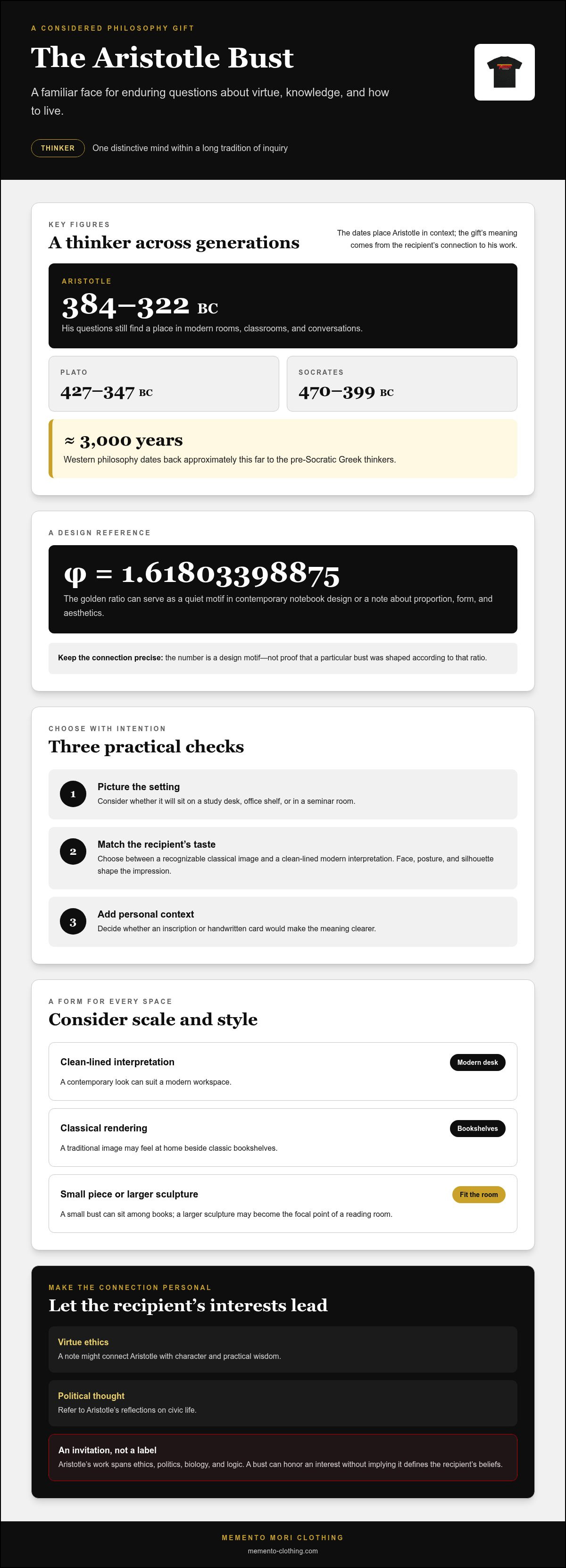
A contemporary Aristotle bust gives a familiar face to questions about virtue, knowledge, and how to live. Aristotle lived from 384 to 322 BC, yet his ideas remain part of classrooms and conversations today. As a gift, the bust can mark an academic interest without needing to summarize an entire body of philosophy. Its meaning comes partly from the thinker it represents, and partly from the recipient’s own relationship with his work.
Choose a design with the recipient’s space and taste in mind. A clean-lined interpretation can suit a modern desk, while a classical rendering may feel at home beside traditional bookshelves. Look at the face, posture, and silhouette: these details shape whether a bust feels contemplative, formal, or striking. A small piece can fit among books, while a larger sculpture may become the focal point of a reading room.
Personal meaning matters as much as appearance. Aristotle’s work spans ethics, politics, biology, and logic, so a bust can resonate with different academic interests. For a student drawn to virtue ethics, pair it with a note about character and practical wisdom. For a professor of political thought, refer to Aristotle’s reflections on civic life. Avoid presenting the bust as a complete portrait of the recipient’s beliefs: it’s an invitation to think, not a label.
Design can also carry a quiet mathematical reference. The golden ratio is expressed as φ=1.61803398875, a figure sometimes used in contemporary notebook design. A gift note might connect that symbol to proportion, form, or the recipient’s interest in aesthetics. Keep the connection precise: the number offers a design motif, not proof that a particular bust was shaped according to that ratio.
Before choosing, make three practical checks. First, picture where the bust will sit, such as a study desk, office shelf, or seminar room. Next, consider whether the recipient prefers a recognizable classical image or a modern interpretation. Finally, decide whether an inscription or handwritten card would add personal context. These steps help the gift feel considered rather than merely decorative.
Western philosophy dates back approximately 3,000 years to the pre-Socratic Greek thinkers. Aristotle’s place in that long history makes his image a fitting gesture for someone who values ideas across generations. Plato lived from 427 to 347 BC, and Socrates from 470 to 399 BC; a bust of Aristotle can therefore sit within a wider tradition, while still honoring one distinctive mind. For academics, that balance between individual thinker and enduring inquiry gives the sculpture its lasting appeal.
2. Gift ideas for philosophy students
A useful gift can support the work of a philosophy course, not just decorate a shelf. Consider what the student does most: annotates dense readings, drafts arguments, or prepares for seminar discussion. A well-made notebook suits someone who develops ideas by hand. Page markers help students return to definitions and objections in texts by Plato, Simone de Beauvoir, or another course author.
For a student who writes constantly, choose a notebook with a clear layout and room to develop arguments. They can reserve one page for a claim, another for supporting reasons, and a margin for objections. This simple structure works for an essay on free will or a close reading of Descartes. A durable cover and portable format make the notebook useful between class, library, and home.
Reading tools can make difficult texts easier to revisit. Pair discreet page tabs with a pencil or removable notes, so the student can mark unfamiliar terms without altering a borrowed book. For a seminar on John Stuart Mill, tabs might separate claims about liberty from examples and counterarguments. Add a brief handwritten note explaining why that text or class came to mind.
Some students prefer to test ideas through play. A logic puzzle, a thoughtfully chosen strategy game, or a set of ethical scenarios can prompt discussion beyond assigned readings. A dilemma about whether to tell a difficult truth, for example, raises different questions for consequentialist and duty-based approaches. Choose a format that invites conversation rather than claiming to settle a philosophical problem.
A quiet study gift can also be practical. A reading lamp, book stand, or comfortable lap desk may support time spent with a challenging text. Match the object to the student’s habits: a commuter may value portability, while someone who studies at one desk may prefer a steadier setup. These everyday choices support hours spent with arguments from thinkers such as Hannah Arendt or David Hume.
Use a simple selection process. First, identify the student’s current course or favorite thinker. Next, choose between a study aid, a discussion prompt, and a personal keepsake. Finally, add a specific detail, such as a note connecting the gift to a memorable seminar on justice. That small reference can make a practical object feel considered.
For a younger student drawn to big questions, a philosophy-themed graphic T-shirt can make abstract interests visible in everyday life. Choose a design that suits their humor and style, rather than assuming every student wants a formal academic motif. Whether you choose a notebook, puzzle, or wearable art, the strongest gift reflects how that person engages with ideas.
3. Gifts by philosophical school or thinker
Choose a gift based on the recipient’s favorite school of thought, not a generic philosophy motif. For a Stoic reader, Marcus Aurelius offers a natural starting point: consider a journal for daily reflection or a print featuring a short passage. Someone drawn to existentialism may prefer artwork inspired by Simone de Beauvoir or Jean-Paul Sartre. A specific intellectual connection makes even a modest object feel considered.
For ancient Greek philosophy, look beyond familiar portraits. A notebook with a golden-ratio motif can suit someone interested in Plato’s ideas about form, while a dialogue-inspired reading journal fits a student who returns to Socratic questioning. For Aristotelian ethics, choose a keepsake connected to practical wisdom or character. These references work best when they match the recipient’s interests, rather than serving as decoration alone.
Match the school of thought to an object with a clear purpose. Stoicism pairs well with a reflection journal; logic with a puzzle or argument map; political philosophy with a print about justice or civic life. A reader of Confucius might appreciate tasteful calligraphic design, while a fan of David Hume may enjoy a gift that invites discussion about knowledge and experience. Keep quotations accurate and attribution clear.
A philosophy-themed bookmark, quote card, or small notebook can make a thoughtful choice within that budget.
Within that budget, consider a carefully made bust, framed artwork, or substantial edition of a thinker’s work. Compare the materials, presentation, and connection to the recipient’s interests before choosing.
Are there ethical or practical concerns when buying philosophy-themed gifts? Yes. Check that quotations are accurately attributed, cultural symbols are used respectfully, and the object suits the recipient’s space and habits. A large display piece may not suit someone with limited room, while a misleading quote can distort a thinker’s ideas.
What philosophy gifts can be personalized or made by independent artists? A custom bookplate, engraved journal, or artwork referencing a favorite thinker can add a personal touch. When considering an independent artist’s work, look at the materials, attribution, and design explanation. Then personalize it with a specific reference, such as Epictetus or Mary Wollstonecraft.
One final step can sharpen your choice: name the recipient’s school, thinker, or current question, then select an object that reflects it. This approach turns philosophy-inspired gifts for academics into personal markers of thought, rather than souvenirs with an abstract label.
4. Gifts for philosophy teachers and professors
A thoughtful gift for a philosophy teacher recognizes both their subject and their teaching style. Consider the courses they lead: ethics, logic, political philosophy, or ancient thought. A framed passage from Mary Wollstonecraft may suit a teacher whose classes examine equality. For someone teaching logic, a well-designed argument map can connect directly to classroom work. A specific intellectual reference makes the gesture personal, not ceremonial.
For an office or study, choose an object that fits comfortably among books and papers. A restrained print inspired by Hannah Arendt can bring political thought into the room without overwhelming it. A useful bookend, reading lamp, or desk organizer can support daily work while fitting the professor’s existing style. Consider the recipient’s space and habits before choosing a display piece. A compact object may be easier to place than a large sculpture.
Books can be meaningful, but choose a title that reflects the recipient’s interests rather than your assumptions. If the professor teaches David Hume, a carefully selected edition or companion volume may suit their work. For a teacher focused on ethics, a journal with a note about a memorable class discussion can feel more personal. A handwritten message should name the idea or moment behind the gift, not just offer a broad compliment.
Consider the classroom, too. A seminar instructor might appreciate discussion cards built around questions of justice, responsibility, or knowledge. They can prompt conversation without prescribing an answer. A teacher who uses visual material may prefer a clear, accurate quotation print from Simone de Beauvoir or Bertrand Russell. Check the wording and attribution before gifting it: a misquoted line can distract from the thought behind the choice.
For a department or student group, a shared gift can carry a collective message. A bookplate signed by students, a framed note recalling a course, or a small collection of written reflections can preserve a particular academic moment. Each contributor can name a question the professor helped bring to life. That detail gives the gift a history, rather than making it feel like a standard end-of-term gesture.
Use a simple process to refine your choice. First, identify a thinker or topic the teacher returns to, such as Aristotle on virtue or John Rawls on justice. Next, choose an object suited to their office, classroom, or reading routine. Finally, add a brief explanation linking the gift to a real exchange or lesson. This makes philosophy-inspired gifts for academics feel grounded in attention, while leaving room for the recipient’s own interpretation.
5. What philosophy gifts are suitable for different academic fields and interests?
A gift feels more personal when it connects philosophy with another discipline. For a political science student, choose a print or journal about civic responsibility, representation, or justice. Someone studying law may appreciate a keepsake referencing John Locke’s ideas about rights. The best connection is specific enough to reflect their interests, but open enough to invite further thought.
For psychology students, gifts can explore questions of identity, consciousness, and agency. A notebook for recording questions after a lecture pairs well with a course on the self. A reader interested in William James might enjoy essays linking experience and belief. Avoid treating philosophical questions as settled scientific findings; the gift should honor inquiry rather than claim certainty.
Students of literature may enjoy gifts that bring philosophical themes into familiar texts. A reading journal can track questions of freedom in Toni Morrison or moral responsibility in Dostoevsky. For a classics scholar, a carefully chosen edition of Sophocles can open conversations about fate and choice. Add a note explaining the connection, such as a shared interest in how characters confront difficult decisions.
For mathematics or computer science, choose a gift that reflects reasoning and formal structure. A logic puzzle, argument-mapping notebook, or artwork based on symbolic notation can suit someone studying proof or computation. A recipient interested in artificial intelligence might appreciate a reading journal for questions about machine intelligence and personhood. Keep the design legible, especially when symbols or equations carry the meaning.
Environmental studies and biology invite gifts exploring humanity’s place in nature. A field notebook can help a student connect ecological observations with questions of responsibility. Someone studying animal ethics may value a bookplate or art referencing Peter Singer’s work. For a science historian, choose something that reflects the history of ideas, such as an illustrated timeline linking Charles Darwin’s writing with debates about evidence and explanation.
Before choosing, identify the recipient’s primary field, then find a genuine philosophical overlap. A history student might explore Hannah Arendt’s writing on political life; an economics student might be drawn to Adam Smith and moral judgment. Avoid forcing a thinker onto a subject simply because their name is familiar. A short card can explain the connection and make your reasoning part of the gift.
For a young person whose academic interests extend beyond class, a graphic design can offer a wearable expression of curiosity. Explore graphic designs for younger wearers when a gift should feel personal and visible in everyday life. Keep the recipient’s age, style, and interests in mind. Whether the connection is literature, law, science, or politics, a considered gift can make an abstract question feel close to home.
Memento Mori Clothing: Memento Mori Heavyweight Hoodie
Memento Mori Clothing offers the Memento Mori Heavyweight Hoodie as a wearable reminder of the philosophy behind the brand’s name. For someone looking beyond a desk object or book, clothing can carry an idea into everyday life. The Memento Mori Vintage Tee, Memento Crewnecks, and Memento Hats offer other ways to express reflection on mortality and the value of the present.
Choose the hoodie for someone who appreciates a substantial, understated expression of philosophical interest. A tee or hat may suit a more casual gift, while a crewneck offers another simple option. Each piece connects personal style with a lasting idea, rather than a passing academic trend.
Explore the Memento Mori collection or contact Memento Mori Clothing.
Let a thoughtful gift begin another conversation
Before choosing, write down the idea you hope the recipient will carry forward. Perhaps it’s a question about how to live, a moment from a seminar, or a thinker who changed how they see the world. That intention can guide your choice and shape a personal note. The most meaningful philosophy-inspired gifts for academics don’t close a conversation; they give it somewhere new to begin.
For a wearable expression of reflection, Memento Mori Clothing offers the Memento Mori Heavyweight Hoodie, Memento Mori Vintage Tee, and Memento Crewnecks. Each gives the recipient a way to carry a reminder of life’s impermanence into everyday days, without turning an idea into a lecture.
Contact Memento Mori Clothing to take the next step. Choose with care, and let the gift become a quiet invitation to keep thinking.
Frequently Asked Questions
What to get for someone who likes philosophy?
A strong choice joins the person’s interests to an everyday ritual. For a reader who annotates, consider a bookplate or reading journal with a note naming a question they often raise. For someone who prefers conversation, choose philosophical dialogue prompts for a dinner or reading group. Tie the gift to a specific habit, not simply the label “philosophy fan.”
What are the best philosophy-inspired gifts for academics?
The strongest philosophy-inspired gifts for academics reflect the recipient’s current work without turning it into a novelty. A scholar preparing lectures may appreciate an elegant desk object; a graduate student may prefer an edition related to a research question. Add a brief note explaining the connection, such as why a particular argument reminds you of their work. That context can make a simple choice feel considered.
What philosophical books make thoughtful gifts for professors and researchers?
Consider Plato’s Republic for someone interested in justice and political order, or Aristotle’s Nicomachean Ethics for a reader studying virtue. Kant’s Groundwork of the Metaphysics of Morals suits research in ethics, while Nietzsche’s On the Genealogy of Morality invites reflection on values. Choose an edition with helpful notes for a new reader, or a translation the specialist has mentioned.
What are unique gifts inspired by Plato, Aristotle, Kant, or Nietzsche?
Give each thinker a distinct form: a dialogue-inspired reading set for Plato, an ethics-themed desk print for Aristotle, a carefully typeset statement of Kant’s moral philosophy, or an aphorism notebook inspired by Nietzsche. Keep quotations exact and identify the original work, since lines are often paraphrased. A short inscription can connect the design to the recipient’s favorite text without suggesting one object captures an entire philosophy.
How can I choose an appropriate gift for a professor or academic colleague?
Choose a gift that suits both your relationship and the recipient’s scholarship. For a professor you know through class, keep the gesture modest and focused on ideas; for a close colleague, a book connected to current research may feel more personal. Consider whether they already own a commonly assigned text, then explain your choice in a brief note. For a department occasion, a shared card can feel warmly appropriate.