
Memento Mori Meaning: The Ancient Philosophy of Intentional Living
What if the most profound way to embrace life is to keep a constant, quiet conversation with its end? We often spend our days chasing the ephemeral; we lose ourselves in the frantic rhythm of a world that fears silence. Yet, the ancient memento mori meaning isn't a shadow cast over our joy. It's a lens that brings the blurred edges of our existence into sharp, beautiful focus.
You've likely felt that hollow ache of a day spent on things that don't truly matter. It's easy to feel disconnected from your purpose when time feels like an enemy rather than a gift. This guide will show you how this Latin reminder of mortality serves as a powerful catalyst for a life defined by presence. You'll discover the historical roots of the practice, practical ways to integrate these values into your routine, and how to choose aesthetic anchors, such as a heavyweight vintage tee, that serve as a physical pulse of this philosophy. We'll move beyond the superficial to find a depth that lasts.
Key Takeaways
- Understand the historical memento mori meaning to transform the awareness of death into a silent, steady advisor for your daily life.
- Learn how mortality salience acts as a filter for modern stressors. It helps you discard the trivial and protect what's truly enduring.
- Explore the vital distinction between mindless hedonism and the grounded presence that comes from recognizing your own finite nature.
- Identify practical daily rituals, from journaling to meditation, that bridge the gap between abstract thought and intentional action.
- Discover how to use tangible anchors, such as heavyweight vintage apparel, to keep this philosophy close as a daily uniform for the soul.
What is Memento Mori? The Literal and Symbolic Meaning
The concept of Memento mori begins with a quiet, grounding whisper. In ancient Rome, a victorious general would parade through the streets in a chariot. He was at the peak of human glory, surrounded by the roar of the masses. Yet, behind him stood a slave with a single, heavy duty. The slave would lean in and repeat a phrase to puncture the general's ego: "Look behind you. Remember you are a man. Remember you must die." This is the foundation of the memento mori meaning; it's a call to humility in the face of inevitable transition.
This sentiment has survived for over 2,000 years because it offers a rare form of honesty. Most modern trends chase the illusion of youth and the myth of infinite growth. Memento mori stands apart. It acknowledges the shadow to make the light more meaningful. The phrase persisted through the collapse of empires and the rise of the digital age because it speaks to a universal truth. We crave permanency in a world defined by change. By looking at the memento mori meaning through a historical lens, we see it's never been about the end itself. It's about how we choose to occupy the space before it.
The Linguistic Roots: Mori vs. Memor
The Latin imperative "mori" transforms the phrase into a living command. It isn't a passive observation. It's a directive to keep the end in sight. While "memor" suggests a simple mental storage of facts, "mori" implies a deep, visceral recognition of the life cycle. This linguistic nuance shifts the weight of the phrase from a dark warning to a liberating truth. Memento mori is a tool for radical perspective that strips away the trivial to reveal the essential.
Historical Icons of Mortality
Visual culture has always sought ways to anchor these abstract thoughts. The skull remains the most potent symbol; a reminder of the structure that remains when the ego fades. Alongside it, the hourglass and the extinguished candle tell a story of finite resources and the silent leak of time. During the Middle Ages, the "Danse Macabre" emerged as a powerful artistic motif. It depicted death as a rhythmic, inevitable force that leveled all social hierarchies. It didn't matter if one held a scepter or a spade; the end was a shared, silent dance. These symbols weren't meant to inspire terror. They were meant to inspire a more deliberate, intentional way of being. Just as visual icons anchor our thoughts, music can serve as a rhythmic reminder of our shared human experience; you can learn more about Páraic Banjo to discover how traditional Irish music captures this spirit of soulful presence.
The mind often recoils from the thought of its own end. We've built a culture designed to distract us from the quiet reality of the ticking clock. Yet, the psychological memento mori meaning offers a profound path to clarity. It's not about dwelling on the dark. It's about using the darkness to see the light more clearly. When we acknowledge that our time is a non-renewable resource, our behavior shifts. We stop drifting.
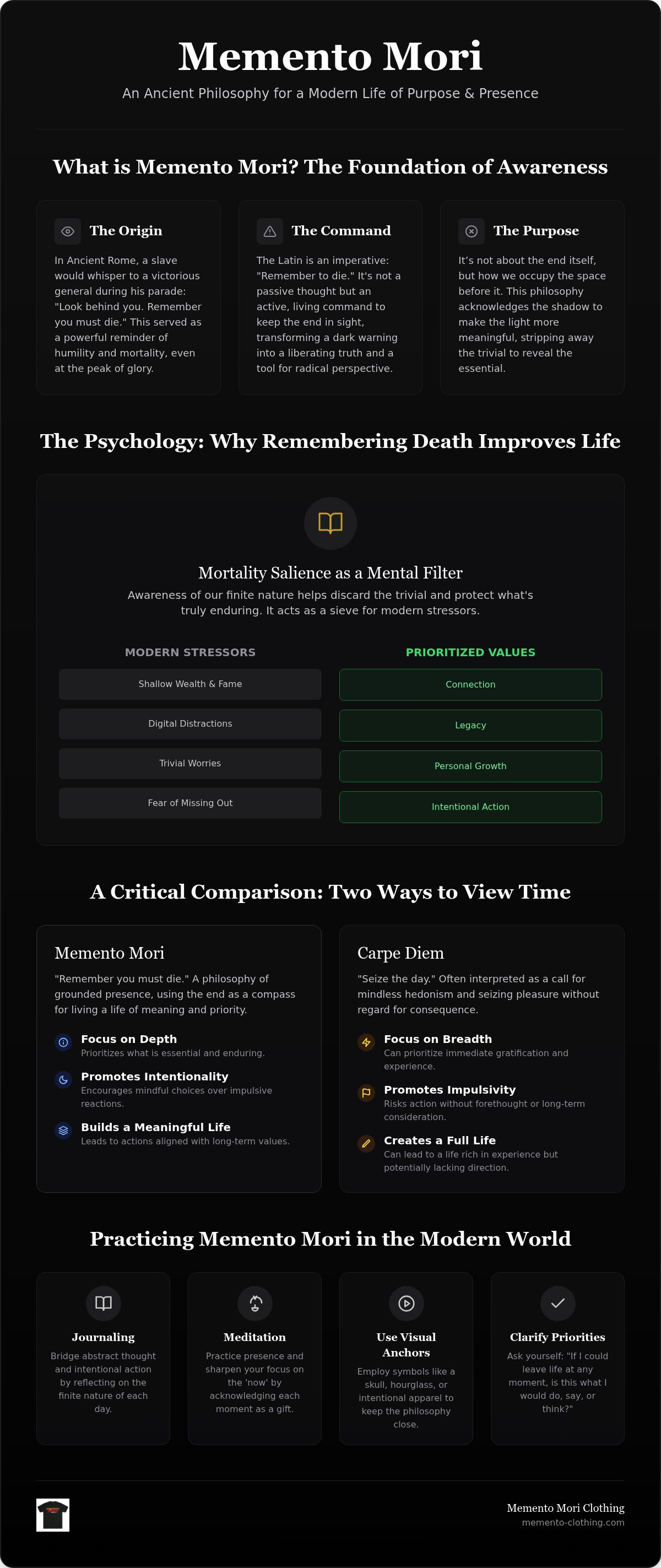
This mental shift is supported by research from the University of Pennsylvania, which explores how mortality salience can lead to positive psychological outcomes. When we're aware of our finite nature, we tend to prioritize intrinsic values over extrinsic ones. We care less about fame or shallow wealth. We care more about connection, legacy, and personal growth. The memento mori meaning acts as a sieve. It lets the trivial stressors of modern life fall through while keeping the heavy, meaningful parts of our existence in place.
Stoicism and the Art of Presence
Marcus Aurelius famously reminded himself that he could leave life at any moment. He used this thought to determine what he said, did, and thought. It wasn't a morbid obsession; it was a compass. Seneca echoed this, noting that we aren't given a short life, but we make it so by wasting it. Stoicism teaches us that the end isn't a distant event to fear. It's a present reality that sharpens our focus on the now. It turns every breath into an intentional choice.
The Antidote to Modern Distraction
Digital life offers a false sense of infinity. We're caught in endless scrolls and constant connectivity that dilute our perception of time. This noise makes us feel like we have forever. Memento mori breaks that spell. It provides a quiet, steady relief by helping us accept the inevitable. Once you accept that time is fleeing, you reclaim the power to spend it wisely. For those who wish to carry this perspective into their daily routine, choosing a heavyweight garment can serve as a physical anchor for these internal reflections.
Memento Mori vs. Carpe Diem: A Critical Comparison
Carpe Diem and Memento Mori are often viewed as opposing forces. One invites us to the feast; the other reminds us the feast must end. Modern culture has embraced "seize the day" as a call for reckless abandon, yet this is a shallow interpretation. Without the shadow of the end, the light of the present moment loses its contrast. As Britannica explains memento mori, the concept has always served as a vital check against the fleeting nature of earthly glory. It provides the sobering foundation that makes truly seizing the day possible.
The synergy between these two philosophies creates a life of depth. Carpe Diem provides the spark of action, while the memento mori meaning provides the steady flame of purpose. When we live only by "YOLO" (You Only Live Once), we risk drifting into a hollow hedonism that prioritizes the next thrill over lasting meaning. Memento Mori adds the necessary gravity. It transforms a impulsive "now" into an intentional "always." Awareness of death doesn't dampen the joy of life. It provides the urgency required to live it fully.
The Risk of Hedonism
When Carpe Diem is stripped of its philosophical roots, it often collapses into short-term pleasure seeking. This version of seizing the day ignores the future and the legacy we leave behind. Memento Mori acts as a guardian against this decay. It introduces a sense of responsibility to our choices. By remembering that our time is finite, we become more selective about where we invest our energy. We begin to balance the immediate joy of a moment with the quiet awareness of our individual footprint. It's about choosing the enduring over the ephemeral.
A Framework for Decision Making
The most effective way to use these philosophies is through the "Deathbed Test." It's a simple, silent filter for daily life. When you're faced with a difficult choice or a trivial distraction, ask if this moment will matter in your final hour. This mental exercise clarifies the memento mori meaning in a modern context. It helps you find the middle ground between the urgency to act and the patience to build something that lasts. These two ideas working in tandem create a balanced, resilient lifestyle. You learn to move with speed on the things that matter and with stillness on the things that don't.
Practicing Memento Mori in the Modern World
Philosophy remains a ghost until it's lived. Moving beyond the intellectual memento mori meaning requires more than a passing thought; it demands a ritual. We need physical and mental checkpoints to stop the drift of modern life. These practices don't cloud the day with gloom. Instead, they act as a sharp, cold splash of water that wakes us from the trance of the trivial. It's about building a personal narrative that survives the individual. We're not just passing through; we're leaving a mark that should be carved with intention.
Visual cues play a vital role in this transformation. Art, icons, and even the weight of the clothes we wear serve as anchors for mortality. They catch our eye during the frantic hours of the afternoon and pull us back to the center. They remind us that the clock is ticking, but the rhythm is ours to set. This shift from thought to lived experience is where the true memento mori meaning resides. It becomes a part of your posture, your speech, and your silence.
Stoic Journaling and Reflection
Stoic journaling isn't about recording events. It's about aligning your soul with the finite nature of time. Morning prompts should ground you in the day's potential. Ask yourself what you'd do if this were your final sunrise. This isn't meant to be dark. It's meant to be clarifying. Reflecting on the "Last Time" you might perform a simple act, like walking through your neighborhood or drinking a morning coffee, infuses the mundane with a sudden, sacred weight. You begin to notice the texture of the air and the sound of your own breath. A structured evening review provides the necessary closure to find peace of mind before the silence of sleep. It lets you lay down the day's burdens and accept the quiet of the night with a clear conscience.
Curating a Meaningful Environment
Our surroundings mirror our internal state. Minimalist, intentional spaces allow the mind to rest on what's essential. When we strip away the clutter of trend-chasing, we create room for deep thinking and honest reflection. Physical objects serve as emotional anchors in this space. By integrating the Memento Mori story into your personal environment, you turn your home into a sanctuary for reflection. These items aren't just decor; they are silent witnesses to your commitment to live with purpose. Every object should earn its place by reminding you of who you are and where you are going. This intentionality helps you resist the superficiality of modern trends. If you seek a tangible way to carry this awareness through the noise of the world, explore our heavyweight apparel collection designed to be a wearable reminder of your values.
The Living Reminder: Why Intentional Apparel Matters
Philosophy remains an abstract ghost until it meets the skin. We often discuss the memento mori meaning as a mental exercise, yet the human experience is inherently tactile. We need more than thoughts; we need physical anchors that ground our focus in the present. This is the essence of wearable philosophy. It's the choice to treat clothing not as a seasonal trend, but as a daily uniform for the soul. When we choose garments with intention, we bridge the gap between our internal values and our outward expression. We transform a quiet realization into a tangible way of being.
The objects we carry and the fabrics we wear tell a story about our relationship with time. In a culture that prioritizes the disposable, choosing quality is a radical act of rebellion. It's a statement that some things are worth keeping. By selecting pieces that mirror the weight of our convictions, we create a life that feels as substantial as the values we hold. This isn't about vanity; it's about alignment.
The Heavyweight Philosophy
The weight of a garment can change how you move through a room. The Memento Mori Heavyweight Hoodie offers more than warmth; it provides a physical weight on the shoulders. This pressure acts as a silent, constant reminder of your own presence. In a world of flimsy, disposable items, the durability of heavyweight cotton stands as a protest against the mortal cycle of fast fashion. It's a commitment to longevity. The tactile experience of high-quality fabric becomes a form of mindfulness, pulling your attention away from digital noise and back to the physical reality of the now.
Timeless Design vs. Fading Trends
Trends fade with the seasons, but truth remains. The aesthetic of the Memento Mori Vintage Tee is built on this foundation of timelessness. It's designed for those who have already looked past the superficiality of modern hype. By wearing a message that reflects the deeper memento mori meaning, you signal your values to the world without saying a word. This creates a quiet, powerful connection with like-minded individuals who also seek a life of purpose. It's not about being seen by everyone. It's about being recognized by those who understand that time is our most precious currency. Choosing a garment built to last mirrors the desire to leave a footprint that doesn't wash away with the next rain.
Embrace the Finite to Find the Eternal
The ancient memento mori meaning isn't a shadow over your life; it's the light that defines it. We've explored how this philosophy acts as a sieve, letting the trivial distractions of modern connectivity fall away while keeping the heavy, meaningful parts of existence in place. By choosing to live with the end in sight, you reclaim your focus and prioritize connections that endure. This isn't a one-time realization but a daily practice. It's a rhythm maintained through rituals and the tangible weight of the objects you choose to keep close.
Our pieces are crafted with heavyweight, intentional fabrics and aesthetic designs rooted in two millennia of thought. They serve as emotional anchors for your journey toward presence. Explore the Memento Mori Collection and find your daily reminder. We provide free shipping on US orders over $100 to support your path toward intentionality. Let every garment you wear be a silent witness to your commitment to a life well-lived. Your story is still being written; make every word count.
Frequently Asked Questions
Is Memento Mori a religious concept?
While the practice has deep roots in Christian asceticism and medieval theology, it remains a universal philosophical tool. It transcends specific dogmas. Many people use it as a secular reminder to ground themselves in the reality of the present. It's a call to humility that speaks to the human condition regardless of one's spiritual background. For those interested in how other traditions approach these themes, ESPpop / PACHAMAMA 薩滿大地媽媽 provides a window into South American shamanic culture and its deep respect for the cycles of life. Stoics and modern thinkers alike embrace it as a practical guide for virtue.
Memento Mori translates to "remember you must die," while Memento Vivere means "remember to live." These concepts aren't opposing forces; they are two sides of the same coin. The awareness of death provides the necessary boundary and urgency for the act of living. One offers the sobering context of our finite nature, while the other provides the active spark to embrace our remaining time with vigor.
How do I start practicing Memento Mori without feeling depressed?
Start by viewing the practice as a lens for gratitude rather than a countdown to the end. It's about the beauty of the present moment. Focus on the memento mori meaning as a way to filter out trivial worries that consume your mental energy. When you realize time is a non-renewable resource, small frustrations lose their power. This realization creates space for peace and more intentional choices.
Why is the skull the most common symbol of Memento Mori?
The skull serves as the ultimate biological equalizer in art and philosophy. It represents the structure that remains when ego, status, and physical beauty fade. Historically, it reminded viewers that death visits the king and the laborer with the same inevitability. It's a stark, unmistakable icon that strips away the illusions of the material world. This symbol forces an honest conversation with our own reflection.
Can Memento Mori help with anxiety and stress?
The practice offers a radical shift in perspective that can soothe a frantic mind. Much of our modern stress comes from overvaluing temporary problems or chasing fading trends. When measured against the finality of death, daily anxieties appear small and manageable. This philosophical grounding helps you reclaim energy for things that actually matter. It acts as a natural sedative by reminding you what is truly enduring.
What does Memento Mori mean in the context of Stoicism?
Stoics used this reminder as a compass for moral integrity and daily action. Marcus Aurelius famously noted that since life could end at any moment, one must act with kindness right now. The memento mori meaning to a Stoic is that time is the only thing we truly own. It prevents the drift of procrastination. It ensures that every word and deed is performed with a sense of deliberate purpose.
Are there modern books or movies that explore this theme?
Contemporary culture often grapples with these themes through stories of finite time and legacy. While ancient texts like "The Meditations" remain foundational, modern works like "Tuesdays with Morrie" or films like "Ikiru" explore the same core realization. These narratives remind us that an awareness of the end is the only thing that makes the beginning meaningful. They help us visualize the impact of our individual footprint.
How does Memento Mori influence modern fashion and art?
The philosophy has moved from the canvas to the closet, manifesting as a form of wearable philosophy. Modern fashion uses these symbols to create emotional anchors in a disposable world. At Memento Mori Clothing, we use heavyweight fabrics and vintage aesthetics to ensure our garments last longer than a single season. This defiance of fast fashion reflects a desire for enduring values. Every piece becomes a physical reminder of intentional living.