
How to Practice Memento Mori Daily: A Guide to Intentional Living
What if the most powerful tool for a vibrant life isn't a productivity hack, but the quiet acceptance of your own end? Most of us spend our 1,440 minutes each day reacting to trivial noise. We feel a persistent ache that our time is slipping away unused. It's a heavy disconnect. You believe in living deeply, yet the mundane often wins the battle for your attention. This guide explores how to practice memento mori daily to bridge the gap between philosophical ideals and your morning coffee.
We'll show you how to use modern, aesthetic rituals to turn the awareness of mortality into a catalyst for intentionality. You'll learn to curate your environment with meaningful anchors. These small reminders pull your focus back to what truly matters. By the end of this journey, you'll have a tangible framework to transform the fleeting nature of time into a source of quiet, unwavering strength. Clarity is found in the shadows of our limits.
Key Takeaways
- Transform the fear of the unknown into a catalyst for action by embracing mortality as a guide for intentional living.
- Learn how to practice memento mori daily through Stoic mental exercises designed to ground your perspective in minutes.
- Discover how to curate your physical environment with symbolic reminders that anchor your philosophy in the material world.
- Establish a rhythmic, ten-minute routine that bridges the gap between ancient wisdom and the demands of modern life.
- Explore the role of timeless, high-quality garments as physical anchors for your personal legacy and daily mindfulness.
The Essence of Memento Mori: Why Practice Mortality Awareness?
Death is the only certainty. It's the silent rhythm beneath our every breath. To understand The Essence of Memento Mori is to accept that our time is a finite resource. This isn't a dark cloud over your head. It's a lens. By remembering we will die, we finally learn how to live. This practice creates a profound psychological shift. We move from a paralyzing fear of the end toward a fierce intentionality in the present. It's about making every second count because those seconds are non-refundable.
We call this melancholic elegance. It's the ability to find beauty in the fleeting nature of a sunset or the subtle wear on a high-quality garment. Critics often claim this focus is depressing. They're wrong. In truth, it's the ultimate act of life-affirmation. When you realize the clock is ticking, you stop wasting energy on trivialities. You begin to understand how to practice memento mori daily as a way to honor your existence. It's a quiet, confident rebellion against a culture that tries to distract us from our own limits.
The Historical Roots of the Reminder
In ancient Rome, specifically during triumphs around 167 BC, victorious generals paraded through crowded streets. Behind them, a slave held a crown and whispered: "Remember you are mortal." This wasn't meant to dampen the mood. It was to preserve the general's humanity. By the 11th century, monastic traditions adopted the phrase "Keep death before your eyes" to maintain spiritual clarity. In 2026, this ancient wisdom serves as a vital digital detox. It's an anchor in a world of infinite, shallow content. It grounds us in the physical reality of our heritage.
The Benefits of Daily Practice
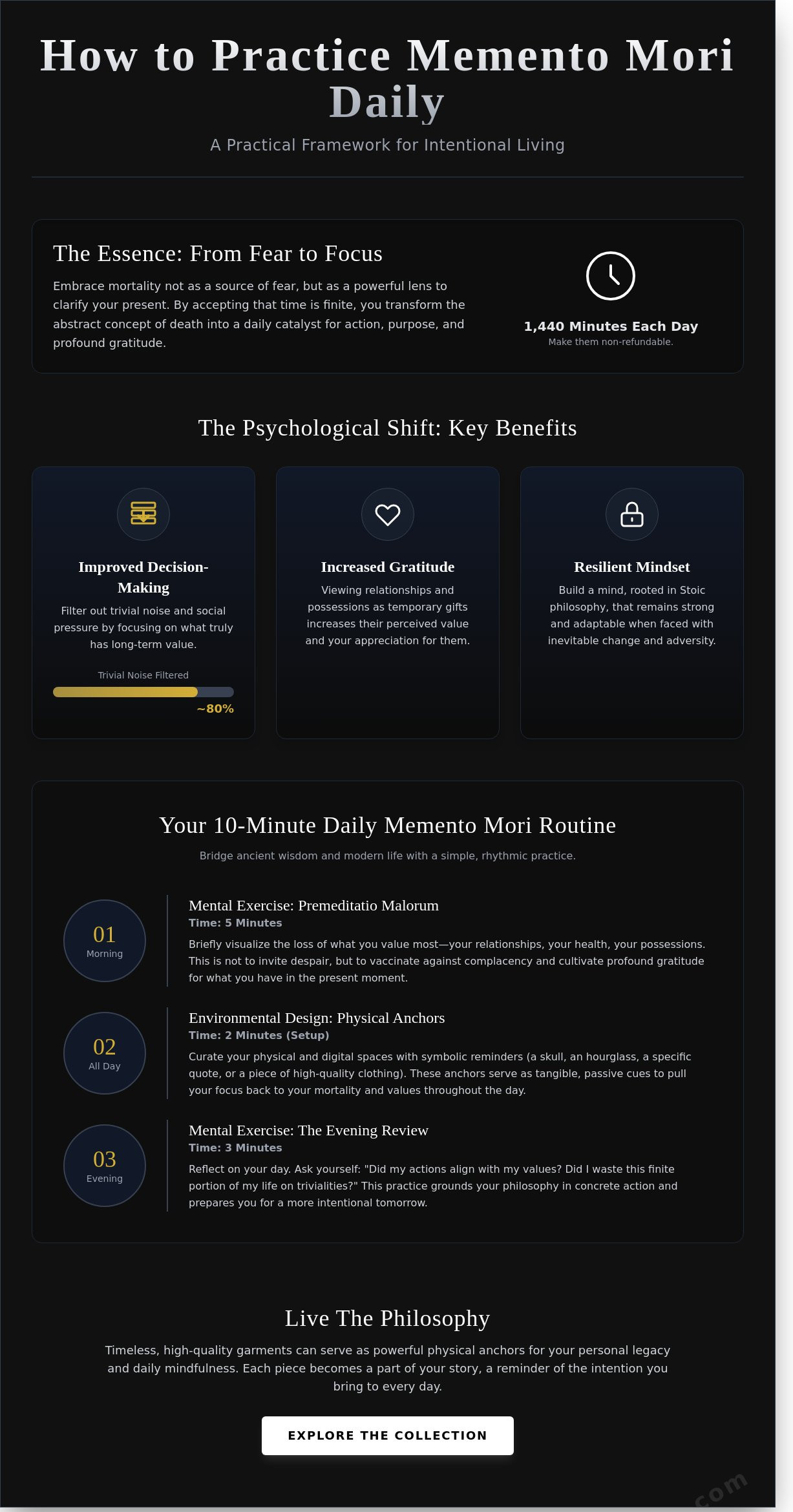
Learning how to practice memento mori daily offers tangible psychological rewards that improve your quality of life. Research into Terror Management Theory suggests that reflecting on mortality can actually increase prosocial behavior and personal growth. Key benefits include:
- Improved decision-making: You filter out approximately 80 percent of trivial noise and social pressure.
- Increased gratitude: You view relationships as temporary gifts, which naturally increases their perceived value.
- Resilient mindset: Stoic philosophy, practiced by leaders since 161 AD, builds a mind that doesn't shatter when inevitable changes occur.
We don't seek the end. We seek the depth of the "now." Every piece of clothing we wear and every word we speak becomes a part of our personal history. This is the art of living with the end in mind. It's restrained. It's meditated. It's necessary for a life of substance.
Mental Exercises: Stoic Techniques for Daily Reflection
The mind is your primary workshop. Transformation doesn't arrive in a single, loud moment of realization; it settles in the quiet spaces between breaths. Philosophy is a slow burn. It's a rhythm. Learning Stoic Techniques for Daily Reflection allows you to build a sanctuary within your own consciousness. In this practice, consistency carries more weight than intensity. A small, daily whisper of your mortality is more effective than a rare, overwhelming existential crisis. It's about the steady pulse of awareness.
Understanding how to practice memento mori daily involves training the ego to accept reality before reality demands it. The ego seeks permanence in a world defined by flux. Mental rehearsal acts as a bridge between your current self and the inevitable truth of change. When you learn how to practice memento mori daily, you begin to see the world with sharper clarity. Every interaction becomes more precious. Every choice carries more weight. This mental discipline is the foundation of the Memento Mori story, where the awareness of death becomes a catalyst for a more vibrant, intentional life.
Premeditatio Malorum (Negative Visualization)
Premeditatio Malorum is a tool for emotional fortitude that transforms fear into preparedness. This technique requires you to briefly imagine the loss of what you value most. It isn't a descent into morbid thoughts. Instead, it's a vaccine against complacency. A 2008 study published in the Journal of Personality and Social Psychology found that "mental subtraction"-the act of imagining the absence of a positive event-boosts current happiness more effectively than simply thinking about the event itself. This practice prevents hedonic adaptation. It stops you from taking your life for granted. By visualizing the end of a relationship or the loss of a possession, you increase your current joy and gratitude for their presence.
The Evening Review: Balancing the Books
Seneca practiced a ritual of "balancing the books" every night before sleep. He treated each evening as the potential end of his journey. This habit turns the day into a complete cycle rather than an unfinished fragment. To adopt this, sit in silence and ask yourself: "What did I do well?" and "What would I change?" These aren't questions of judgment, but of observation. The goal is to go to sleep "complete." When you close your eyes, do so with the satisfaction that you've lived fully. If you wake up the next morning, it's a new gift. It's an extra day you weren't promised. Reflecting on these truths helps you curate a life of substance, much like choosing a timeless piece of heritage apparel that carries your story through the years.
Environmental Design: Creating Physical Reminders of Mortality
Philosophy lives in the mind, but it thrives in the world. To truly master how to practice memento mori daily, you must externalize your inner values. Thoughts are fleeting. Objects endure. The items you choose to surround yourself with act as silent anchors for your subconscious. They shape your perspective before you even realize you've begun to think. Our surroundings are never neutral; they either distract us from our purpose or call us back to it.
Environment is destiny. When your physical space mirrors your philosophical intent, mindfulness becomes effortless. It's about moving from abstract concepts to tangible reality. High-quality objects bridge this gap. Aesthetics play a vital role here. A reminder of mortality shouldn't feel like a threat. It should feel like a homecoming. It's a return to what is essential. By curating your space, you create a sanctuary where the noise of the world fades, leaving only the truth of the moment.
Symbols and Totems in Your Space
Historical art often utilized the vanitas tradition. Skulls, hourglasses, and wilted flowers served as grim yet beautiful reminders of the passage of time. These weren't meant to cause despair. Instead, they were tools for Overcoming the Fear of Death by making the inevitable familiar. In a modern context, you might choose minimalist desk objects or a carefully curated digital wallpaper. Placement is everything. These totems belong in high-visibility areas. Your bedside table, your workspace, or the mirror where you start your day. These are the front lines of your consciousness. When you see these symbols 15 to 20 times a day, the philosophy moves from your head to your heart.
Philosophy You Can Wear: Aesthetic Anchors
What we wear changes how we think. This is enclothed cognition, a term coined by researchers in 2012 to describe the systematic influence that clothes have on the wearer's psychological processes. It's the shift that occurs when a garment carries weight beyond its fabric. Choosing a Memento Mori Vintage Tee transforms a simple outfit into a personal uniform for intentionality. It's a tactile touchstone. Throughout a busy day, the feel of the premium cotton or a glance in the mirror serves as a quiet nudge. It asks: is this how you want to spend your limited time? This is how to practice memento mori daily without saying a word. It's a silent commitment to quality, legacy, and the present moment. You aren't just wearing a brand. You're wearing a reminder of your own timeline.
Your Daily Memento Mori Routine: A Step-by-Step Guide
Philosophy often feels distant, trapped in heavy books and ancient stone. It shouldn't. To understand how to practice memento mori daily, you must move from abstract theory to habitual action. This isn't a morbid obsession; it's a ritual for the modern soul. It builds a quiet, psychological resilience that prepares you for life’s inevitable storms. This framework takes less than 10 minutes total each day. It’s designed to be a subtle thread woven through your existing schedule, adaptable to any lifestyle.
Morning: Setting the Intentional Compass
The first moments of the day are the most fragile. Instead of reaching for a screen, reclaim your consciousness through three deliberate steps.
- Step 1: Acknowledge the gift. Upon waking, spend 60 seconds acknowledging that this 24-hour window isn't a debt repaid to you. It's a gift. The Stoic Seneca famously noted that we die every day because the time that passes belongs to death. Breathe into that reality.
- Step 2: Filter your priorities. Identify one task that would still hold weight if this were your final week. This isn't about productivity; it's about legacy. Choose the interaction or project that truly echoes.
- Step 3: Don your uniform. Dress with intent. Whether you choose an oversized silhouette or a minimalist piece, view your clothing as a philosophical armor. It’s a physical anchor that carries the reminder of your mortality throughout the day.
Mid-Day: The Awareness Check-In
The noise of the world often drowns out our initial intentions. Mid-day is the time to recalibrate your internal compass and shed the weight of trivialities.
- Step 4: The 10-second pause. Use a recurring trigger, like checking your watch or a specific phone notification, to stop. Feel the fabric against your skin. Observe your breath. This 10-second audit breaks the trance of mindless busywork.
- Step 5: Release the trivial. Identify one frustration, perhaps a delayed email or a minor social slight. Ask yourself: "Will this matter in my final hour?" Usually, the answer is a resounding no. Let the irritation dissolve in the face of your finitude.
- Step 6: Re-center on quality. Look at your current task. Whether you’re writing a report or sharing a coffee, commit to doing it with total presence. High-quality attention is the best way to honor the ephemeral nature of time.
Learning how to practice memento mori daily transforms the way you perceive every interaction. It turns mundane moments into a series of conscious choices. If you're ready to make this philosophy a permanent part of your identity, you can embody the philosophy through timeless pieces that serve as your daily reminder.
Living the Philosophy with Memento Clothing
True intentionality demands a physical presence. It's easy to forget the finite nature of time when lost in the digital noise of the 21st century. Memento Mori Clothing exists to ground you. We don't just sell apparel; we provide a partner for your journey into awareness. Our focus remains on heavyweight quality and garments that last, ensuring your philosophy isn't as fleeting as a seasonal trend.
By blending ancient wisdom with the silhouettes of modern streetwear, we've created a medium for the urban philosopher. This is where depth meets the pavement. You aren't just wearing a brand. You're joining a community that values craftsmanship over consumption and substance over spectacle. Understanding how to practice memento mori daily becomes simpler when your very attire serves as a silent, constant reminder of your values.
The Heavyweight Hoodie: A Shield for the Mind
The Memento Mori Heavyweight Hoodie acts as a physical anchor in a chaotic world. Its substance is intentional. When you pull on the dense fabric, you feel its weight. This isn't a thin, disposable layer. It's a presence. The heavy GSM fabric provides a tactile sensation that brings your wandering mind back to the present moment.
Think of it as a modern cowl. In the same way ancient thinkers used their robes to signal their dedication to truth, this hoodie shields the wearer from the trivial. It offers a space for introspection amidst the city's roar. It's a garment designed for those who walk with purpose and recognize the weight of their own mortality. It's built for the long walk.
Craftsmanship Meets Contemplation
Our Memento Mori Crewnecks represent a commitment to longevity. We choose premium materials that don't degrade; they evolve. These pieces age with the wearer, gathering character through every season. This process reflects the passage of time, turning a simple garment into a personal heritage piece. Each stitch is a testament to the belief that some things should endure.
To master how to practice memento mori daily, you need tools that withstand the friction of life. Our designs bridge the gap between the ephemeral and the eternal. Start your practice today. Choose a physical reminder that carries the weight of your convictions. Wear your philosophy. Remember your time. Live with depth.
Embrace the Finite
Understanding mortality isn't about fear; it's about focus. Marcus Aurelius practiced these reflections as early as 161 AD to remain grounded while leading the Roman Empire. You can mirror this discipline by building a routine that values intentionality over distractions. Integrating physical anchors into your space turns an abstract thought into a tangible habit. Learning how to practice memento mori daily requires more than a passing thought. It demands a deliberate environment. Our garments utilize 400gsm heavyweight cotton designed for maximum longevity, mirroring the enduring nature of these Stoic truths. These philosophically driven designs serve as a silent pulse against your skin, reminding you that every second counts. We provide national shipping across the United States, ensuring your daily reminder arrives at your door regardless of your location. Don't let the hours slip away unnoticed. Your legacy starts with the choices you make this morning. Every thread we weave is a testament to the beauty of the present moment. Own your time before it owns you.
Explore the Memento Mori Collection and find your daily anchor.
Frequently Asked Questions
Is practicing Memento Mori supposed to make me sad?
Practicing Memento Mori isn't designed to induce sadness; it serves as a catalyst for presence. Marcus Aurelius wrote in Meditations that remembering death clarifies our priorities. A 2017 study in the journal Psychological Science found that awareness of mortality can increase altruism and gratitude. It's a tool for life. This perspective shifts focus from what we lack to the value of the current hour.
How is Memento Mori different from YOLO (You Only Live Once)?
Memento Mori differs from YOLO through its emphasis on intentionality rather than impulse. While YOLO often justifies reckless behavior, Memento Mori invites reflection on your legacy. Seneca suggested that we should live as if each day were a complete life. This is how to practice memento mori daily with purpose. It's the difference between wasting time and cherishing it. It's about depth, not just speed.
Can I practice Memento Mori if I am not a Stoic?
You don't need to be a Stoic to embrace this philosophy. Various cultures, including 15th-century European artists and Tibetan Buddhists, have used death as a teacher. The Maranasati meditation in Buddhism has existed for over 2,500 years. It's a universal human practice. Anyone seeking a deeper connection to their time can find value in these reflections. It transcends any single school of thought.
What are some simple Memento Mori triggers for a busy workday?
Use physical anchors like a specific ring or a minimalist desktop wallpaper. Set a notification for 12:00 PM to pause for 30 seconds. A 2021 survey showed that 68% of professionals feel overwhelmed by digital noise. A simple coin in your pocket acts as a tactile reminder. It grounds you when the schedule feels chaotic. These small triggers transform a busy day into a series of meaningful moments.
Is it okay to wear Memento Mori symbols if I am religious?
Religious traditions often incorporate these symbols as reminders of divine priority. In Catholicism, the Ash Wednesday ritual dating back to the 11th century explicitly uses the phrase "Remember that you are dust." It complements faith rather than contradicting it. Wearing a skull or a timepiece signifies a respect for the soul's journey. It's a cross-cultural expression of humility that acknowledges our shared human condition.
How do I explain my Memento Mori practice to friends or family?
Explain that remembering death helps you love them better. Tell them it's about removing distractions to focus on what matters. This is a core part of how to practice memento mori daily without sounding morbid. You can mention that it makes you more patient. People usually understand when they see the resulting calm in your character. It's an invitation to live more fully together.
Does meditating on death actually help with anxiety?
Meditating on mortality reduces anxiety by shrinking the perceived size of daily stressors. Research from the University of Arizona in 2015 indicates that structured reflection on death can lower defensive reactions. It puts a deadline on your worries. When the ultimate end is acknowledged, the fear of a missed deadline or a social slip loses its power. It provides a quiet, steady confidence.