
How to Make Your Clothes Last Longer: A Guide to Intentional Garment Care
What if the most sustainable garment in your closet isn't the one you just bought, but the one you've loved for a decade? There is a quiet, heavy frustration in watching a favorite vintage tee lose its depth or seeing a cherished hoodie surrender its shape to a mindless machine cycle. Understanding how to make your clothes last longer is a quiet rebellion against the transience of modern trends. You likely feel that your clothes are more than just products; they are anchors for your personal history. Yet, with the fashion industry accounting for 10% of global carbon emissions, durability is now a necessary act of mindfulness.
We agree that the era of disposable fashion must end. This guide explores the intersection of textile science and mindful maintenance to preserve the life, color, and story of your favorite pieces. We will look at the ritual of cold-water washing, the technical nuances of fabric stress, and how new 2026 standards like ISO 9348 are reshaping our approach to garment longevity. Discover how to transform routine maintenance into a meditative practice that honors the items you wear and ensures your wardrobe remains a timeless reflection of your journey.
Key Takeaways
- Embrace the philosophy of permanence by viewing garment care as a ritual of respect for craftsmanship and personal history.
- Learn the technical science of textile stress, including how to make your clothes last longer by mitigating the destructive forces of heat and friction.
- Preserve fiber integrity and tensile strength by avoiding high-heat drying and mastering gravity-aware storage techniques.
- Reframe mending as a badge of honor, using a simple toolkit to restore the narrative of your most cherished pieces.
- Invest in the physics of durability by choosing heavyweight fabrics with high GSM to ensure resilience against years of wear.
The Philosophy of Permanence: Why Caring for Your Clothes Matters
Objects carry weight. A piece of clothing is not merely a utility; it is a container for memory. When we choose to understand how to make your clothes last longer, we are practicing a form of intentional living that honors the hands that built the fabric. This is the heart of the Memento Mori philosophy. It is a recognition of transience. By preserving a meaningful item, we acknowledge the passage of time while stubbornly holding onto the stories woven into the seams. Modern culture has desensitized us. We have forgotten the value of a single thread, replaced by a cycle of endless acquisition. We now treat garments as ephemeral shadows rather than lasting companions.
True craftsmanship demands a witness. To ignore the care of a well-made piece is to ignore the artistry of its creation. A wardrobe narrative is built through years of shared experience. It is the hoodie you wore during a defining winter or the tee that has softened over a thousand sunsets. These items become part of your individual footprint. They are the physical remnants of your personal history. Learning the nuances of garment care is the only way to ensure these witnesses don't fade before their time. It is about respecting the material's journey as much as your own.
Breaking the Cycle of Disposable Fashion
The true cost of a cheap garment is hidden in its brevity. Fast fashion relies on a psychological trick. It suggests that novelty is more valuable than history. When you shift from being a consumer to a steward of your apparel, your perspective changes. You no longer see a Memento Mori Heavyweight Hoodie as a temporary possession. It becomes an emotional anchor. High-quality garments age with you. They develop a patina of lived experience that a new, flimsy replacement can never replicate. This stewardship is a quiet rebellion against a world that demands we constantly discard the old for the sake of the hollowly new.
The Environmental Impact of Longevity
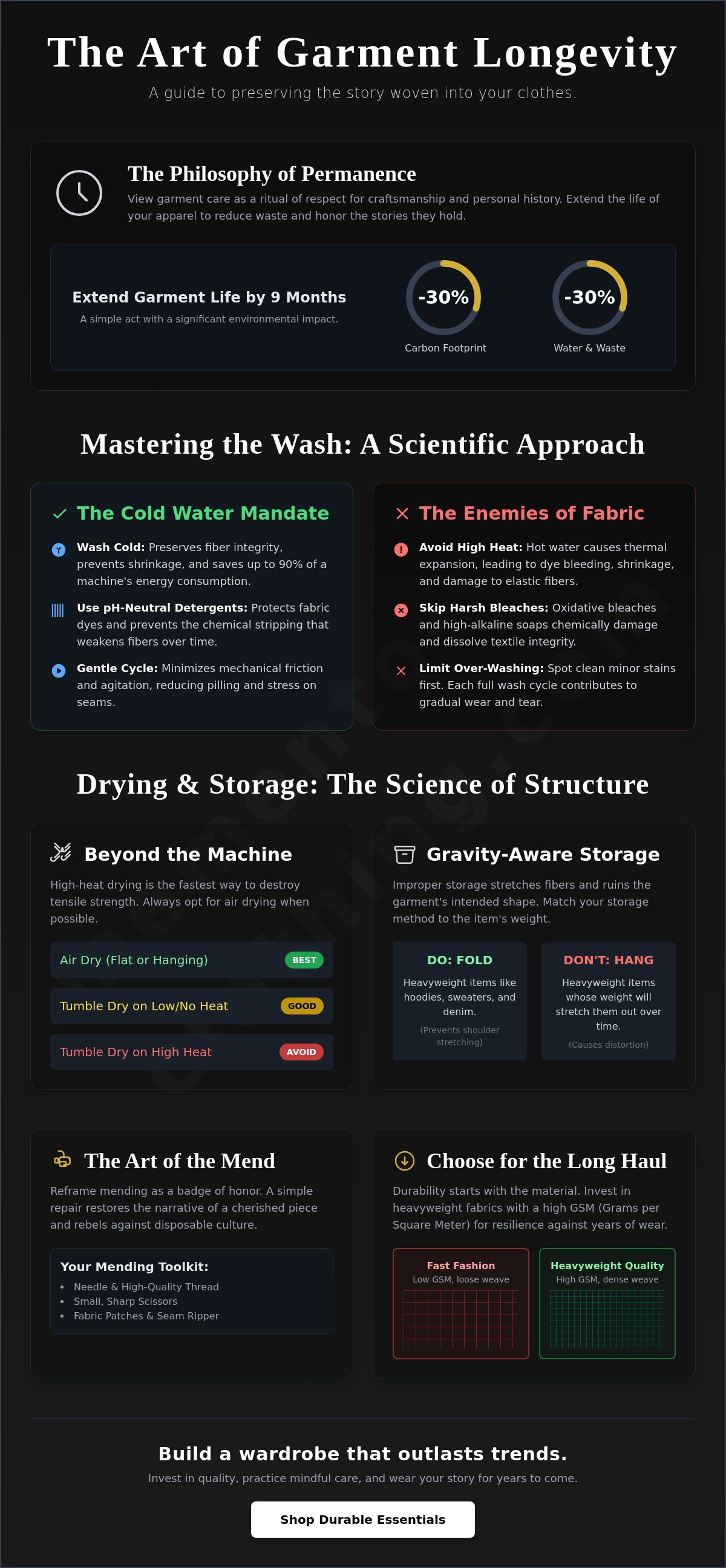
Care is a form of conservation. Research indicates that extending the life of a garment by just nine months can reduce its carbon, water, and waste footprints by approximately 30%. This simple act of preservation is more impactful than many industrial solutions. Beyond carbon, mindful maintenance reduces the shedding of microplastics into our oceans. Adopting textile conservation principles in your daily routine transforms a chore into a contribution. By focusing on heavyweight basics and durable materials, you build a wardrobe that respects the planet. It is a commitment to a minimalist future where quality outweighs quantity. Understanding how to make your clothes last longer is the bridge between personal style and global responsibility.
Mastering the Wash: Protecting Fabric Integrity Through Science
The washing machine is a vessel of hidden violence. While we perceive it as a tool of renewal, the mechanical agitation and thermal stress act as a slow erosion on the fibers we cherish. Heat is the primary antagonist. It targets the natural moisture in cotton and the delicate binders in elastic, leaving them brittle and prone to failure. Friction follows. As garments tumble, fibers rub against each other, creating the tiny knots of pilling that signal a garment's decline. To master how to make your clothes last longer, we must treat the wash as a scientific process rather than a mindless chore.
Chemical choices matter deeply. Harsh oxidative bleaches and high-alkaline detergents strip away more than just stains; they dissolve the integrity of the textile itself. Opting for pH-neutral detergents preserves the deep saturation of a Memento Mori Vintage Tee, ensuring the color remains as haunting and vivid as the day it was created. Before committing to a full immersion cycle, embrace the 'Spot Clean First' rule. Often, a gentle touch on a localized mark is enough to revive a piece without subjecting the entire structure to the trauma of the drum.
The Cold Water Mandate
Thermal expansion is the silent killer of fit. Hot water forces fibers to swell, leading to dye release and the inevitable heartbreak of shrinkage. Modern chemistry has evolved; today’s detergents are engineered for peak performance in cold cycles. There is also a quiet environmental logic to this choice. Approximately 90% of a washing machine's energy consumption is dedicated solely to heating water. By choosing cold, you preserve the planet while adhering to essential laundry best practices that protect your wardrobe's longevity.
Inversion and Protection
Preservation requires a defensive posture. Always wash garments inside out. This simple act of inversion ensures that the face of the fabric, the part the world sees, is shielded from the abrasive friction of the cycle. For items with high-density graphic prints or delicate weaves, mesh laundry bags provide a necessary sanctuary. Preparation is equally vital. Zip up every zipper and fasten every button. Exposed metal teeth act like serrated blades against soft cotton, causing micro-tears that eventually become irreparable holes. Every closed fastener is a promise of continuity for your clothing.
Beyond the Machine: Drying and Storage Strategies for Longevity
The dryer is a silent thief of time. While it offers the convenience of speed, it extracts a heavy toll on the structural integrity of your wardrobe. If you want to understand how to make your clothes last longer, you must look at the lint trap. That soft, grey fuzz is not merely dust; it is the disintegrated remains of your favorite garments. Every high-heat cycle is a mechanical assault that snaps fiber tensile strength and weakens the seams until they eventually surrender. Heat is the enemy of continuity.
Air drying is the most profound act of sustainable garment care. It allows fibers to settle back into their natural state without the trauma of high-velocity tumbling. For heavyweight items, the ritual of the 'Flat Dry' is essential. Gravity is a slow but persistent force. When a wet, heavy garment is hung, the water weight pulls at the shoulders, permanently distorting the silhouette. Laying these pieces flat on a clean, ventilated surface preserves their original architecture and prevents the slow stretch of time.
The Dangers of Mechanical Drying
The 'Dryer Death' theory isn't hyperbole. It's a scientific reality. Heat acts as a catalyst for fiber degradation, making natural cotton brittle. If a dryer is unavoidable, the 'low-heat only' rule is your only defense. This reduces the thermal shock to the fabric. Constant tumbling also causes friction that accelerates the pilling mentioned in previous sections. Choosing to air dry is a commitment to the longevity of the thread. It is a choice to let your clothes age with grace rather than under duress.
Folding vs. Hanging: A Material Guide
Storage is the final stage of stewardship. Not all garments belong on a hanger. Memento Mori Heavyweight Hoodies should always be folded. Their substantial GSM (grams per square meter) makes them too heavy for standard hangers, which inevitably create unsightly shoulder bumps. Conversely, lightweight tees can be hung if you use padded hangers to prevent collar stretching. This nuance is key to how to make your clothes last longer in a curated collection.
Protecting your collection from external threats is equally vital. UV light from a window can bleach color in a matter of months. Humidity invites mold. To deter pests without the harsh scent of chemicals, use cedar blocks or lavender sachets. These natural alternatives provide a non-toxic barrier against moths while adding a subtle, clean aroma to your space. Every choice in storage is a choice to honor the life of the garment. It is the difference between a temporary possession and a lasting legacy.
The Art of the Mend: Reviving Your Wardrobe’s Narrative
To mend is to remember. It is an act of defiance against the throwaway culture that permeates our modern existence. When we discuss how to make your clothes last longer, we must view a tear not as an end, but as a transition. A repair is a badge of honor. It signals that a garment is worthy of our time and our touch. This philosophy shifts the narrative from poverty to stewardship. A well-mended piece carries more weight than one that has never known a needle. It reflects a life lived with intention. It is an acknowledgment that some things are too valuable to be discarded.
Every intentional steward needs a modest toolkit. A set of sharp needles. High-quality thread. A reliable fabric shaver. These are the tools of preservation. Catching wear early is vital. Look for thinning threads or loose loops before they surrender to the void. The Visible Mending movement takes this further by making repairs part of the garment's aesthetic. It celebrates the scar. By using contrasting threads or intricate stitching, you turn a flaw into a feature. You ensure the story of the piece remains visible. It becomes a unique map of your shared history.
Depilling and Surface Maintenance
Pilling is the physical manifestation of friction. On synthetic blends, these tiny spheres are stubborn and unsightly. On high-quality natural cotton, they are softer and more easily managed. Maintaining the hand-feel of a Memento Mori Vintage Tee requires a gentle touch. Use a fabric shaver or a cashmere comb with precision. Glide the tool over the surface to remove the fuzz without wounding the underlying structure. This ritual restores the original clarity of the weave. It preserves the tactile experience that defines a premium garment.
Basic Structural Repairs
Structural integrity is the foundation of longevity. Reinforcing a thinning seam takes only moments but adds years of life. Start by aligning the edges. Use a backstitch for maximum strength. Secure the end with a hidden knot. Reattaching a button follows a similar logic. Always create a small thread shank between the button and the fabric. This allows for the thickness of the closure without straining the thread. For small holes in heavyweight fabric, the 'Inside-Out Patch' provides invisible support. It acts as a silent reinforcement. By mastering these small acts, you truly learn how to make your clothes last longer through direct intervention. Invest in pieces designed to age with you by browsing our collection of heavyweight essentials.
Choosing for the Long Haul: Why Heavyweight Quality is the Ultimate Hack
The physics of durability is a quiet truth. While the rituals of washing and mending are essential, they can only preserve what is fundamentally sound. Choosing the right materials is the ultimate secret in how to make your clothes last longer. It begins with GSM, or grams per square meter. This metric defines the density and weight of the knit. A higher GSM signifies a tighter, more resilient weave that resists the stretching and tearing common in thinner fabrics. Heavyweight cotton isn't just a stylistic choice; it is a commitment to structural permanence.
High-quality construction is visible if you know where to look. Double-needle stitching at the seams and reinforced necklines are the marks of a garment built for the years. These details ensure that the piece can withstand the mechanical stress of wear without losing its silhouette. When you invest in intentional basics, you're building a foundation that doesn't surrender to the passage of time. It's about finding pieces that possess the inherent strength to age with grace. By selecting superior materials, you simplify the journey of how to make your clothes last longer from the very first day.
The Heavyweight Advantage
Density is a shield against the elements. Memento Crewnecks utilize a substantial weave that naturally resists warping and pilling. Contrast the drape of a 12oz cotton garment with the standard 5oz retail alternative. The lighter fabric is translucent and prone to disintegration; the heavier fabric offers a protective weight that maintains its integrity through countless cycles. This denser weave provides a natural resilience against abrasion, ensuring the surface remains smooth and the structure stays firm for years of consistent use.
Building a Legacy Wardrobe
A wardrobe should be a curated collection of memories, not a graveyard of discarded trends. By choosing pieces that reflect the Memento Mori story, you align your style with a philosophy of timelessness. The math of 'Cost Per Wear' reveals the true value of quality. A $100 hoodie that survives five winters is significantly more economical than a $20 version that loses its shape after three washes. Your clothes are a physical manifestation of your individual legacy. They deserve the respect of careful selection and intentional care. Treat them as the anchors of your history, and they'll remain with you as faithful witnesses to your journey.
A Living Legacy: Stewardship of the Thread
Preserving a garment is a quiet act of devotion. By mastering how to make your clothes last longer through cold-water rituals and gravity-aware storage, you transform utility into history. You've learned that pilling is not a death sentence and that a visible mend is a badge of honor. These practices ensure your favorite pieces don't merely exist in your closet but age alongside you. They become anchors for your personal narrative, surviving the transience of modern trends. Every thread you save is a commitment to a more intentional way of being.
True longevity begins with a foundation of strength. Our pieces are crafted from premium heavyweight cotton and designed for a lifetime of wear, not a fleeting season. This is the intersection of ancient philosophy and modern durability. We invite you to Explore the Memento Mori Collection of Intentional, Heavyweight Apparel and discover garments rooted in a philosophy of permanence. Your wardrobe is your legacy. Treat every thread with the respect it deserves, and it will carry your story forward for years to come.
Frequently Asked Questions
How often should I actually wash my hoodies and jeans?
Wash these items only when they are visibly soiled or after ten wears. Over-washing is the silent architect of fiber fatigue and color loss. Between cycles, choose to air your garments in a cool, shaded space. Spot cleaning localized marks preserves the structural integrity of the piece. This restraint is a fundamental step in how to make your clothes last longer while respecting the material's natural state.
Does dry cleaning really make clothes last longer than home washing?
Dry cleaning is often more aggressive than a careful home wash. The process relies on chemical solvents that can strip natural oils from cotton and degrade delicate fibers over time. For heavyweight essentials, a cold, gentle home cycle is usually superior. Reserve dry cleaning only for complex, structured wool pieces or items labeled with strict professional requirements. Trust your own hands for daily preservation.
Can I reverse shrinkage if I accidentally put a cotton tee in the dryer?
You can often restore the silhouette by soaking the garment in lukewarm water mixed with a small amount of hair conditioner. The conditioner acts as a lubricant, relaxing the tightened cotton fibers. After twenty minutes, gently stretch the damp fabric back to its original dimensions. Lay it flat to dry on a clean towel. This ritual of restoration can breathe new life into a stressed textile.
What is the best way to store heavy winter clothes during the summer?
Clean every piece thoroughly before folding them into breathable cotton storage bags. Avoid plastic bins. They trap moisture and can lead to yellowing or fiber rot over several months. Place cedar blocks or lavender sachets inside to provide a natural barrier against pests. This mindful storage ensures your heavyweight collection remains in a state of suspended animation, ready for the first frost of the coming year.
Is it better to use liquid detergent or powder for fabric longevity?
Liquid detergent is the gentler choice for garment longevity. Powders are often abrasive and may not dissolve completely in the cold water cycles required for how to make your clothes last longer. Undissolved particles can settle into the weave, causing friction and eventual fiber breakage. A pH-neutral liquid formula cleans effectively without compromising the deep saturation of the fabric's dye or its tactile softness.
How do I stop my black clothes from fading so quickly?
Always wash dark items inside out and add a half-cup of white vinegar to the rinse cycle. The vinegar helps seal the pigment into the thread and prevents soap residue from dulling the finish. Never dry black clothes in direct sunlight. The sun's ultraviolet rays act as a natural bleach. They will erase the melancholic depth of a dark garment in a single afternoon of exposure.
Are fabric softeners actually bad for my high-quality clothing?
Fabric softeners are generally detrimental to high-quality textiles. They coat the fibers in a waxy, chemical film that reduces breathability and can eventually weaken the fabric's internal structure. This coating also makes garments more susceptible to trapping odors and oils. For heavyweight cotton, the most authentic softness comes from the passage of time and the natural breaking-in of the fibers through intentional wear.
What should I do if a heavyweight garment starts to lose its shape?
Use a steam iron to realign the fibers while the garment is slightly damp. The heat and moisture allow you to gently guide the fabric back to its intended silhouette. Pay close attention to necklines and hems where stretching is most common. This structural realignment is a quiet, meditative task. It restores the original architecture of the piece and ensures it continues to hang with confidence.