
How to Express Philosophy Through Style: A Guide to Intentional Dressing
Your wardrobe is either a collection of random artifacts or a deliberate manifesto of your existence. In a global market projected to reach $3.1 trillion by 2030, most people are simply consuming noise. You likely feel the hollow pull of fast fashion that fails to translate your abstract convictions into something tangible. Learning how to express philosophy through style isn't about vanity. It's about reclaiming your visual identity from the ephemeral.
We recognize that fashion often feels like a shallow pursuit, especially when 71% of industry executives plan to raise prices in 2026 without increasing the soul of the product. This guide will show you how to transform your daily attire into a tool for deep self-reflection. We'll examine the semiotics of heavyweight fabrics, the power of intentionality, and how to curate a wardrobe that serves as a lasting memento of your values.
Key Takeaways
- Distinguish between the fleeting noise of fashion and the enduring nature of style as a visual syntax for your internal world.
- Discover how to express philosophy through style by selecting symbols and fabric weights that mirror your intellectual substance.
- Master a four-step wardrobe audit to remove inauthentic pieces and align your collection with core tenets like Stoicism or Existentialism.
- Use layering and texture as narrative tools to represent the complexity of thought and the dialectics of human experience.
- Understand why wearing reminders of finitude serves as a profound celebration of life and the present moment.
Understanding Style as a Silent Philosophical Language
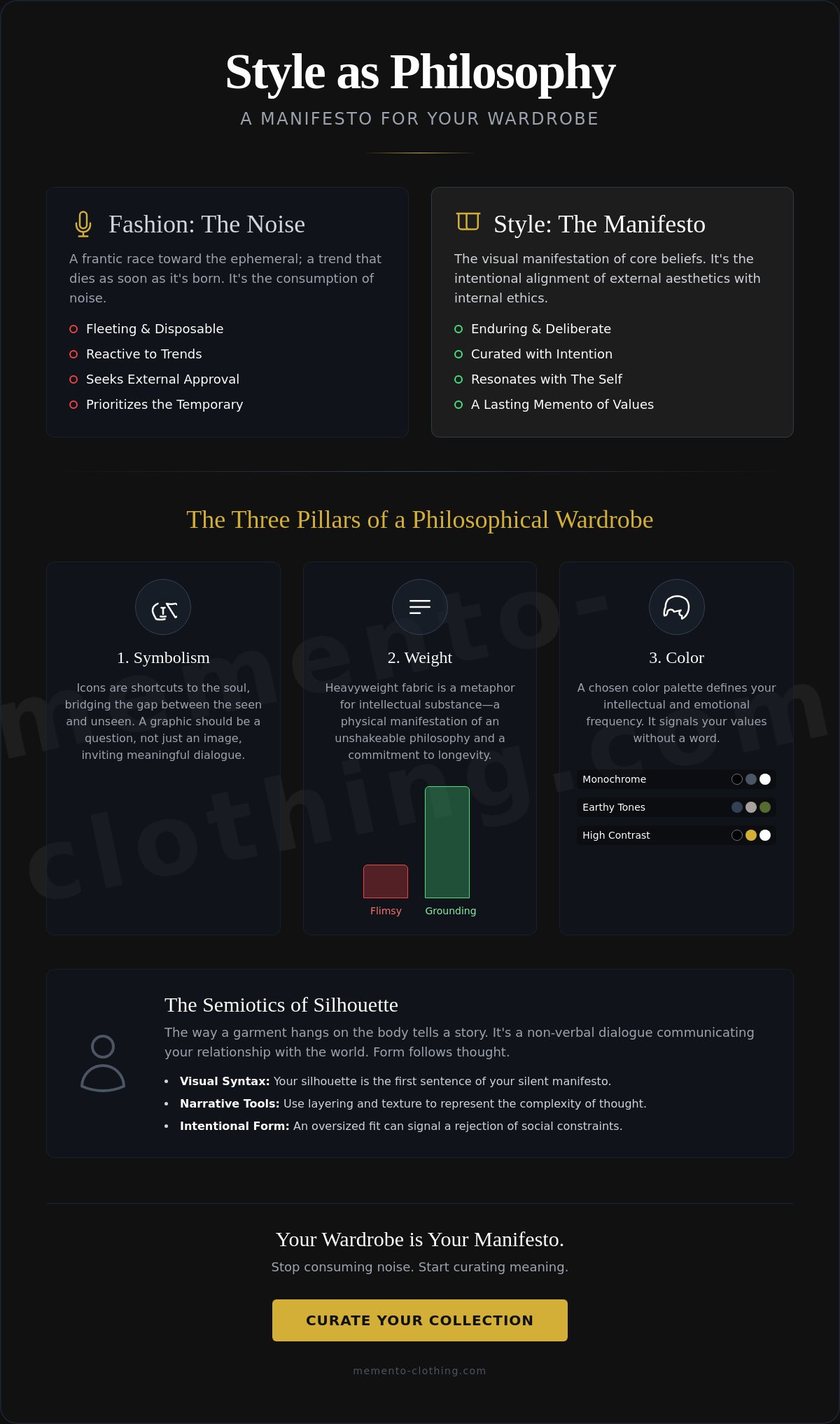
Clothing is more than a shield against the elements. It's a non-verbal dialogue that speaks before you do. While vanity seeks the fleeting approval of the crowd, style seeks a deep resonance with the self. Learning how to express philosophy through style begins with recognizing that garments are not mere cover; they are the visual syntax of your internal world. Fashion is often a frantic race toward the ephemeral; it's a trend that dies as soon as it's born. Style is the opposite. It's the visual manifestation of a person's core beliefs. Historical figures frequently used dress to signal intellectual allegiances. The Stoics favored simplicity to reflect their focus on internal virtue over external wealth. Philosophical Dressing is the intentional alignment of external aesthetics with internal ethics.
Moving Beyond the Triviality of Fast Fashion
Fast fashion contradicts a life of contemplation. It prioritizes the temporary over the permanent. In 2023, the global fashion market generated $1.8 trillion in revenue, much of it driven by disposable garments designed to be discarded. These items don't last. They lack soul. Wearing garments that reflect your values has a profound psychological impact. It grounds you in your own history. You stop being a passive consumer reacting to trends. You become a curator. This shift in mindset ensures that every piece in your wardrobe has a reason to exist beyond a seasonal impulse.
The Semiotics of the Silhouette
The way a garment hangs on the body tells a specific story. This is the semiotics of fashion; the study of how clothing functions as a system of signs and symbols. Fit and form communicate your relationship with the world. Oversized silhouettes, for example, often act as a rejection of traditional social constraints. They provide physical and mental space for the self to exist apart from the gaze of others. These visual cues allow you to engage with complex narratives like the Memento Mori story. A heavyweight fabric or a specific cut becomes a meditation on mortality and presence. Form follows thought. Your silhouette is the first sentence of your silent manifesto.
The Three Pillars of Philosophical Style: Symbolism, Weight, and Color
Understanding how to express philosophy through style requires a specific set of tools. You don't just wear clothes; you wear convictions. These tools are symbolism, weight, and color. They form the foundation of a curated wardrobe that acts as a silent manifesto. When these elements align, your attire becomes a deliberate choice rather than a habit. It's a way to ground your abstract thoughts in the physical world and provide a sense of visual continuity to your internal beliefs.
Symbolism and the Power of the Graphic
Icons are the shortcuts of the soul. They bridge the gap between the seen and the unseen. A graphic shouldn't just be an image; it should be a question. It should challenge the observer and the wearer alike. The Memento Mori Vintage Tee acts as this bridge. It reminds us that time is our only true currency. This isn't about darkness. It's about clarity and the legacy we leave behind. Choosing iconography that resonates with your worldview allows your clothing to invite meaningful dialogue rather than superficial glances.
The Philosophy of Heavyweight Fabric
The tactile nature of weight is a metaphor for intellectual substance. In a world of flimsy, disposable items, heavyweight fabric represents a commitment to longevity. It's a rejection of the superficial. The sensory experience of wearing a Memento Mori Heavyweight Hoodie provides a sense of physical security. It's a constant reminder of your own presence. Fabric density is the physical manifestation of an unshakeable philosophy. This weight provides a constant, grounding touch throughout the day, anchoring you to your values even when the world feels chaotic.
Color Palettes as Intellectual Moods
Choosing a color palette is an exercise in defining your emotional frequency. Monochrome dressing is an act of restraint. It signals a mind that values form and substance over loud distractions. Earthy tones connect the wearer to the Stoic tradition of living in accordance with nature. Slate, bone, and olive aren't just colors; they're connections to the natural order. Using sharp contrast, like deep blacks against stark whites, mirrors the dualities of existence. It acknowledges the tension between life and death, light and shadow.
Research into a psychological approach to fashion confirms that these aesthetic choices influence our cognitive processes and well-being. When you align these pillars, you aren't just getting dressed. You're preparing for the world with a sense of purpose. Your wardrobe becomes a tool for self-reflection. Explore our Memento Mori Clothing collection to find pieces that resonate with your own story and provide a foundation for your intentional style.
How to Curate a Meaningful Wardrobe: A 4-Step Process
Building a wardrobe that reflects your soul is a process of subtraction as much as addition. It requires a move from the chaotic impulse of the consumer to the disciplined eye of the curator. Most closets are graveyards of past versions of ourselves. They contain garments bought for occasions that never happened or trends that died within months. Understanding how to express philosophy through style starts with a commitment to clarity. By following a structured process, you can ensure that every piece you own serves a higher purpose. This is the path to a silent manifesto.
Auditing for Authenticity
The first step is a purge. Open your wardrobe and confront the noise. Research suggests that most people only wear 20% of their clothing 80% of the time. The rest is often debris from forgotten marketing campaigns. Remove any item that was bought for a fleeting trend rather than a lasting truth. For every garment, ask the Philosophical Question: "Does this represent who I am becoming?" If the answer is no, the item has no place in your future. There is a profound liberation in owning fewer pieces. A lean wardrobe reduces decision fatigue and forces you to confront the weight of your choices. It turns your morning routine into a meditative act of preparation.
Economic uncertainty in 2026 has made this intentionality more than just an aesthetic choice. With 46% of fashion executives expecting industry conditions to worsen this year, investing in pieces that last is a practical necessity. You are not just buying a shirt; you are selecting a tool for living.
Investing in Anchor Pieces
Anchor pieces are the pillars of your visual language. These are the versatile, high quality garments that form the core of your daily uniform. Memento Mori Clothing Crewnecks serve as perfect examples of these foundational items. They offer a sense of physical and intellectual stability. Quality construction is a prerequisite for a philosophical wardrobe because it mirrors the durability of your beliefs. Flimsy fabrics suggest flimsy convictions. Heavyweight cotton provides a significant return on investment. It doesn't just survive the wash; it ages with you, gaining character over time. These pieces become emotional anchors that ground you in your personal history.
- Define your tenets: Identify if you lean toward the restraint of Stoicism or the complexity of Existentialism.
- Select your palette: Stick to colors that reflect your internal mood and ensure total inter compatibility.
- Prioritize fabric: Choose weights that offer a physical presence and tactile feedback.
- Practice mindful maintenance: Treat laundering and repair as a ritual of respect for your tools.
Care is the final step. When you repair a seam or carefully fold a heavyweight hoodie, you are practicing a form of discipline. You are acknowledging that nothing is permanent, but quality is worth preserving. This maintenance is an act of respect for the resources used and the message the garment carries. It's the difference between owning a product and honoring a memento.
Advanced Styling: Layering Narrative into Your Outfit
Layering is an architectural act. It mirrors the complexity of human thought and the overlapping nature of our identities. We are rarely one-dimensional; our clothing shouldn't be either. Mastering how to express philosophy through style requires moving beyond the single garment. It's about how pieces interact to create a cohesive narrative. A single layer is a statement. Multiple layers are a story. By carefully selecting what goes over and under, you communicate the depth of your character without saying a word. This approach transforms dressing from a daily necessity into a deliberate composition of the self.
The Dialectics of Texture
Texture functions as the physical language of life's contradictions. By mixing rough and smooth materials, you acknowledge the dialectics of existence. Contrast is essential here. Combining a vintage wash with a modern, high density fabric bridges the gap between heritage and the present moment. While earlier sections focused on the individual weight of garments, advanced styling looks at the friction between them. A rugged, textured outer layer worn over a soft, refined base creates a powerful visual metaphor. It represents the tension between our external resilience and our internal sensitivity. This balance shows a mind that understands the dualities of the human condition.
Accessories as Conversation Starters
Small details often carry the heaviest philosophical weight. Accessories like Memento Mori Clothing Hats are not mere additions; they are anchors. They signal community and shared values to those who recognize the symbols. These details act as private reminders of your own tenets. Sometimes the most potent statement is a hidden detail that only the wearer knows is there. It's a silent pact with yourself. It ensures that your intentionality remains intact, even in the most subtle choices. These pieces serve as emotional horgonyok, keeping you tethered to your purpose throughout the day.
Dressing for different contexts doesn't mean abandoning your beliefs. It means adapting the visual language to the environment. You can maintain your core aesthetic in a professional setting by focusing on the quality of the fit and the density of the fabric. The substance remains the same; only the silhouette shifts to meet the demands of the occasion. This consistency is the hallmark of a truly intentional wardrobe. It shows that your philosophy isn't a costume you put on, but a foundation you live by. Your style becomes a constant in a world of variables.
Ready to build your narrative? Shop the Memento Mori Clothing collection to find the layers that define your story and express your enduring values.
Memento Mori: A Case Study in Living and Dressing with Finitude
The concept of Memento Mori has deep roots in the Dutch Vanitas paintings of the 1600s. These artists used skulls and extinguished candles to whisper of the transience of life. Today, that whisper becomes a visual shout on the streets. This is the final lesson in how to express philosophy through style. Wearing a reminder of death isn't a morbid obsession. It's a profound celebration of the present. It strips away the trivial and leaves only the essential. The Memento Mori lifestyle is one of urgent intentionality. By acknowledging the end, we give the middle more meaning.
The Symbolism of the Skull and the Hourglass
Modern aesthetics have moved beyond the macabre. We now interpret these classic motifs through a minimalist lens. A skull isn't a threat; it's a neutral fact of our shared biology. An hourglass isn't a countdown; it's a call to action. These symbols help move the wearer from a consumer mindset to a curator mindset. They act as anchors for the soul.
- The Skull: A symbol of equality and the shared human condition.
- The Hourglass: A reminder that time is our only non-renewable resource.
- The Candle: A representation of the light of consciousness in a vast world.
Craftsmanship as a Philosophical Act
Integrity starts at the loom. High-quality manufacturing is a form of respect for the wearer and the message. There's a beautiful irony in creating garments engineered to outlast the person wearing them. It highlights our own finitude while celebrating human creation. Heavyweight garments are the physical counterpart to heavyweight ideas. They don't yield to the wind or the wash. They remain. As US consumers' spending on fashion ranks fourth for discretionary spending in 2026, the choice of where to place that capital becomes a moral one. Your style is the legacy you wear every day. It's the footprint you leave in the world, one intentional layer at a time.
Curate Your Silent Manifesto
Your wardrobe is no longer a collection of fabrics. It's a declaration of presence. Mastering how to express philosophy through style requires a shift from passive consumption to active curation. You've learned to audit for authenticity and select pieces that mirror your internal tenets. Symbols like the skull or hourglass serve as anchors; they ground you in the reality of the present moment. This is the art of living with finitude.
Quality is the prerequisite for this journey. Our garments feature heavyweight 12oz cotton construction and vintage inspired graphics designed to survive the cycles of time. These aren't just products. They're tools for legacy. When you choose pieces built for longevity, you reject the disposable nature of modern culture. You choose to wear your history rather than follow a trend.
Step into a life of urgent intentionality. Explore the Memento Mori Collection and find your intentional style. Every choice you make is a mark left on the world. Make yours meaningful.
Frequently Asked Questions
Is expressing philosophy through style just another form of branding?
Philosophical style is the opposite of corporate branding because it focuses on internal resonance rather than external sales. Personal style is a silent dialogue with the self. While brands seek to project a manufactured image to a mass audience, intentional dressing is about aligning your external aesthetics with your private ethics. It turns your wardrobe into a personal manifesto rather than a billboard for a company.
How do I start dressing philosophically if I’m on a budget?
Start with subtraction rather than spending. A 2026 consumer survey revealed that fashion spending now ranks fourth behind dining and travel, making every purchase a significant choice. Remove the items that don't represent your values. By owning fewer, more meaningful pieces, you create space for a single, high quality anchor that will outlast a dozen fast fashion alternatives. Quality is a long term investment in your identity.
Can I express multiple philosophies through my style at once?
You can certainly blend different schools of thought through layering and texture. A structured coat might represent the discipline of Stoicism, while a relaxed, oversized hoodie underneath speaks to the freedom of Existentialism. Mixing these elements allows you to represent the complex dialectics of the human experience. Your style should be as nuanced as your own intellectual journey.
Why is fabric weight so important in philosophical dressing?
Fabric weight provides a physical presence that acts as a metaphor for the substance of your ideas. Flimsy, lightweight materials often mirror the disposable nature of modern trends. Heavyweight cotton, specifically the 12oz construction found in premium garments, offers tactile feedback that grounds the wearer in the present moment. This density is the physical manifestation of an unshakeable worldview.
What are the best colors for a Stoic-inspired wardrobe?
Neutral and earthy tones are the foundation of a Stoic aesthetic. Slate, olive, and bone represent a connection to the natural order and a rejection of loud, distracting trends. These colors promote a sense of calm and focus. By limiting your palette, you emphasize the form and quality of the garment over superficial flashiness.
Does wearing Memento Mori clothing make people think I'm obsessed with death?
Wearing these symbols actually signals an obsession with the quality of life. It’s a visual reminder that time is a non-renewable resource. Most observers find that these graphics invite deep, meaningful conversations rather than morbid discomfort. It’s about living with urgent intentionality. You are simply acknowledging a neutral fact of existence to better appreciate the present.
How do I explain my style choices to others who think it's just fashion?
Explain that your clothing functions as a tool for self-reflection. Tell them that learning how to express philosophy through style has helped you move from being a consumer to being a curator. You aren't following a trend; you are practicing a discipline. Most people respect the idea that your visual identity is a deliberate choice based on your deepest convictions.
Can graphic tees actually be considered intellectual?
Graphic tees are intellectual when the iconography serves as a mnemonic for complex ideas. A well-designed graphic acts as a visual question that challenges both the wearer and the observer. It bridges the gap between abstract thought and the physical world. When a shirt carries a symbol of legacy or mortality, it becomes a wearable piece of art with profound depth.