
How Streetwear Became High Fashion: The Evolution of Intentional Style
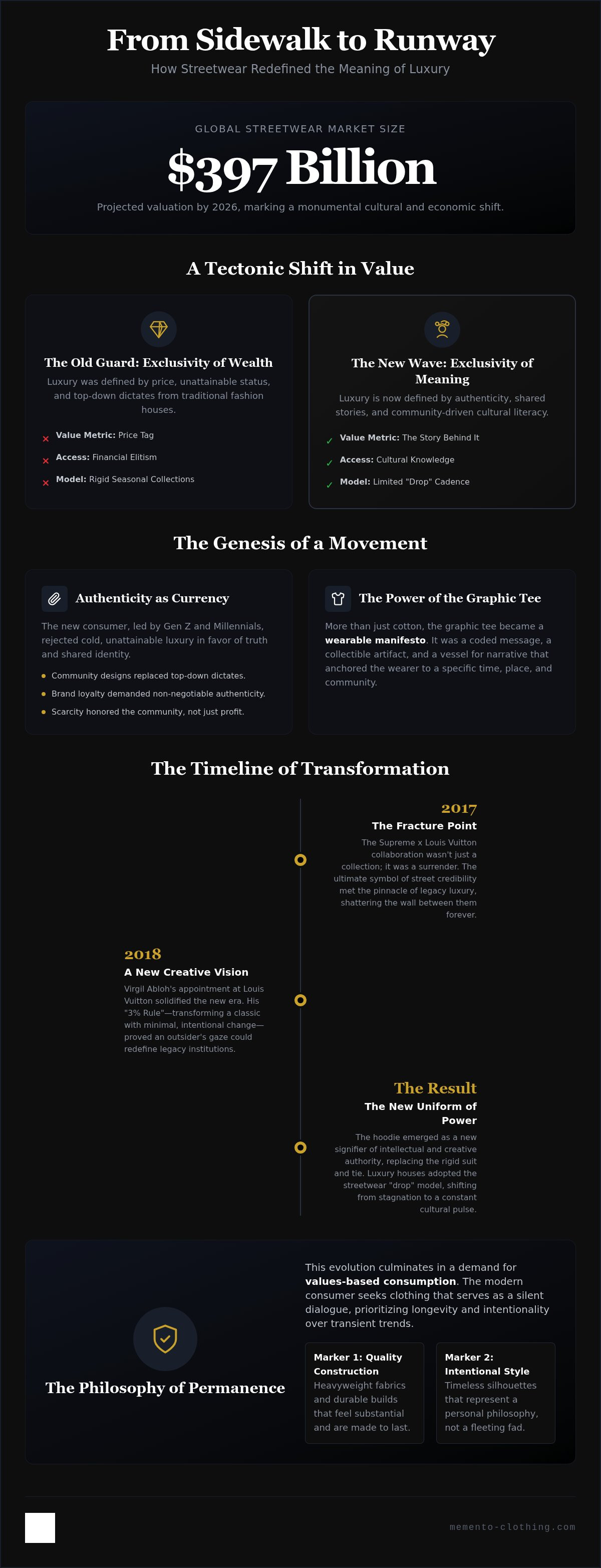
A single cotton thread can hold the weight of an entire subculture. For decades, the fashion elite looked down at the pavement, dismissing the graphic tee as a mere artifact of the youth. Today, that same silhouette defines a global market that reached over 397 billion dollars in 2026. Understanding how streetwear became high fashion isn't just about tracking sales or spotting logos on a runway; it's about recognizing a shift from the exclusivity of wealth to the exclusivity of shared meaning. The echo of a skateboard on concrete now resonates through the halls of Parisian ateliers.
You might feel exhausted by the relentless cycle of fast-moving trends. It's difficult to find high-quality basics that offer a sense of permanence in a world that feels increasingly disposable. You'll discover the philosophical transition that moved intentional garments from city streets to the world's most prestigious runways. We will examine the history of this rise, from the 2017 Supreme and Louis Vuitton collaboration to Virgil Abloh's 2018 appointment. By the end, you'll know how to identify the quality markers of modern apparel and build a wardrobe with true intentionality.
Key Takeaways
- Trace the journey of subcultural uniforms as they evolved into a new form of cultural currency and artistic expression.
- Uncover the specific timeline of how streetwear became high fashion, focusing on the watershed moments that blurred the lines between the sidewalk and the runway.
- Recognize the tactile markers of intentional style, identifying why the construction of a Memento Mori Heavyweight Hoodie represents the pinnacle of this evolution.
- Understand the shift toward values-based consumption, where clothing serves as a silent dialogue between the wearer and their personal philosophy.
- Learn to build a wardrobe that prioritizes longevity and permanence over the transient nature of modern, fast-moving trends.
The Genesis of the Movement: From Subculture to Cultural Currency
Streetwear didn't begin in a boardroom. It began on the pavement. It was a quiet rebellion against the rigid, exclusionary structures of 20th-century fashion. For those in skate parks or hip-hop circles, clothing wasn't about status. It was a communal language. This is The Genesis of the Movement. The uniform of the outsider became a badge of identity. It was a way to say "I am here" without speaking. This shift from surface-level aesthetics to deep-rooted community is the foundation of how streetwear became high fashion. It replaced the desire to look wealthy with the desire to be understood. The sidewalk was the first runway. Meaning was valued over margins. It was a world where knowing the story mattered more than the price tag on your back.
The Power of the Graphic Tee
A graphic tee is rarely just a shirt. It's a wearable manifesto. Early pioneers didn't care for mass-market appeal. They printed messages for the few who knew the code. These garments transformed from simple cotton basics into collectible art. Even the evolution of Youth Graphic T-Shirts reflects this change. What was once a basic item is now a vessel for narrative. It's an emotional anchor. The weight of the message matters more than the logo. These pieces became the first form of digital-age social currency. They weren't just clothes; they were artifacts of a specific time and place. They represented a bridge between the ephemeral nature of youth and the desire for something that lasts.
Authenticity as the New Luxury
The 90s offered a version of luxury that felt cold. Stiff. Unattainable. Gen Z and Millennials sought something else. They wanted truth. This led to the "drop" model. It wasn't just about scarcity; it was about being present in the moment. Subcultures protected their intentional style with fierce loyalty. They didn't want outsiders to dilute the meaning. This protectionism created a new kind of exclusivity. It wasn't based on a bank account. It was based on cultural literacy. Knowing the story became the ultimate luxury.
- Community-driven designs replaced top-down dictates.
- Authenticity became a non-negotiable requirement for brand loyalty.
- Scarcity was used to honor the community, not just to drive profit.
The Great Luxury Pivot: When the Runway Met the Sidewalk
The year 2017 marked a fracture in the history of elegance. When Supreme met Louis Vuitton on the runway, it wasn't just a collaboration. It was a surrender. The traditional gatekeepers realized that the pavement held the pulse of the future. This is The Great Luxury Pivot. It fundamentally altered the architecture of the fashion industry. The suit and tie, once the singular symbol of corporate authority, began to wither. In its place, the hoodie emerged as a new signifier of power and intellectual depth. Luxury houses didn't just take the silhouettes; they adopted the streetwear "drop" cadence. They moved away from seasonal stagnation toward a constant, rhythmic pulse of limited releases. This transformation is the core of how streetwear became high fashion. It was a shift from looking rich to being culturally literate.
The Virgil Abloh Effect
Virgil Abloh didn't just design objects. He reimagined the luxury house as a cultural hub. It was a place where art, music, and philosophy collided. His appointment at Louis Vuitton in 2018 was the final seal on this new era. He championed the "3% Rule," the idea that a classic could be transformed into something contemporary with a minimal, intentional change. It was the art of the remix. This transition toward narrative-driven design is a path that resonates deeply with our own philosophy. The Memento Mori story mirrors this shift. It prioritizes the "why" behind the garment. It turns a simple piece of clothing into an act of remembrance. Abloh democratized the creative director role. He proved an outsider's gaze could redefine centuries-old institutions.
The Luxury Sneaker Revolution
The very shape of high fashion changed with the arrival of the Balenciaga Triple S. It was bulky. It was unrefined. It was entirely unapologetic. This was the sneaker as the new "it-bag," a gender-neutral anchor for a generation that refused to be categorized. It successfully integrated athletic performance with aesthetic prestige. These pieces offered a sense of permanence in a landscape of transient trends. They became emotional anchors for the modern wearer. You can see this same commitment to enduring form in our heavyweight apparel, which seeks to bridge the intersection of daily life and high-end artistic expression. Luxury is found in the details of the everyday.
The Philosophy of the Heavyweight: Quality as a Luxury Bridge
Luxury is a tactile experience. It's found in the resistance of a fabric against the skin. While mass-market brands prioritize the ephemeral, intentional style demands a physical presence. This is The Philosophy of the Heavyweight. Fabric weight became the ultimate marker of a new era. It represents a rejection of the disposable. Understanding how streetwear became high fashion requires looking past the graphics and into the fibers. We've moved beyond the fragility of fast fashion. We seek garments that carry the weight of our stories. Longevity is the ultimate counter-culture. It's a quiet protest against a world that moves too fast.
The Science of Heavyweight Cotton
Grams per Square Meter (GSM) is the silent language of quality. High-end apparel often begins at 300 GSM, but true luxury pushes further. The Memento Mori Heavyweight Hoodie represents a structural shift in this landscape. It uses dense, high-GSM cotton to create a silhouette that doesn't collapse. It holds its form. Mass-market blends rely on synthetic fillers that lose their shape after a single season. Heavyweight cotton offers a superior drape. It feels substantial. It provides a sense of protection. This isn't just about warmth; it's about the permanence of the object. A garment that doesn't falter is a garment that can be remembered. It becomes a part of your history.
Intentionality in Craftsmanship
Vintage isn't a look; it's a standard of construction. Modern precision allows us to recreate the rugged durability of the 90s without the inconsistencies. The Memento Mori Vintage Tee bridges this gap perfectly. It captures the soul of subcultural staples while utilizing contemporary refinement. Every stitch is a choice. Every seam is a commitment to the future. Our approach to design is rooted in the "Memento Mori" philosophy. We create pieces that outlast the trend cycle. We build emotional anchors.
- Heavyweight construction ensures a lasting silhouette.
- Intentional design prioritizes narrative over noise.
- Longevity serves as the ultimate expression of luxury.
The Demographic Shift: Why the New Consumer Demands More
The modern wearer is a scholar of their own identity. By 2026, the global streetwear market has grown into a 397 billion dollar reality because consumers stopped buying products and started buying philosophies. This demographic shift is the final chapter in the story of how streetwear became high fashion. It's no longer about the loud, performative branding of the past. Today's consumer, where 60% are under the age of 25, seeks a "quiet luxury" within the streetwear framework. They value the garment as a permanent asset. The secondary market has validated this, treating intentional pieces as items of lasting value rather than fleeting trends. We've moved from the noise of logomania to a more reflective, inward-facing elegance.
Fashion has become an extension of personal philosophy rather than a mere display of status. The new consumer is digitally native but physically intentional. While social media influences 60% of discovery, the final choice is often rooted in a desire for authenticity. They reject the "stiff" luxury of previous decades. Instead, they embrace a version of high fashion that allows for movement, comfort, and a deep connection to the creator's intent. The garment is a silent dialogue between the wearer and the world.
The Death of the Seasonal Trend
The cycle of "what's in" has finally broken. In its place, we find a desire for what lasts. The transition to a permanent wardrobe is a rejection of the disposable culture that once defined the industry. Memento Crewnecks serve as a foundation for this new way of living. They aren't designed to be replaced. They are designed to age with the wearer. This search for melancholic elegance suggests that fashion is most powerful when it acknowledges the passage of time. We no longer chase the next season. We curate the next decade.
Community and Identity
A brand is no longer just a business. It's a social club. It's a philosophical community. In a digital world, the physical garment provides a rare sense of tangible belonging. Intentional design is the bridge to this community. It signals a shared worldview. When you wear a piece that prioritizes narrative, you aren't just getting dressed. You're participating in a ritual of remembrance and self-expression. This deep connection is what builds true loyalty. It's an invitation to step out of the shadows of mass production and into a more meaningful existence.
Explore our latest collection and find your place in our narrative at Memento Mori Clothing.
The Future of High Fashion: Beyond the Hype
The hype is a shadow. It is a fleeting projection that fades as the sun moves. What remains when the noise subsides is the substance of the garment itself. The fusion of the street and the atelier is no longer a temporary experiment. It is a permanent shift in the human landscape. Understanding how streetwear became high fashion allows us to see that the future isn't about the next drop; it's about the next decade. The sidewalk and the runway have merged into a single, enduring path. This hybridity reflects a world where we no longer accept the division between comfort and prestige. We demand both. We seek a version of elegance that can survive the friction of daily life.
Curating a Wardrobe of Meaning
Building a wardrobe in 2026 requires a return to the foundation. It begins with the heavyweights. A Memento Mori Heavyweight Hoodie or a perfectly constructed Vintage Tee isn't just an item of clothing. It is an anchor. To curate with intentionality is to embrace the Memento Mori mindset: buy less, but choose with a soul-deep focus on quality. You don't need a closet full of ephemeral trends. You need a few pieces that possess a structural and emotional weight. Mixing these high-fashion silhouettes with subcultural staples creates a personal narrative. It is a quiet recognition that the objects we carry through time should possess a weight equal to the memories they hold. Luxury is found in the drape of a heavy cotton sleeve and the knowledge that it will not fail you. It is a commitment to permanence.
The Lasting Legacy of Streetwear
Streetwear has become the new classic of the 21st century. It has replaced the rigid formality of the past with a philosophy of intentional style. This legacy is rooted in the belief that clothing should be a reflection of one's personal history and community. The focus has shifted from the brand to the wearer. It is about how a garment feels after years of wear, not just how it looks in a photograph. Memento Mori Clothing Ohio stands at the intersection of this movement. It represents a national brand that remains deeply rooted in the craftsmanship of intentional design. Sustainability is achieved through durability. When a garment is built to last, it becomes an act of rebellion against the disposable. This is the ultimate luxury; the ability to leave a footprint that remains long after the trends have turned to dust. The future of fashion is not found in the new, but in the enduring.
Embracing the Permanence of Intentional Style
The journey from subcultural uniform to high-fashion staple is complete. We've witnessed a tectonic shift where the weight of a garment's story now carries more prestige than a legacy logo. Understanding how streetwear became high fashion means recognizing that luxury is no longer defined by exclusion, but by the depth of intent. We've moved past the era of disposable trends toward a future built on structural integrity and philosophical substance. The sidewalk has become the ultimate atelier. It is a place where meaning is woven into every fiber.
True style requires a foundation that resists the passage of time. Our collection honors this evolution through philosophy-driven, minimalist designs and a heavyweight 400GSM cotton construction that ensures your pieces remain emotional anchors for years to come. We provide national shipping across the United States to bring this vision of permanence to your doorstep. It's time to move beyond the hype and invest in garments that reflect your personal history. Explore the Memento Mori Collection of Intentional Streetwear and begin building a wardrobe that speaks of always rather than just now. Your story deserves to be carried by something that lasts.
Frequently Asked Questions
When did streetwear officially become high fashion?
Streetwear's transition into the luxury sphere was a gradual evolution that culminated in the 2017 Supreme and Louis Vuitton collaboration. This moment fractured the traditional hierarchy of fashion. It forced the industry to recognize that cultural currency was more valuable than heritage alone. This watershed event turned the sidewalk into the new runway, forever changing the architecture of global style and identity.
Why is heavyweight cotton considered more luxurious?
Heavyweight cotton is the physical manifestation of permanence. Its density, often measured in high GSM, allows a garment to retain its architectural shape through years of use. Unlike mass-market blends that lose their soul after a few washes, heavyweight cotton offers a tactile depth and a sense of protection. It represents a conscious choice to value the enduring over the ephemeral.
What was the first luxury streetwear collaboration?
The 2017 Supreme x Louis Vuitton collection is the definitive moment, but earlier shifts like the 2014 Riccardo Tisci x Nike collaboration were vital. These partnerships proved that athletic silhouettes could carry high-fashion prestige. They provided the blueprint for how streetwear became high fashion, showing that subcultural icons could thrive within the walls of a traditional Parisian luxury house.
How did Virgil Abloh change the high fashion industry?
Virgil Abloh democratized the role of the creative director by reimagining the luxury house as a cultural hub. He bridged the gap between subcultural literacy and institutional power. By championing the "3% Rule," he showed that small, intentional changes could redefine classic items for a new generation. His work ensured that high fashion would always be a dialogue with the street.
Is streetwear still considered 'subculture' in 2026?
Streetwear remains rooted in subculture even as it dominates the global market. While the aesthetics are now mainstream, the underlying values of community and authenticity still define the core experience for many wearers. It's a worldview rather than just a category of clothing. True streetwear is a silent language that connects individuals through a shared understanding of cultural history.
What are the key markers of a high-quality streetwear hoodie?
A high-quality hoodie is defined by its structural weight and the precision of its details. You should look for a 100% cotton construction with a GSM of 400 or higher to ensure a lasting silhouette. The ribbing on the cuffs and hem must be dense and resilient. These markers indicate a garment built for longevity rather than a single season of wear.
Can streetwear be part of a minimalist or 'quiet luxury' wardrobe?
Minimalist streetwear is the foundation of the modern "quiet luxury" wardrobe. By stripping away loud branding and focusing on superior fabric weight and refined cuts, these pieces offer a sophisticated form of self-expression. This transition is central to how streetwear became high fashion. It proves that a heavyweight hoodie can possess the same understated elegance as a bespoke woolen suit.
How does the Memento Mori philosophy apply to modern fashion?
The Memento Mori philosophy encourages a return to permanence in a world of transient trends. By acknowledging the passage of time, we're inspired to choose garments that possess a soul. It's a commitment to buying less and choosing better. This approach turns each piece into a vessel for personal history, ensuring our clothes are emotional anchors that outlast the hype.