How Spirit Wear Builds Community: The Power of Shared Identity and Intentional Design
A shared logo doesn't create community. Belonging does.
Most groups understand this intuitively. They've felt the quiet disconnect that settles in when a team grows too large, when a season ends, or when the digital noise drowns out any real sense of shared purpose. A cheap, forgotten hoodie stuffed in the back of a drawer doesn't help. It confirms what people already fear: that the connection was never meant to last.
That's exactly why how spirit wear builds community is worth examining more carefully than most organizations do. It's not about printing a mascot on cotton. It's about giving people something they actually want to carry forward, a physical anchor for a shared story that outlasts any single season or school year.
This article explores the deeper mechanics behind apparel-driven identity: why intentional design matters more than quantity, how fabric quality shapes the way people perceive belonging, and what separates spirit wear that ends up in landfills from pieces that become genuine legacy objects. The difference is more deliberate than most realize, and it starts long before the first stitch.
Key Takeaways
- How spirit wear builds community goes far deeper than logo placement — intentional design creates visual cues that signal shared values and lower social barriers before a single word is spoken.
- The physical weight and quality of a garment directly shapes how people perceive the importance of their community — fabric isn't just a material choice, it's a message.
- Spirit wear can bridge the gap between active participants and silent supporters, giving alumni and parents a living, wearable connection to a group long after their direct involvement ends.
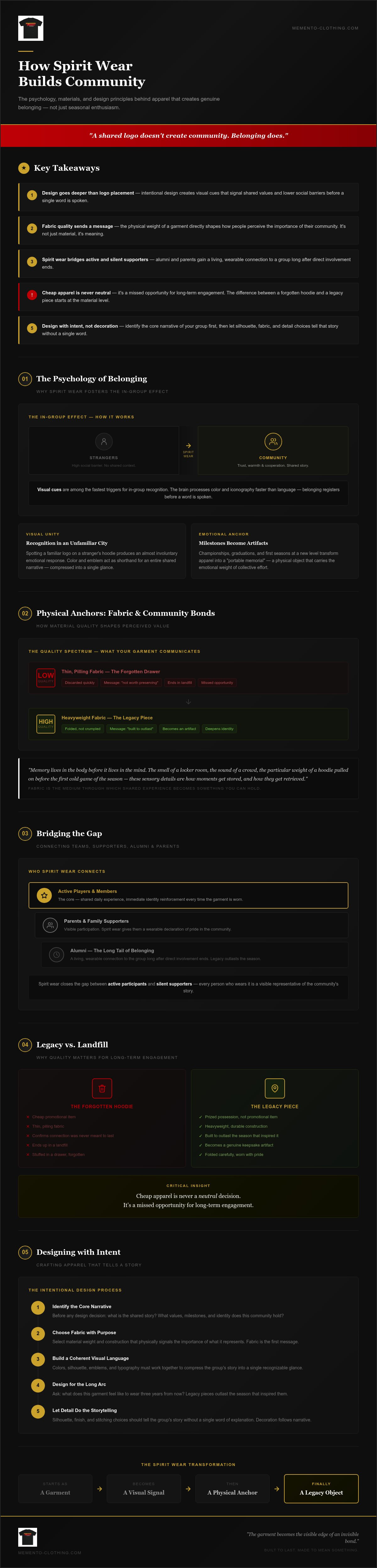
- Cheap apparel isn't a neutral decision — it's a missed opportunity for long-term engagement, and the difference between a forgotten hoodie and a legacy piece starts with the quality of materials chosen.
- Designing with intent means identifying the core narrative of your group first, then letting silhouette, fabric, and detail choices tell that story without a single word of explanation.
The Psychology of the Uniform: Why Spirit Wear Fosters Belonging
Before a single word is spoken, clothing communicates. It signals tribe, intention, and shared history. This isn't a modern marketing insight; it's one of the oldest social functions of dress. What's less understood is precisely why a shared garment can dissolve the distance between strangers so quickly, and how spirit wear builds community at a psychological level that goes far deeper than school pride or seasonal enthusiasm.
Psychologists describe this as the in-group effect: the measurable tendency for people to extend greater trust, warmth, and cooperation toward those they perceive as members of the same group. Visual cues are among the fastest triggers for this response. A familiar color combination or a recognizable emblem doesn't just identify someone; it lowers the social cost of approach. It says, quietly, we already have something in common.
Visual Unity and the Power of Recognition
Visual unity is the shared aesthetic language that transforms a crowd into a community, acting as an immediate, wordless signal of mutual trust and belonging.
Consider the moment of recognition: spotting a familiar logo on a stranger's hoodie in an unfamiliar city. The emotional response is almost involuntary. A small warmth surfaces. A nod, sometimes a conversation. Color and iconography do this work efficiently because the brain processes visual information faster than language. The Marysville Monarchs' colors on a crewneck or the Urbana Hillclimbers' emblem on a hat aren't decorative choices; they're shorthand for an entire shared narrative, compressed into a single glance.
This is why the quality and intentionality of that visual language matters so much. A faded, ill-fitting garment communicates something too: that the group's identity wasn't worth protecting carefully.
The Emotional Anchor of Shared Goals
Spirit wear earns its deepest meaning at the intersection of milestone and memory. A championship season, a graduation, a team's first year competing at a higher level; these are the moments that transform a piece of apparel from clothing into an artifact. Wearing something that marks a shared achievement creates what might be called a portable memorial, a physical object that carries the emotional weight of collective effort.
This is the transition from individual to collective identity that spirit wear, at its best, quietly facilitates. When someone pulls on a heavyweight hoodie before a game, they're not just getting dressed. They're choosing a side. They're declaring a shared story as their own. The garment becomes the visible edge of an invisible bond, and that bond is what actually builds community, one intentional design choice at a time.
Physical Anchors: How Quality Fabric Solidifies Community Bonds
Memory lives in the body before it lives in the mind. The smell of a locker room, the sound of a crowd, the particular weight of a hoodie pulled on before the first cold game of the season — these sensory details are how moments get stored, and how they get retrieved. Fabric isn't neutral. It's the medium through which shared experience becomes something you can hold.
This is the dimension most spirit wear conversations never reach. Discussions about color palettes and logo placement miss the more fundamental question: what does this garment feel like to wear three years from now? A thin, pilling pullover answers that question poorly. It communicates, without a word, that the moment it was made for wasn't worth preserving carefully.
The Memento Mori Approach to Craftsmanship
There's a meaningful difference between a promotional item and a prized possession, and it's almost entirely material. The Memento Mori Heavyweight Hoodie represents a specific philosophy: that the garment carrying a community's identity should be built to outlast the season that inspired it. Heavyweight fabric isn't just a construction choice; it's a statement about what the community is worth. When someone pulls it on and feels that density, that solidity, the message is immediate and physical. This was made to last. So was what it represents.
Premium materials also shift the wearer's relationship to the object. A garment that feels substantial gets treated differently than one that doesn't. It gets folded rather than crumpled. It gets kept. That behavioral shift is precisely how spirit wear builds community across time, not just across a single season.
Tactile Memory and the Vintage Feel
Softness carries its own emotional register. The Memento Mori Vintage Tee taps into something specific: the feeling of fabric that has already been broken in, that already feels like home before it's earned the right to. That worn-in quality isn't accidental. It's a design intention that collapses the distance between "new purchase" and "old favorite," between a shirt and a memento.
Disposable fashion undermines community in a way that's easy to underestimate. When a garment deteriorates quickly, it doesn't just wear out; it signals that the connection it was meant to represent had an expiration date. A community that invests in quality apparel is, whether consciously or not, making a claim about its own permanence.
Choosing the right foundation matters before a single design decision is made. Exploring Memento Mori's apparel collections is a practical starting point for any organization that wants its spirit wear to function as something more than a seasonal giveaway.
Bridging the Gap: Connecting Teams and Supporters
Not everyone who belongs to a community wears a uniform. Parents watching from the bleachers, alumni living three states away, grandparents who've never set foot on the field — they carry the same loyalty, the same quiet pride, without any visible way to express it. This is the gap that intentional spirit wear is uniquely positioned to close. It doesn't just dress the active participants; it gives the silent supporters a place to stand.
That distinction matters more than most organizations recognize. When a parent wears the same colors as their child on game day, something shifts. The boundary between participant and observer softens. The community expands without losing its coherence. Understanding how spirit wear builds community means understanding that the circle of belonging was always wider than the roster.
Legacy Gear for Every Generation
A community's story doesn't reset each year. It accumulates. Designing apparel with that continuity in mind means thinking beyond the current student body and considering everyone who has ever been, or will ever be, part of the same shared narrative.
Youth graphic t-shirts do something specific and powerful: they introduce the next generation to a community's visual language before they're old enough to fully articulate what that community means to them. A child wearing the same emblem as their grandparent at a reunion, a tournament, or a homecoming game isn't just dressed appropriately. They're participating in a living act of transmission. Three generations, one logo, one unbroken thread of belonging.
That image, a grandparent, a parent, and a child in matching colors, is not sentimental decoration. It's evidence that the community was designed to last. Organizations that invest in apparel across age ranges are making a deliberate claim about their own permanence.
The Public Face of Private Values
Spirit wear doesn't stay inside the stadium. It moves through grocery stores, airports, and neighborhood streets. Every time someone wears a community's colors in an unaffiliated space, they become an unscripted ambassador for what that group represents.
High-quality gear shapes that impression in ways cheap alternatives simply can't. A well-constructed crewneck or a carefully designed hat communicates standards before a single conversation begins. It suggests a community that takes itself seriously, that respects its own identity enough to protect it with craftsmanship.
This is the "third space" function of spirit wear: an identity that exists outside of school hours, outside of work, outside of any official context. It's the quiet, persistent presence of shared values in everyday life, carried forward not by institutional mandate, but by genuine pride in what the garment represents.
Building a Lasting Legacy: Why Quality Matters for Longevity
Memento mori. Remember that you will die. It's a confronting phrase to attach to a clothing brand, and that's precisely the point. The philosophy isn't morbid; it's clarifying. If everything ends, then what you choose to make permanent matters. Applied to community apparel, this reframes the entire conversation: don't ask what's cheapest to produce this season. Ask what's worth preserving.
Most spirit wear decisions are made backwards. Budget comes first. Design follows. Longevity is never part of the calculation. The result is predictable: garments that communicate the community's values for approximately one wash cycle before they begin to communicate something else entirely. Understanding how spirit wear builds community requires confronting this honestly. A cheap tee isn't a neutral choice. It's a statement about how much the shared story is worth protecting.
The return on investment calculation here is rarely done properly. Ten forgettable shirts, each worn twice and discarded, generate no loyalty, no memory, and no ambassadorship. One heavyweight hoodie, worn for a decade, carried across moves and milestones, tells a different story. It becomes evidence. Evidence that the community was real, that the moment it marked deserved to be carried forward.
Intentional Style vs. Passing Trends
Trend-chasing in spirit wear is a losing strategy. A design built around this season's aesthetic is obsolete before the ink dries. Intentional design works differently. It starts with a question: what is the permanent truth about this community? Not what's popular right now, but what will still be true in fifteen years.
Memento Crewnecks embody this principle structurally. The silhouette is considered. The weight is deliberate. Nothing about the construction defers to what's trending; it defers to what endures. That's the distinction between a garment that documents a moment and one that survives it.
The Sustainability of Community Pride
Durable goods aren't just the practical choice. They're the ethical one. Apparel that disintegrates quickly doesn't disappear quietly; it ends up in landfills, and it takes the community's visual identity with it. There's a psychological dimension here too. When a garment holds its shape, its color, its weight across years, it reinforces something the wearer feels without articulating: this friendship was built to last as well.
A 2026 hoodie, constructed with genuine care, doesn't retire in 2028. It sits in a box, gets rediscovered, gets passed down. By 2036, it's not apparel anymore. It's an heirloom. A physical record of a time when a particular group of people chose to belong to something together.
That transformation, from purchase to artifact, doesn't happen by accident. It requires a decision, made early, to treat the garment as something worth keeping. Explore Memento Mori's apparel collections to find pieces built with exactly that intention.
Designing with Intent: Crafting Apparel that Tells a Story
Every community has a soul. The question is whether its apparel reflects that soul or simply fills a drawer. Intentional design starts long before a single color is chosen or a logo is placed. It starts with a question that most organizations skip entirely: what is the permanent truth about this group? Not what's convenient to print. Not what fits the budget. What is the story that will still be true in fifteen years?
That question shapes everything that follows. Silhouette, weight, texture, graphic language; these aren't aesthetic preferences. They're decisions about how a community sees itself and how it wants to be seen. Understanding how spirit wear builds community at this level means treating design as an act of translation: taking something invisible and felt, and making it wearable.
The process, done well, moves through four deliberate steps:
- Identify the core narrative. What defines this group beyond its name? Grit, tradition, ambition, resilience? The answer shapes every subsequent decision.
- Choose silhouettes that carry that character. A structured crewneck reads differently than a relaxed pullover. Both communicate something. Neither is neutral.
- Match fabric weight to the community's importance. A heavyweight construction signals permanence. It tells the wearer, without words, that this moment was worth building something substantial around.
- Distribute with intention, not just logistics. The moment a garment is handed over matters. A team unboxing gear together creates a shared memory that a mailed package never can.
Case Study: The Hillclimber and Monarch Legacy
Urbana Hillclimbers apparel doesn't try to look like it belongs somewhere else. That's the point. The design language is rooted in local identity, in the particular grit of a community that climbs, that pushes, that doesn't soften its edges for outside approval. When that character is translated faithfully into fabric and form, the garment becomes something a stranger in another city can feel even without knowing the school's history.
Marysville Monarchs spirit wear works from a different register but the same principle. The Monarchs' visual identity carries a sense of earned authority, a community that knows what it is and isn't apologetic about it. Translating that into apparel means resisting the temptation to chase broader trends and instead protecting the specific, localized meaning that makes the gear matter to the people who wear it.
Both examples demonstrate something competitors rarely articulate: localized design isn't a limitation. It's the source of the garment's power. A Hillclimbers hoodie worn at a national tournament doesn't disappear into the crowd. It announces a home. That's how spirit wear builds community on a stage far beyond the original context.
Announcing a home is a point of pride, and for those looking to transition to a new one in the West Bloomfield area, you can learn more about M1 Home Buyers to see how they support local residents with straightforward real estate solutions.
The Final Stitch: From Product to Pillar
The Memento Mori story began with a philosophical premise: that awareness of impermanence is not a reason for despair but a reason for care. That premise runs through every construction decision, every fabric choice, every design brief. It reframes the entire purpose of a garment. Not a promotional item. Not a seasonal giveaway. A stewardship.
Organizations that adopt this posture stop thinking about selling gear and start thinking about what they're leaving behind. A community's apparel, chosen with that seriousness, becomes a pillar rather than a product. It holds something up. It gives people a place to stand.
That shift, from transaction to legacy, is available to any group willing to ask the right questions first. Explore Memento Mori's community-driven collections and find the foundation your shared story deserves.
Your Community Deserves to Be Remembered
How spirit wear builds community isn't a mystery. It's a choice. A choice about what materials carry your story, what design reflects your values, and whether the garment someone pulls on in five years still feels like it means something.
The through-line across everything covered here is simple: intentionality separates legacy pieces from landfill items. Quality fabric signals permanence. Thoughtful design crosses generational lines. And apparel that earns its place in someone's drawer, rather than being forgotten in it, becomes evidence that the community was worth belonging to.
Memento Mori Clothing was built on exactly that premise. Premium heavyweight cotton standards, philosophically-driven design, and national shipping across the USA mean your community's identity gets the foundation it deserves, wherever your people are.
Don't settle for apparel that expires with the season. Build your community legacy with Memento Mori Clothing and give your shared story something worth holding onto.
Frequently Asked Questions
Does wearing the same clothes really improve group performance?
Research in social psychology consistently supports the idea that visual uniformity strengthens group cohesion, which in turn influences collective effort. When people wear matching apparel, they experience a heightened sense of shared identity that reduces internal social friction and increases cooperative behavior. It's not magic; it's the in-group effect made visible.
The key word is "shared." A garment that people actually want to wear reinforces this effect far more than one they tolerate. Quality matters here precisely because a piece someone chooses to put on voluntarily carries more psychological weight than something worn out of obligation.
How do I choose the right spirit wear for a diverse community?
Start with what unites the group rather than what differentiates it. A shared visual language, consistent colors, a meaningful emblem, works across age, background, and role because it anchors identity in something larger than any individual. Offering multiple garment types across the same design family, hoodies, crewnecks, tees, hats, lets people choose the format that fits their life without fragmenting the visual unity.
Inclusive sizing and age-appropriate options matter too. A community that dresses three generations in the same colors makes a visible claim about who belongs. That's how spirit wear builds community across difference rather than despite it.
Why is heavyweight fabric better for community building than standard cotton?
Heavyweight fabric changes the wearer's relationship to the object. A garment that feels substantial gets treated differently; it gets folded, kept, and reached for again. Standard cotton alternatives pill, fade, and thin out quickly, which communicates, without a word, that the moment they were made to mark had an expiration date.
Durability is also a form of respect. When a community invests in heavyweight construction, it's signaling that the shared story is worth protecting carefully. The Memento Mori Heavyweight Hoodie is built on exactly this premise: that the garment carrying a community's identity should outlast the season that inspired it.
Can spirit wear help with fundraising and community building at the same time?
Yes, but only when the gear is desirable enough that people want to buy it rather than feel obligated to. Apparel that looks and feels premium sells itself; apparel that looks like a fundraising afterthought creates awkward obligation. The distinction matters because one builds genuine community enthusiasm while the other quietly erodes it.
Organizations that invest in quality designs and materials find that their gear functions as both a revenue stream and an ongoing ambassador for the community. Every time someone wears a well-crafted piece in public, they're extending the community's reach without any additional cost or effort from the organization.
What makes 'intentional design' different from standard custom printing?
Standard custom printing starts with a template and adds a logo. Intentional design starts with a question: what is the permanent truth about this community? The answer shapes every decision that follows, silhouette, fabric weight, graphic language, color palette. Nothing is chosen because it's convenient or cheap; everything is chosen because it accurately translates something invisible and felt into something wearable.
The practical difference is visible in how long the garment stays relevant. A trend-chasing design reads as dated within a few years. A design rooted in a community's specific, localized identity, like the Urbana Hillclimbers' visual language or the Marysville Monarchs' aesthetic, holds its meaning precisely because it was never trying to appeal to anyone outside the community it was built for.
How do I ensure our community gear doesn't just become 'clutter'?
Clutter is what happens when a garment fails to earn its place. Gear becomes clutter when it's thin, generic, or disconnected from anything the wearer actually values. The antidote isn't producing less; it's producing better. One heavyweight hoodie that someone reaches for on cold mornings for a decade occupies the same drawer space as ten forgotten tees, but it carries entirely different meaning.
Distribution also shapes perception. Gear handed over as part of a shared ritual, a team unboxing, a season opener, a milestone celebration, starts its life as a memory rather than a transaction. That context doesn't just add emotional weight; it's what separates a prized possession from something that quietly migrates to the back of a closet.