
House of Blanks Alternative: Premium Heavyweight Fleece for Everyday Wear
The heaviest hoodie isn’t automatically the better one. If you’re searching for a house of blanks alternative premium heavyweight fleece, focus on how the garment feels, how it fits and holds its shape, and whether you want a blank to customize or a finished design ready to wear.
House of Blanks Canada’s 400 GSM fleece offers a useful reference point, but weight alone can’t tell the whole story. Fiber content, interior finish, silhouette, and whether the garment is blank or branded all affect the comparison. Product pages don’t always make those differences easy to assess.
This guide explains which fleece details to compare and how to weigh them against the look and purpose you want. It also distinguishes blank garments from finished branded apparel, including Memento Mori Clothing’s heavyweight hoodie and crewnecks. No single number settles the choice. The right fleece is the one that suits how you want to wear it and what you want it to express.
Key Takeaways
- Use a house of blanks alternative premium heavyweight fleece comparison to assess the whole garment, not just its fabric-weight figure.
- Separate blank garments from finished apparel so you can choose between customization flexibility and a complete design.
- Compare fleece feel, drape, silhouette, finish, and purpose to understand how each garment may wear.
- Use a short checklist for fit, intended use, product specifications, and care before choosing a hoodie or crewneck.
- Consider whether a branded piece better reflects your personal style than an undecorated base.
Looking for a House of Blanks Alternative? Start with Blank vs. Finished Fleece
A blank and a finished hoodie can both use heavyweight fleece but serve different purposes. A blank is an undecorated garment base intended for customization. A finished heavyweight garment is a complete, branded piece, with its design and identity already part of the purchase. This distinction isn’t a measure of quality. It comes down to what you want the garment to do.
If you’re considering a house of blanks alternative premium heavyweight fleece, first decide whether you want a foundation for your own design or apparel that already feels complete. That choice puts fabric claims in context. A higher weight may indicate more material per area, but it doesn’t tell you whether a blank or a finished piece better suits your everyday needs.
What does heavyweight fleece mean in a garment?
Heavyweight fleece is a fabric category described by the weight of the fabric, not a complete score for a finished garment. Specifications commonly use GSM, or grams per square meter, and may also use ounces per square yard. Both express fabric weight across an area. Neither establishes softness, warmth, structure, finish, or overall quality on its own.
Keep fabric weight separate from the weight of the hoodie in your hands. The finished garment’s weight also reflects its size and components, such as the hood, ribbing, pocket, and drawcords. Two hoodies with similar fabric-weight figures can still feel and hang differently because their proportions and construction differ.
There isn’t one universal number that makes fleece premium. Categories and intended uses vary. A fabric chosen for warmth may feel different from one selected for a more fluid drape or a particular silhouette. Treat published weight as one comparison point, then look at the listed fiber content, surface, fit, and intended use. Don’t infer a missing detail from GSM alone.
When is a finished hoodie a better alternative to a blank?
Choose a blank when you’re sourcing a base for a decoration project and want control over the artwork or branding. Choose finished apparel when you want the design and identity to arrive as part of the garment. It’s the difference between creating a piece and choosing one that already expresses a point of view.
For personal wear, a finished design can simplify the decision: there’s no separate customization step to plan. Memento Mori’s heavyweight hoodie and crewnecks are branded apparel, rather than undecorated blanks. Their appeal is the complete expression, not a claim that one fabric figure settles every question of feel or fit. The Memento Mori Heavyweight Hoodie guide offers a closer look at that branded option.
- Choose a blank if you need an undecorated base for a project.
- Choose a finished garment if you want its design and identity to be part of what you wear.
Neither choice is inherently more considered. The better alternative suits your purpose: room to create, or a finished piece ready for your everyday wardrobe.
Compare Premium Heavyweight Fleece Beyond the GSM Number
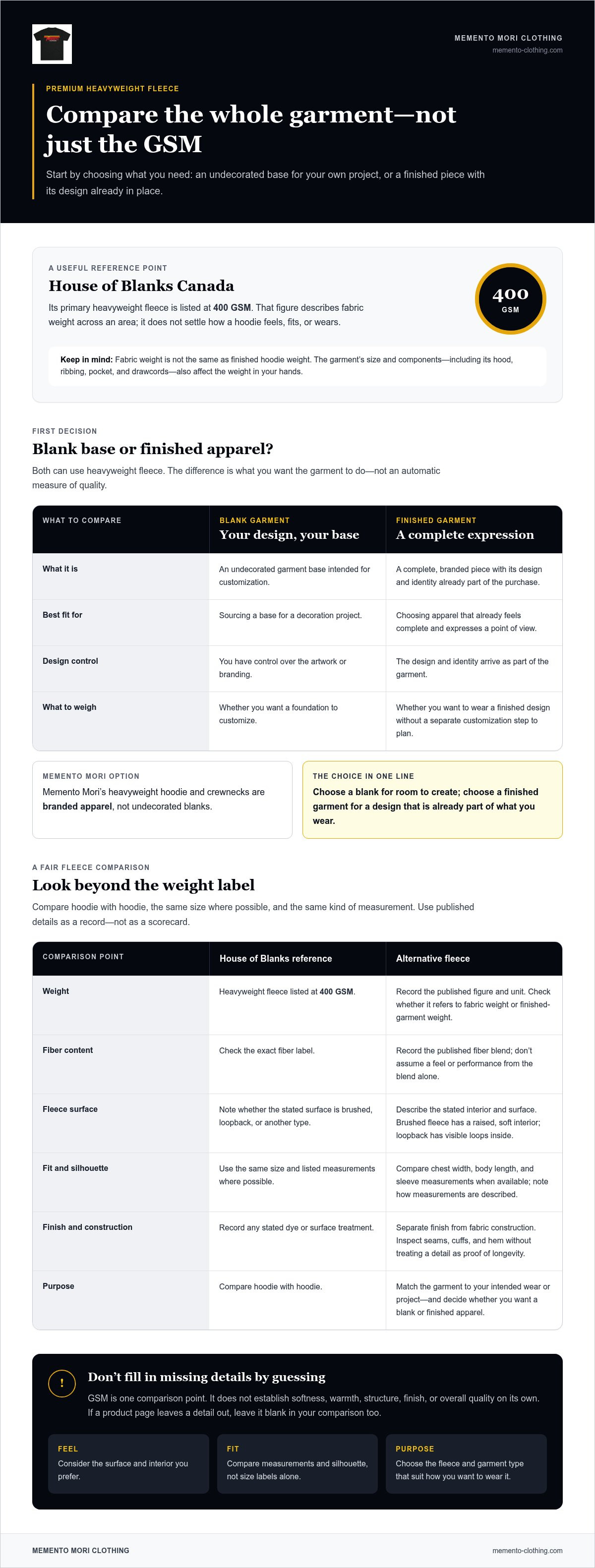
GSM gives you a starting point, not a verdict. House of Blanks Canada’s primary heavyweight fleece is listed at 400 GSM, but that figure alone can’t tell you how a hoodie feels against the skin, falls from the shoulders, or suits the way you plan to wear it.
Fabric weight alone cannot establish the overall quality of a finished garment. Compare like with like: hoodie against hoodie, the same size where possible, and the same kind of measurement. A fabric-weight figure describes material per area; garment weight includes the garment’s dimensions and components. Product pages may use different units or describe fabric weight versus finished-garment weight, so check what each number refers to.
| Weight | Fiber content | Fleece face | Fit | Finish | Garment purpose |
|---|---|---|---|---|---|
| House of Blanks heavyweight fleece: 400 GSM | Compare the exact fiber label | Note brushed, loopback, or another stated surface | Use the same size and listed measurements | Record any stated dye or surface treatment | Compare hoodie with hoodie |
| Alternative: record the published figure and unit | Record the published fiber blend | Describe the stated interior and surface | Compare measurements and silhouette notes | Separate finish from fabric construction | Match intended wear or project |
Use the table as a comparison record, not a scorecard. If a detail isn’t provided, leave it blank rather than guessing. This keeps published specifications distinct from your own observations.
Which fabric and construction details affect fleece feel?
Fiber labels are useful when they’re specific. A 100% cotton description and a cotton-polyester blend identify different compositions, but neither guarantees a particular feel or performance. Brushed fleece has a raised, soft interior surface; loopback fleece has visible loops on the inside. Neither is universally better. The right surface depends on the feel and use you prefer.
Look closely at seams, cuffs, and hem. Product photos and descriptions can help you assess how those areas are finished and how the garment is put together. Treat this as an inspection, not proof of longevity: a single detail or close-up can’t establish how a hoodie will perform over time.
How do fit and finish change the comparison?
Size labels aren’t a universal measuring system. Compare listed chest width, body length, and sleeve measurements when available, and note whether each brand measures the garment flat or describes body measurements. Relaxed, classic, and oversized are useful silhouette cues, but proportions vary. Compare the listed measurements with a hoodie you already like.
Drape describes how fabric falls; structure describes how it holds a shape. Both differ from hand feel, or the sensation of the fabric in your hands. A product description may suggest a silhouette, but weight can’t tell you how these qualities will feel when worn.
Keep surface finish distinct from weight and construction. Garment dyeing or a washed appearance describes treatment and visual character, not GSM. For a finished branded option, explore Memento Mori heavyweight hoodies and crewnecks, where the design is part of the garment’s identity.
House of Blanks vs. a Premium Fleece Alternative: Make a Fair Comparison
A fair house of blanks alternative premium heavyweight fleece comparison starts by separating two questions: what is the garment made for, and what do its published specifications tell you? House of Blanks Canada’s primary heavyweight fleece is listed at 400 GSM. That’s a useful reference, but it doesn’t establish how a finished branded hoodie compares in fit, feel, care, or design.
| Comparison point | House of Blanks heavyweight blank | Finished branded option |
|---|---|---|
| Purpose | Undecorated base intended for customization | Design and brand identity are part of the garment |
| Weight | 400 GSM for its primary heavyweight fleece; compare product and fabric figures carefully | Use the specific garment’s published weight |
| Fiber content, measurements, care | Compare details listed for the exact product | Compare details listed for the exact product |
| Design decisions | Decoration and artwork remain to be chosen | Assess the existing graphic, message, and overall design |
| Missing detail | Record as not stated; don’t infer | Record as not stated; don’t infer |
Use this as a framework, not a verdict. Compare hoodies with hoodies, and match sizes and measurement methods wherever possible. A product page may report fabric weight without giving garment weight, or omit a measurement or care detail. Keep those gaps visible rather than filling them with assumptions.
What a blank garment offers, and what it leaves to you
A blank’s defining advantage is flexibility. It gives a brand or decorator a base for artwork, logos, and other decoration choices. That freedom is useful if you’re building a design, but it isn’t evidence that the fleece itself is superior. For personal wear, account for the choices still ahead: what decoration you want, how it will look, and whether you want to manage those decisions.
What to compare in a finished branded hoodie or crewneck
With finished apparel, the design is part of the value. Consider whether the graphic, message, and overall identity feel right for how you want to wear the piece. Then compare product-specific measurements, materials, and care instructions wherever they’re provided. Don’t assume the brand name or a fabric-weight figure answers those separate questions.
Memento Mori’s range includes a heavyweight hoodie and crewnecks as finished branded apparel, rather than undecorated blanks. The right comparison isn’t simply which garment offers a decoration-ready base. It’s whether the complete design suits your intention, alongside the product details for the specific piece. The Memento Crewnecks quality and style guide can add context when you’re considering a crewneck.
Manufacturing origin and vertical integration may be relevant context, but neither proves that one garment is better for every wearer. Judge the published details and purpose of each product on their own terms. A blank offers room to create; a finished garment offers an identity already in place.
Choose Your Heavyweight Fleece Alternative by Fit, Use, and Care
A useful choice begins with your routine, not a fabric-weight headline. Think about where you’ll wear the garment, what you’ll layer beneath it, and whether you want a blank for a project or a finished design for your wardrobe. This five-step checklist turns those preferences into a practical comparison.
- 1. Define the use. Decide whether the garment is for daily wear, colder days, layering, or a decoration project. Your purpose helps you judge which details matter most.
- 2. Compare the fit. Look at garment measurements and silhouette descriptions. Choose proportions that work with your preferred shape and the layers you expect to wear beneath it. Oversized isn’t automatically more premium.
- 3. Inspect the specifications. Review the stated fiber content, fabric weight, and garment measurements. Note what each weight figure refers to, and don’t fill gaps in the product description with assumptions.
- 4. Check the care instructions. Treat the garment’s care label or product-specific care guidance as authoritative. Washing and drying directions can differ, so don’t rely on universal promises about shrinkage or how a fabric will change over time.
- 5. Choose the design. For a blank, consider the artwork and decoration choices still ahead. For a finished garment, decide whether its graphic and identity suit the way you want to express yourself.
How should you choose a fleece fit for everyday wear?
Start with a similar hoodie or crewneck you already own and enjoy wearing. Lay it flat, then compare its chest, body-length, and sleeve measurements with the new garment’s product details. Check how each brand measures; a size label alone doesn’t guarantee comparable proportions. A roomy cut may feel useful over another layer, while a closer silhouette may suit wearing the piece on its own.
Think about movement, too. If you plan to layer over a tee, you may prefer different roominess than if you’ll wear a shirt or another layer underneath. Sleeve and body length affect how the garment sits. Measurements provide a more practical fit comparison than a size label alone.
What should you check before buying heavyweight fleece online?
Read the full product description rather than relying on a headline specification. Look for material composition, garment measurements, care instructions, and photographs that show the shape and visible details. Check whether a weight refers to the fabric or the complete garment. If a detail isn’t provided, treat it as unknown instead of using another specification to guess.
Once your priorities are clear, explore Memento Mori heavyweight apparel for finished branded hoodie and crewneck options. Compare purpose, proportion, care, and design. A considered garment should suit the life you’ll give it.
Consider Memento Mori as a Branded House of Blanks Alternative
A blank fleece garment is a starting point. Memento Mori offers another kind of choice: finished branded apparel for someone who wants the design, message, and garment to belong together from the outset. The range includes the Memento Mori Heavyweight Hoodie and Memento Crewnecks. These are branded garments, not undecorated bases waiting for your artwork.
That distinction matters if you’re searching for a house of blanks alternative premium heavyweight fleece for personal wear. The comparison isn’t simply about which garment has the larger fabric-weight figure. It’s also about whether you want to make the design decisions yourself or wear a piece with an identity already shaped into it. The right choice depends on your purpose, taste, and the details provided for the specific garment.
Who may prefer a branded heavyweight hoodie?
A branded hoodie may suit you if you want a complete design rather than a blank to decorate. Consider the visual language and message as carefully as the garment category: Does the graphic feel like something you’d choose to wear? Does its meaning fit how you want to present yourself, whether quietly or with conviction?
Memento Mori’s reflective philosophy treats clothing as more than a surface. A message can become part of the moments attached to a garment, and a familiar piece can carry personal meaning over time. That’s an invitation to choose with intention, not a promise that a branded garment will outperform every blank in quality or value. If you enjoy developing your own artwork and decoration, a blank may be a better fit.
Where to explore the Memento Mori garment range
The Memento Mori Heavyweight Hoodie is a finished branded option for shoppers drawn to the hoodie format. Memento Crewnecks offer another garment category with the brand’s identity already present. Compare the individual product details, including any stated materials, measurements, and care guidance. Don’t assume that the word “heavyweight” supplies information about fiber content, fit, or construction.
If you’re weighing a hoodie in particular, the Memento Mori Heavyweight Hoodie guide is a useful product-focused companion to this broader comparison. Let its details inform your choice, alongside the design itself and how you expect to wear the garment.
There’s no single answer for every fleece shopper. A blank leaves room for your own creative direction. A finished branded piece offers a complete expression to make your own. If the latter feels closer to what you’re looking for, discover Memento Mori apparel and consider which garment and message speak to you.
Choose a Garment That Feels Like Your Own
The best choice isn’t always the one with the most imposing specification. It’s the piece you reach for because its shape, purpose, and design feel right in your life. A blank leaves space for what you’ll add; a finished garment carries an identity you can make part of your own.
Let that distinction guide your next step as you consider a house of blanks alternative premium heavyweight fleece. Look beyond the product page’s headline: imagine how the garment fits into your routine, what you want it to express, and whether you want to shape its design yourself. Specifications matter, but so does the meaning a piece gathers through wear.
If a complete, branded design feels closer to what you’re looking for, explore Memento Mori heavyweight apparel. Choose a garment that suits your style and wear it with intention.
Frequently Asked Questions
How should I wash heavyweight fleece to help it keep its shape?
Follow the garment’s care label first, since fiber blends, dyes, and finishes can require different treatment. Turning a hoodie inside out before washing may reduce direct rubbing on its outer surface, and avoiding unnecessarily harsh washing can help limit wear. Don’t assume machine drying is suitable for every fleece garment. If the care instructions specify a drying method or temperature, follow that guidance rather than applying a general rule.
Does heavyweight fleece shrink after washing?
It can, but the result depends on the fiber content, fabric processing, and washing and drying conditions. “Heavyweight” describes fabric weight, not whether a garment is pre-shrunk or resistant to heat. Before buying, review the product’s material details and care instructions. If you’re between sizes, don’t rely on an assumption that washing will change the fit; use the listed measurements and care guidance to decide.
What is the difference between brushed fleece and loopback fleece?
Brushed fleece has a raised, softened interior, while loopback fleece has visible loops on its inner face. Look for the difference in a product description or close-up image rather than inferring it from a weight figure. Each construction creates a distinct surface and wearing experience, but neither is automatically better. For a house of blanks alternative premium heavyweight fleece, choose based on the texture and feel you prefer.
Can heavyweight fleece be worn in every season?
It can be worn across seasons, though comfort depends on the weather, your activity, layering, and personal preference. For a cool evening, a fleece hoodie may work as an outer layer; indoors or during more active wear, the same garment may feel too warm. Fabric weight alone can’t predict comfort in every setting. Consider when and where you’ll wear it, along with the product’s construction and care information.
Will a heavyweight hoodie feel too bulky under a jacket?
That depends on the hoodie’s proportions, the jacket’s available room, and how you like to layer. Compare the hoodie’s chest, shoulder, and sleeve measurements with a similar garment that fits comfortably beneath your jacket. A roomy cut can take up more space, especially through the shoulders and arms. Product photos may help you picture the silhouette, but measurements are more useful for assessing the fit before ordering.
Is cotton fleece different from a cotton-polyester fleece blend?
Yes. The fiber composition differs, which can influence hand feel, care needs, and how the fabric behaves. The exact results depend on the specific fabric and its construction, so a fiber label isn’t a complete prediction of performance. Read the listed percentages and care instructions for each garment. Compare blends when the product pages provide clear, product-specific details, and avoid assuming all fabrics with similar labels will feel alike.
How can I tell whether a fleece garment is pilling?
Pilling appears as small balls of fiber on the fabric surface, often in areas that rub against a bag, another layer, or the garment itself. Fiber type, yarn, construction, and care can all affect whether it develops. Fabric weight alone doesn’t establish resistance to pilling. Product photos may show surface texture, but they can’t prove how a garment will wear over time, so treat broad durability claims cautiously.