
Heavyweight vs. Midweight Hoodie: A Guide to Intentional Quality in 2026
What if the garment you wear most often wasn't designed to fade into a memory after a single season? Most of us have felt that quiet disappointment when a favorite piece loses its silhouette. It thins out and sags after just three washes. This is the hidden cost of choosing convenience over substance. To find a piece that truly lasts, you must understand the tension between a heavyweight vs midweight hoodie. This choice isn't just about warmth. It's about the architecture of your wardrobe.
You deserve a garment that maintains its shape and serves as a lasting anchor. We'll show you how to decode technical GSM values and fabric structures to ensure your next investment feels meaningful. We will explore the technical weight of 350 to 500 GSM fabrics, the nuances of drape, and why a heavier knit offers a sense of permanence that standard retail simply cannot match. This is a guide to choosing quality with intention.
Key Takeaways
- Master the technical language of GSM to distinguish between fleeting retail softness and enduring fabric density.
- Understand how the architectural structure of a heavyweight garment preserves your silhouette and resists the wear of time.
- Evaluate the practical differences of a heavyweight vs midweight hoodie to find the perfect balance between thermal permanence and seasonal fluidity.
- Learn to view your wardrobe through the lens of Memento Mori, selecting pieces that serve as lasting vessels for memory and intention.
The Language of Fabric: Decoding GSM and Hoodie Weights
Every object carries a weight. In the clothes we choose, this weight is the bridge between a fleeting trend and a permanent companion. To choose with intention, one must speak the language of the loom. Understanding the nuances of a heavyweight vs midweight hoodie begins with a single, definitive metric that defines how a garment lives and ages.
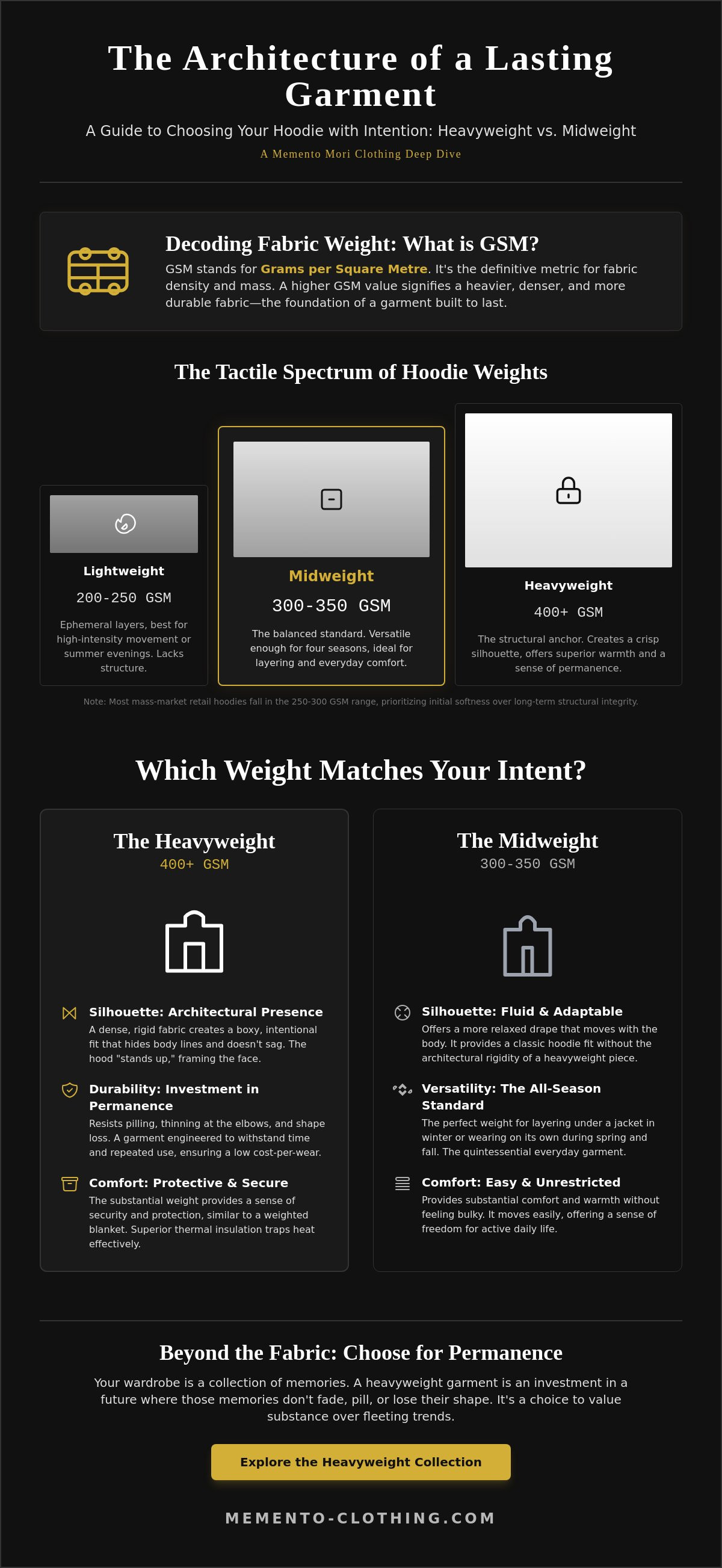
This metric is Grams per Square Metre (GSM). It measures the literal mass of the fabric. Most retail options settle for a modest 250 to 300 GSM. These pieces feel soft initially, yet they often lack the structural integrity to survive the years. They are designed for the moment. They aren't built for a legacy. By 2026, the standard for quality has shifted toward higher density, reflecting a desire for garments that act as anchors rather than disposable layers.
Beyond the numbers, the weight of a fabric dictates your physical experience. A lighter fabric offers a sense of freedom and movement, while a denser knit provides a feeling of protection. It's the difference between a garment that merely covers you and one that holds its own shape, standing as a shield against the world and the passage of time.
What Exactly is GSM in 2026?
GSM is the DNA of garment durability. It tells you exactly how many fibers are packed into every square inch of the fabric. When the density is high, the knit is tight. This creates a natural barrier that retains warmth more effectively than thin, synthetic alternatives. In 2026, discerning wearers look for high GSM values because they represent a commitment to permanence. A dense fabric doesn't just feel better; it resists the sagging and thinning that marks the end of a lesser garment's life.
The Tactile Spectrum: From Light to Ultra-Heavy
The weight you choose should reflect your environment and your intent. Each category on the spectrum serves a different purpose in the ritual of dressing.
- Lightweight (200-250 GSM): These are ephemeral layers. They are suited for summer evenings or high-intensity movement. They offer a touch of warmth but lack the structural presence of a true investment piece.
- Midweight (300-350 GSM): This is the balanced standard for everyday life. It's versatile enough for four seasons, moving with the body's natural rhythm. It provides comfort without the heavy architecture of denser knits.
- Heavyweight (400+ GSM): The structural anchor. These garments stand on their own. A hoodie in this range, such as a heavyweight vs midweight hoodie comparison reveals, hides body lines and maintains a crisp silhouette. It's a piece designed to be remembered.
Heavyweight Hoodies: The Architecture of Structure and Permanence
A heavyweight garment is more than a simple layer. It is a structure. When you compare a heavyweight vs midweight hoodie, you immediately notice the difference in how they occupy space. Heavyweight fabric, typically 400 GSM or higher, possesses a natural rigidity. This isn't stiffness; it's presence. It creates a deliberate, architectural silhouette that refuses to collapse or sag. It stands as a testament to the idea that some things are built to remain unchanged.
This density serves a dual purpose. Beyond the visual, it offers superior thermal regulation. High-quality, dense cotton acts as a natural insulator, trapping heat without the suffocating feel of synthetic blends. There is also a quiet, psychological comfort in the weight. Much like a weighted blanket, the pressure of a heavy fleece provides a sense of security. It's an emotional anchor in a world of fleeting things. It protects you from the cold and the noise of the outside world alike.
Durability is the silent promise of weight. These pieces are designed to resist the common failures of mass-market retail. They don't pill easily. They don't thin at the elbows. Most importantly, they maintain their shape after dozens of laundry cycles. It's a garment that respects your investment by refusing to vanish into the bin after a single season.
Silhouette and Drape: The Aesthetic of Presence
Cheap retail options often look sloppy after a few hours of wear. They slouch. They lose their lines. A heavyweight piece maintains its shape because the fabric is thick enough to hide body lines. It creates a boxy, intentional fit that feels modern yet timeless. This structural integrity extends to the details. A well-crafted hood doesn't lay flat or limp. It "stands up," framing the face and maintaining its form even when down. It gives the wearer a sense of visual gravity.
Longevity and the Cost-Per-Wear Calculation
Investing in a Memento Mori Heavyweight Hoodie is a choice for the future. While fast fashion prioritizes the immediate sale, true quality focuses on the longevity of quality clothing. These pieces are built to resist the "bacon neck" effect where collars stretch into waves. They resist the hem stretching that makes standard hoodies look old before their time.
The beauty of a dense knit lies in how it ages. It doesn't wear out; it breaks in. Over the years, the fabric softens and molds to your life, becoming a personal history in fiber. It outlasts three or four standard hoodies, making the initial investment a wise one. If you seek a piece that stays with you, our Memento Mori Heavyweight Hoodie offers that rare sense of permanence.
Midweight Hoodies: The Art of Fluidity and Layering
If the heavyweight hoodie is a fortress, the midweight is a conversation. It exists in the delicate space between protection and total freedom. When you navigate the choice of a heavyweight vs midweight hoodie, you are choosing the rhythm of your day. Midweight fabrics, typically resting between 300 and 350 GSM, offer what we call a "Fluid Fit." This is a garment that honors the body’s natural movement. It doesn't impose an architectural shape; it adapts to yours. It is a study in balance, providing a sanctuary of warmth without the weight of an anchor.
For those whose lives involve constant transition, this weight offers a necessary breathability. It prevents the stifling heat that can sometimes accompany ultra-dense knits in indoor environments. It's a garment for the active mind and the moving body. It is for the person who values the ability to reach, turn, and exist without the sensation of being shielded. The midweight hoodie is an invitation to move through the world with a certain lightness of being, making it the ideal choice for those who find heavier fabrics too restrictive for their personal cadence.
Year-Round Versatility: The Transitional Essential
Spring and autumn demand a specific kind of grace. A midweight piece serves as the definitive outer layer for these shifting days. It's light enough to carry, yet dense enough to ward off a sudden evening chill. Unlike its heavier counterparts, the midweight hoodie is defined by its packability. It folds into a travel bag with ease, occupying less space while offering significant utility. It's the ephemeral choice for a summer evening by the water or a quiet morning in a sun-drenched studio. Its versatility makes it a staple that rarely sees the inside of a closet, regardless of the season.
The Layering Strategy
True style often lives in the layers. Midweight hoodies are the masters of this art. Their reduced bulk allows them to slide comfortably beneath a structured leather jacket or a heavy wool overcoat. You won't find the restrictive bunching in the armpits or sleeves that can plague heavier knits. This streamlined profile creates a sophisticated, multi-dimensional look that maintains a clean silhouette. To achieve a perfect thermal harmony, consider these pairing options:
- Combine with Memento Mori Vintage Tees for a breathable, base-layer foundation.
- Wear beneath a tailored overcoat to soften a formal look with a touch of modern ease.
- Use as a standalone piece during high-activity days where moisture-wicking and airflow are paramount.
By choosing a midweight garment, you aren't sacrificing quality. You're choosing a different kind of permanence; one based on utility, movement, and the ability to adapt to the world as it changes around you.
The Comparison: Which Weight Matches Your Intent?
The choice between a heavyweight vs midweight hoodie is a reflection of your daily ritual. It is not merely a technical decision; it is a question of how you wish to inhabit your space. A garment should be a mirror of your values. If you prize a sedentary sanctuary, perhaps working from a quiet home office, the heavyweight provides a sense of stillness and focus. For the urban commuter moving through the shifting currents of the city, the midweight offers the necessary agility. It's about matching the density of the fabric to the cadence of your life.
Climate is the silent architect of this choice. In regions defined by a dry, biting cold, the sheer mass of a 400+ GSM knit is indispensable. It acts as a barrier against the void. Conversely, humid transitional weather often favors the midweight. Its ability to breathe prevents the stifling sensation that occurs when moisture meets extreme density. By choosing with intention, you move away from the chaos of fast fashion and toward an intentional closet where every piece serves a specific, meaningful purpose.
Choosing by Occasion and Setting
Context dictates the weight. The heavyweight hoodie is your statement of presence. It is best suited for outdoor gatherings, cold morning commutes, or moments when you want your attire to carry visual gravity. It doesn't yield; it commands. The midweight hoodie is the ultimate tool of utility. It excels in the gym, during indoor lounging, or as the middle layer in a complex sartorial composition. To identify your primary weight, look to your local horizon. If your winters are long and unforgiving, the heavyweight is your anchor. If your seasons are a blurred transition, the midweight is your most faithful ally.
Maintenance and Care: Does Weight Change the Rules?
Quality demands a different kind of attention. Heavyweight cotton is honest but demanding. Because of its density, it requires significantly more patience during the drying ritual. Air drying is essential to preserve the fibers, yet a 500 GSM garment may take twice as long as a standard retail piece to release its moisture. This is the price of permanence.
Storage is equally critical. You must never hang a heavyweight garment. Gravity is a cruel architect; it will stretch the fibers and create permanent distortions at the shoulders. Fold your hoodies with care. It is a small, repetitive gesture of respect for the object's longevity. Furthermore, the high quality of these fabrics allows for a "no-wash" philosophy. Unless soiled, these pieces benefit from less frequent laundering. This preserves the natural oils of the cotton and ensures the silhouette remains unchanged for years to come. Begin your journey toward a more permanent wardrobe by exploring our curated Memento collection.
Beyond the Fabric: Why Quality is a Memento Mori
Our possessions are the silent witnesses to our lives. They catch the spills of a late-night coffee, the scent of a wood fire, and the unique shape of our movements. When we choose between a heavyweight vs midweight hoodie, we aren't just selecting a level of warmth. We're deciding which vessel is worthy of carrying these memories. Fast fashion asks us to treat our clothing as disposable. This is, at its core, a disregard for the time we spend wearing it. To choose quality is to resist the ephemeral nature of the modern world. It is a choice to own something that remembers.
The Memento Mori story teaches us that life is finite. This realization shouldn't lead to despair, but to a profound appreciation for the things that stay. In the context of craftsmanship, it means building garments that do not shy away from the passage of time. A high-density fabric doesn't fear the laundry or the friction of daily life. It welcomes them. It grows more personal with every season. Every wash that thins a cheap, retail garment is a small loss of your personal history. A quality piece preserves it.
The Philosophy of Intentional Apparel
Choosing a heavyweight garment is a silent promise to your future self. It is a commitment to a wardrobe that doesn't need constant replacing. High-density cotton possesses a unique beauty in its aging process. It develops a patina, a soft fade at the seams and a molding to the elbows, that a thin retail piece can never achieve. This transformation is a visual record of your presence in the world. To buy well is to acknowledge that our time, and our resources, are finite. We don't have the luxury of wasting either on objects that don't last.
The Memento Mori Standard: Craftsmanship Meets Narrative
Our Memento Crewnecks and hoodies represent the intersection of ancient philosophy and modern engineering. We don't build for the season. We build for the decade. Every stitch is a rejection of the temporary. Whether you prefer the architectural presence of our heavyweight knits or the versatile ease of a midweight layer, you are investing in a piece that respects the narrative of your life. Deciding on the right heavyweight vs midweight hoodie is the first step in curating a life of intention.
Explore our collection. Find the garment that serves as your anchor. In a world that moves too fast, choose the piece that stays with you.
The Choice of a Lasting Anchor
Choosing a garment is an act of curation. You've explored the technical landscape of density and the architectural differences of a heavyweight vs midweight hoodie. One offers the structural permanence of a shield. The other provides the fluid grace of a transitional layer. Both represent a departure from the disposable culture of the past. Quality isn't a luxury. It's a quiet rebellion against the ephemeral. It is a decision to own something that respects the passage of time.
Our collection is built on the belief that clothing should endure. We use 400+ GSM Premium Cotton to ensure every piece holds its form. Every seam is double-stitched for longevity. These pieces are designed to maintain their silhouette for years. They aren't just hoodies. They are vessels for your personal history. They are anchors in a world of shifting trends. They are built to break in, not wear out.
Take the time to choose with intention. Select the weight that resonates with your life's rhythm and your environment. Shop the Memento Mori Heavyweight Collection and find the piece that will age with you. Let your wardrobe be a reflection of what you value most.
Frequently Asked Questions
Is a heavyweight hoodie too hot to wear indoors?
High quality cotton hoodies are not inherently too hot for indoor use because natural fibers allow for breathability. Unlike synthetic blends that trap moisture against the skin, a dense 400 GSM cotton knit regulates your body temperature. It provides a steady, comforting warmth rather than a stifling heat. It's the quality of the fiber that dictates comfort rather than the mass alone.
What is the best GSM for a high quality everyday hoodie?
A weight between 350 and 400 GSM is the ideal standard for a lasting everyday piece. This range provides enough structural integrity to resist sagging while remaining light enough for daily movement. It represents the perfect equilibrium between permanence and utility. This density ensures the garment feels like a meaningful investment without becoming a burden during a busy day.
Do heavyweight hoodies shrink more than midweight ones?
Shrinkage depends on the quality of the cotton and the finishing process rather than the weight itself. Heavyweight garments often hold their shape better because the tight knit resists distortion. To preserve the specific silhouette of a heavyweight vs midweight hoodie, always use cold water. Heat is the primary cause of fiber contraction, so air drying is the only way to ensure longevity.
Can I wear a heavyweight hoodie under a jacket?
You can wear a heavyweight hoodie under a jacket, but it's often a restrictive experience. The sheer thickness of the sleeves and torso can cause bunching in the armpits of tailored coats. If your intent is to create a streamlined, layered look under a leather jacket or overcoat, a midweight option is the more graceful choice. Reserve the heavyweight for standalone wear or oversized outer layers.
How can I tell if a hoodie is truly heavyweight before buying?
A true heavyweight garment should be able to stand on its own. If the hood collapses flat or the fabric feels limp when held, it likely lacks the necessary density. Look for a stated GSM of 350 or higher in the technical specifications. The fabric should feel substantial and have a visible, tight grain that doesn't go translucent when stretched slightly.
Is 350 GSM considered heavyweight or midweight?
350 GSM is the threshold where a midweight garment becomes a heavyweight. It's often categorized as the entry point for premium weight apparel in 2026. This weight offers significantly more structure than standard retail options while retaining some of the fluidity found in lighter pieces. It's a versatile choice for those who want substance without extreme bulk.
What are the best washing practices for heavy cotton hoodies?
Longevity requires a gentle ritual of care. Wash your heavy cotton pieces in cold water and never use a tumble dryer. High heat destroys the natural oils in the cotton and leads to pilling. Always lay the garment flat to dry on a rack. This prevents the weight of the water from stretching the hem or shoulders while the fibers are wet.
Why are heavyweight hoodies more expensive than standard ones?
The cost reflects the literal amount of raw material required for the build. A 500 GSM hoodie uses nearly double the cotton of a standard 250 GSM retail piece. Beyond the material, the slower knitting process and reinforced, double-stitched seams require more time and precision. You aren't just paying for a label; you're paying for the physical mass and the craftsmanship that ensures it lasts for years.