
Daily Reminders of Mortality for Personal Growth: The Art of Living Intentionally
What if the one thing you spend your life avoiding is actually the key to finally feeling alive? Most of us are caught in a relentless cycle of trivial anxieties, worrying about minor inconveniences that won't matter in five years while we procrastinate on the changes that truly define us. It's a heavy burden to carry. A January 2026 study suggests that existential awareness, when channeled correctly, can significantly boost our engagement with life's most demanding tasks. You're likely here because you're tired of feeling stuck and want a way to reclaim your focus.
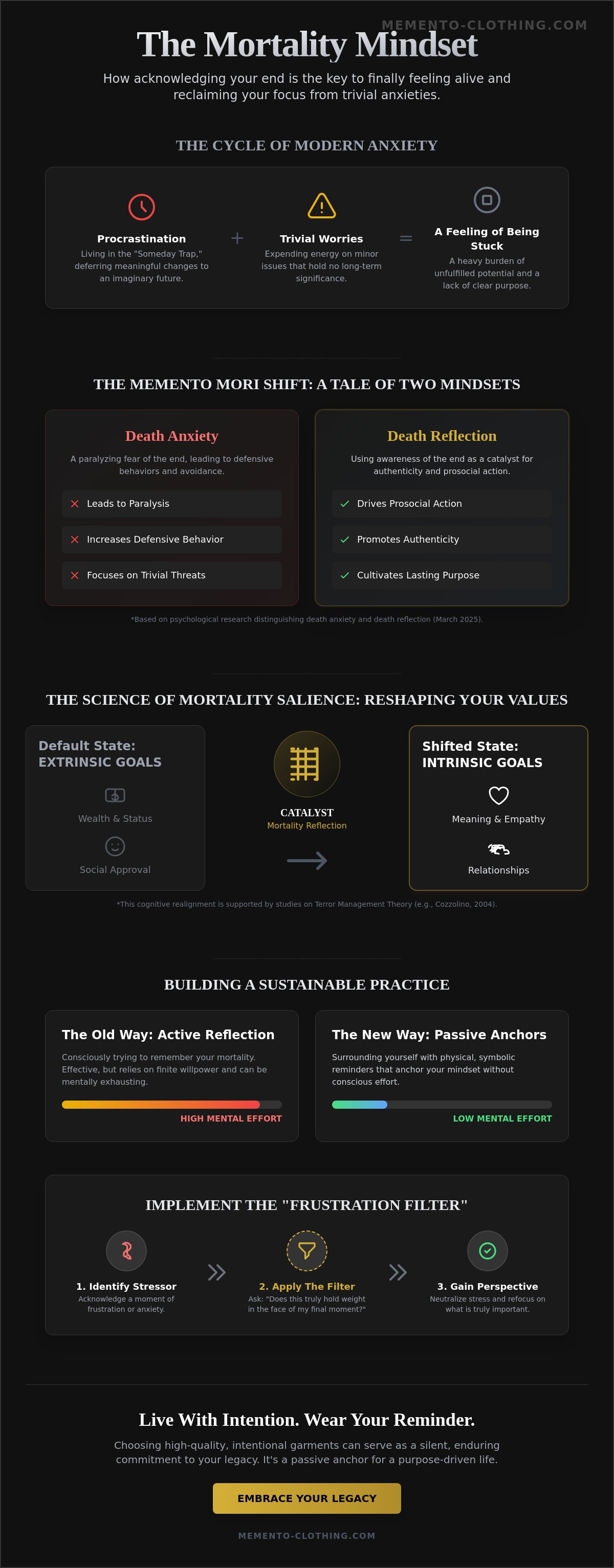
This article shows you how to use daily reminders of mortality for personal growth to shift your perspective from fear to profound purpose. We'll explore how the ancient practice of Memento Mori serves as a visual anchor, helping you move past the "rat race" into a life of intentional action. You'll learn the vital difference between paralyzing anxiety and the "death reflection" that drives prosocial behavior, as highlighted in research from March 2025. From the science of Terror Management Theory to the rise of meaningful apparel in 2026, we'll examine how to cultivate a mindset that values time over triviality.
Key Takeaways
- Reframe mortality as a catalyst for urgency, breaking the illusion of infinite time that leads to chronic procrastination.
- Utilize daily reminders of mortality for personal growth to move beyond "death anxiety" and toward a state of intentional, prosocial action.
- Transition from exhausting active reflection to sustainable "passive anchors" by surrounding yourself with physical symbols of timelessness.
- Implement a mid-day "Frustration Filter" to instantly neutralize stress by evaluating if your current worries hold weight in the face of the final moment.
- Understand how choosing high-quality, intentional garments can serve as a silent, enduring commitment to your own legacy.
The Architecture of a Meaningful Life: Why Mortality is Your Greatest Teacher
Time is a quiet thief. Most people live within the "Someday Trap," a psychological safety net where meaningful changes are deferred to an imaginary, infinite future. This illusion of permanence paralyzes us. We chase extrinsic status and social approval while our intrinsic desires remain dormant. To build a life of substance, we must first acknowledge its end. The ancient concept of Memento Mori isn't a surrender to darkness; it's a radical reclamation of the present. When we accept that our days are numbered, we stop asking "what if" and start asking "what now."
Historical figures have long used finitude as a strategic framing device. In his 2005 Stanford address, Steve Jobs noted that remembering he would be dead soon was the most important tool he ever encountered for making big choices. This isn't just for icons. It's a universal blueprint for anyone seeking to escape the "rat race." By integrating daily reminders of mortality for personal growth, we strip away the trivial. We're left with the raw materials of a legacy: authentic action and deep connection.
Breaking the Taboo: Death Awareness vs. Morbid Rumination
Psychological research from March 2025 distinguishes between death anxiety and death reflection. Anxiety leads to paralysis and defensive behavior. Reflection, however, acts as a catalyst for authenticity. A study involving 684 students in October 2024 showed that how we frame mortality determines our response. When we treat death as a teacher rather than a threat, we experience a psychological "zoom-out" effect. The minor inconveniences of the workday lose their weight. You're no longer stressed by a delayed email or a social slight. You see the big picture instantly. This shift reduces chronic stress and allows for a meditatitve, focused approach to your goals.
The Stoic Foundation of Intentional Living
The Stoics mastered this art centuries ago. Marcus Aurelius famously urged himself to act, speak, and think as if he were leaving life at that very moment. Seneca, in his treatise "On the Shortness of Life," argued that we aren't given a short life but we make it so by wasting it. Modern data supports this ancient wisdom. A January 2026 study found that daily reminders of mortality for personal growth can significantly increase engagement with life's most demanding tasks. It serves as a mechanism to manage existential threat by turning it into productive fuel. Time is our only non-renewable resource. Stoicism teaches us to treat it with the reverence it deserves, ensuring every moment carries the weight of intention.
The Science of Mortality Salience: How Reminders Reshape the Brain
Science validates what the soul senses. Mortality salience, or the awareness of our end, functions as a cognitive filter. A landmark 2004 study by researcher PJ Cozzolino showed that death reflection, which is distinct from simple fear, triggers genuine psychological growth. Participants in the study shifted their focus from extrinsic goals like wealth to intrinsic meaning. This neurological realignment is powerful. By using daily reminders of mortality for personal growth, you simulate the clarity found in those who face finitude every day.
Consider why funeral directors often report higher levels of life satisfaction. It's the habit of perspective. Constant exposure to the reality of death stops the mind from drifting into the trivial. It forces an investment in empathy and relationships because the deadline is always visible. Through neuroplasticity, this habit of perspective becomes a default state. The brain learns to prioritize the enduring over the ephemeral, training itself to ignore the noise of modern life.
Intrinsic vs. Extrinsic Motivation
Death awareness is a natural deterrent to the urge for social validation. When the end is visible, the weight of others' opinions often vanishes. Research indicates that mortality reminders decrease the desire for mindless consumerism. Instead, they increase empathy and relationship investment. You begin to see time as your most valuable, non-renewable currency. This isn't about being morbid. It's about being honest. You stop seeking status and start seeking substance.
Cognitive Priming and Environmental Cues
Willpower is a finite resource. It often fails during high-stress periods. This is where environmental cues become vital. Your subconscious is a silent observer. It processes background symbols such as an hourglass on a desk, a specific motif, or the tactile weight of a garment without conscious effort. This is cognitive priming. These passive anchors create a constant awareness that shapes your choices. Unlike sporadic meditation, these cues are always present. They turn intentional style into a functional tool for the mind. Daily reminders of mortality for personal growth are most effective when integrated into your physical surroundings. They create a ritual experience that bridges abstract philosophy and the reality of your life.
Active vs. Passive Reminders: Building a Sustainable Practice
Willpower is a fragile shield. We often begin our journey with a burst of motivation, only to find our resolve crumbling under the weight of a standard workday. Active reflection requires energy. It demands that we stop, sit, and consciously engage with the heavy reality of our finitude. While vital, this method is prone to failure during periods of high stress. This is where the concept of the passive anchor becomes essential. By surrounding yourself with physical cues, you bypass the need for constant effort. You create an environment that speaks to your subconscious even when your conscious mind is elsewhere. It's a way to ensure the philosophy remains present without becoming another chore on a to-do list.
Integrating daily reminders of mortality for personal growth works best through a hybrid approach. You combine the deep, focused work of active ritual with the constant, quiet presence of visual mementos. This ensures that the philosophy doesn't just live in your journal; it lives in your room, on your desk, and against your skin. A study from January 2026 highlights that such constant awareness can serve as a mechanism to manage existential threat, turning potential anxiety into a steady stream of academic and professional engagement. You aren't just thinking about death; you're using the awareness of it to fuel your life.
The Daily Protocol: Journaling and Meditation
A sustainable practice begins with the "Premeditatio Malorum," a Stoic technique of visualizing potential hardships. By spending two minutes each morning anticipating life's friction, you strip away the power of unexpected stress. You've already faced the worst in your mind. Complement this with a nightly two-minute check-in. Ask yourself: "If this were my final day, would I be satisfied with how I spent my hours?" This isn't about guilt. It's about alignment. Prompts should focus on defining a "good death" as a mirror for a "good life." Research from March 2025 suggests that this type of reflection increases prosocial motivation, making us more present for those who matter most.
Visual Anchors: The Role of Objects and Apparel
Environmental design is the most overlooked tool in the art of living intentionally. A physical object acts as a mental reset button. These are not merely decorations. They are talismans. When you wear a piece of clothing designed with a Memento Mori philosophy, you're donning a form of intentional armor. It serves as a silent, tactile reminder that your time is fleeing. This passive cue works in the background of your psyche. It filters out the world's noise and grounds you in the present. You don't have to remember to think about mortality; the object remembers for you. This creates a ritual experience where every glance in the mirror or touch of a fabric reinforces your commitment to an authentic life.
Integrating Memento Mori into Your Daily Routine
Morning begins with a deliberate pause. Before you reach for your phone or check your inbox, anchor your attention on the finite nature of the day ahead. This isn't about morbid fixation; it's about setting a high bar for what deserves your energy. By employing daily reminders of mortality for personal growth, you create a psychological shield against the trivial. You decide, in the quiet of the early hours, that your time is too valuable to be lost to reactive living. This ritual ensures that you approach your tasks with the weight of a person who understands that time is a non-renewable resource.
The 'Will it Matter?' Filter
Applying the 'Will it Matter?' Filter during your commute or in the heat of a deadline provides instant clarity. When a minor inconvenience threatens your peace, ask yourself if this will matter on your deathbed. Most of our daily stressors dissolve under this lens. It's a quick way to interrupt a negative thought spiral and return to a state of calm. This simple shift in perspective allows you to navigate the chaos of the world without being consumed by it.
The 'Last Time' exercise adds another layer of depth to your social interactions. Try treating every conversation with a friend or a parent as if it were the final one. You'll find that your listening becomes sharper and your patience deeper. It's no longer just a routine chat; it's a moment of authentic connection. This practice prevents the regret of words left unsaid and ensures that your legacy is built on the quality of your presence.
Fostering Gratitude through Finitude
Fostering gratitude becomes easier when you acknowledge the finitude of those around you. The Frias finding, a key study in psychology, suggests that reflecting on a loved one's mortality significantly boosts our current levels of appreciation for them. You move from the burden of 'I have to' to the privilege of 'I get to.' I get to help with this task. I get to share this evening. This realization transforms your relationships into a sanctuary of focus. If you're looking for a way to carry this mindset with you, our philosophical apparel acts as a constant, silent prompt for this daily practice.
End your day with a quiet audit. Before sleep, examine your actions against your core values. Did you live with intention, or did you let the day slip away? This final check-in ensures that you wake up tomorrow with even greater resolve. It's the closing ritual of a life lived with open eyes.
Intentional Style: How Memento Mori Clothing Serves the Practice
Theoretical awareness is a vital seed, but your environment is the soil where that awareness grows. Memento Mori Clothing creates physical artifacts that bridge the gap between abstract thought and daily reality. If life is fleeting, the objects we carry should possess substance. This is why we prioritize heavyweight, 12oz cotton. It's a protest against the disposable nature of modern culture. When you choose to wear daily reminders of mortality for personal growth, you're making a silent, radical declaration to yourself and the world. You are choosing the enduring over the ephemeral.
Our designs utilize vintage aesthetics to honor the timeless truths that have survived the centuries. The Memento Mori Vintage Tee is crafted to age with you, gaining character as it weathers the passage of time. Similarly, the Memento Mori Heavyweight Hoodie provides a grounding sensation. Its physical pressure acts as a constant prompt to stay present in your body and your purpose, serving as a vessel for your personal journey.
Craftsmanship as a Memento
Every stitch is an exercise in intentionality. We don't just create apparel; we create emotional anchors that help you navigate the noise of a fast paced world. This commitment to quality is rooted in the Memento Mori story, a narrative that transforms ancient wisdom into a modern tool for authenticity. As of 2026, the movement toward meaningful apparel has grown into a powerful community. Wearing these messages helps you find your tribe of intentional livers, creating a shared language of value and depth that transcends fleeting trends.
Your Daily Uniform for Growth
Consistency is the foundation of any practice. By adopting a daily uniform that reflects your internal values, you reduce decision fatigue and sharpen your focus. The Memento Crewnecks offer a sophisticated anchor for any setting, ensuring that daily reminders of mortality for personal growth are always within reach. This is the final step in living intentionally. It's the realization that every object you own is a part of your personal history. If you're ready to embrace the clarity of finitude, shop the full collection and start your practice today. Your time is your most precious resource. Spend it on what is real.
The Final Act: Turning Awareness into Action
The illusion of infinite time is the greatest barrier to your potential. We've explored how shifting from "death anxiety" to "death reflection" creates a psychological zoom-out effect, stripping away the trivial stress of the modern world. By integrating daily reminders of mortality for personal growth, you transform a silent truth into a loud, guiding principle. This isn't just about thinking; it's about being. It's about ensuring your daily actions align with the legacy you wish to leave behind.
Our national community of intentional thinkers understands that quality is a philosophical choice. We craft pieces from heavyweight 12oz cotton designed for longevity, featuring vintage-inspired designs that honor the past while grounding you in the present. These aren't just garments; they're tactile anchors for a life lived with purpose. Wear the Philosophy: Shop Memento Mori Apparel.
Your story is still being written. Make every word count. Your time is the only currency that truly matters; spend it on what is authentic. Spend it on what lasts.
Frequently Asked Questions
Is Memento Mori supposed to be depressing?
Memento Mori is a tool for vitality rather than a celebration of gloom. While the subject is serious, the intent is to highlight the preciousness of the present moment. By acknowledging finitude, you strip away the trivial anxieties that cloud your focus. It's a shift from fear to profound appreciation. It helps you realize that because time is limited, every choice carries more weight and beauty.
How can I explain my Memento Mori reminders to people who find them weird?
Frame your practice as a tool for intentionality and focus. You might explain that these symbols serve as a "perspective filter" to help you prioritize what truly matters. Most people understand the desire to avoid wasting time. By highlighting that it helps you be more present for loved ones, you bridge the gap between a perceived obsession and a practical life strategy.
What is the best way for a beginner to start practicing death reflection?
Beginners should start with a passive visual anchor before moving to active meditation. Place a small symbol, like an hourglass or a specific piece of art, in your workspace to act as a silent prime. Pair this with a single nightly question: "Did I live today in a way that I'd be proud of if it were my last?" This gradual integration builds the habit without overwhelming the psyche.
Does thinking about death actually reduce anxiety or increase it?
Research from March 2025 indicates that the outcome depends on the quality of the reflection. While "death anxiety" can lead to defensive behaviors, "death reflection" typically reduces stress over minor inconveniences. A January 2026 study found that academic engagement increases when mortality is used as a motivator. Using daily reminders of mortality for personal growth helps transition the mind from paralyzing fear to productive action.
What are the most common symbols used as reminders of mortality?
Traditional symbols include the skull, the hourglass, and the extinguished candle. These represent the physical end, the passage of time, and the fragility of life. Modern practitioners often use more subtle cues, such as heavyweight apparel or vintage inspired art. These objects serve as a tactile bridge between ancient philosophy and your current environment, keeping the concept present but sophisticated.
How does Memento Mori differ from 'YOLO' (You Only Live Once)?
YOLO often encourages immediate, hedonistic gratification, whereas Memento Mori emphasizes long term meaning and legacy. While both acknowledge that life is short, Memento Mori asks you to build something that lasts. It's not about reckless abandon; it's about disciplined presence. You aren't just seeking a thrill; you're seeking a life of substance and authentic action.
Can children or youth benefit from these concepts?
Youth can benefit from a softened version of this philosophy that focuses on the value of time and gratitude. An October 2024 study involving students showed that mortality awareness can foster prosocial behavior and helping others. For younger audiences, the focus should remain on not wasting the day and appreciating family. It builds an early foundation for intentionality and reduces the pressure of social validation.
How do I avoid becoming obsessed with death while practicing this?
Balance your practice by remembering its counterpart: Memento Vivere, or "remember to live." The goal of using daily reminders of mortality for personal growth is to enhance your experience of life, not to withdraw from it. If you find yourself ruminating, shift your focus to the actions the reminder inspires. Use the awareness of death as a fuel for creativity, connection, and joy in the present moment.