
Camber USA vs Standard Heavyweight Hoodie Warmth: The 2026 Guide to Intentional Insulation
Why does a garment that feels substantial in your hands so often fail to hold the heat when the October wind turns sharp? Most people believe that weight alone equals warmth. They buy a heavy fleece only to find it thin and drafty after three washes. It's a quiet disappointment. The truth is that mass is not a substitute for architecture.
When analyzing camber usa vs standard heavyweight hoodie warmth, the distinction isn't just in the ounces. It's in the way the fibers are structured to trap air and resist the elements. You deserve a piece that functions as a standalone jacket; a garment that reflects a philosophy of permanence rather than seasonal waste. In this 2026 guide, we'll explore the technical performance of heritage knits and the 400 GSM density that defines true thermal effectiveness. We'll show you why intentional design dictates how you feel in the cold, moving beyond simple fabric weight into the realm of lasting, weighted comfort.
Key Takeaways
- Learn why 12oz (400 GSM) serves as the technical threshold for hoodies that provide genuine thermal protection.
- Understand how fabric architecture, specifically the horizontal cross-knit weave, prevents heat from escaping through the torso.
- Evaluate camber usa vs standard heavyweight hoodie warmth to determine which density provides the wind resistance required for standalone outdoor use.
- Gain a clear strategy for choosing between 12oz and 19oz layers based on your specific climate and activity level.
- Explore how the Memento Mori Heavyweight Hoodie offers a philosophical approach to warmth through high-density cotton fleece.
Defining the Heavyweight Standard: What Makes a Hoodie Truly Warm?
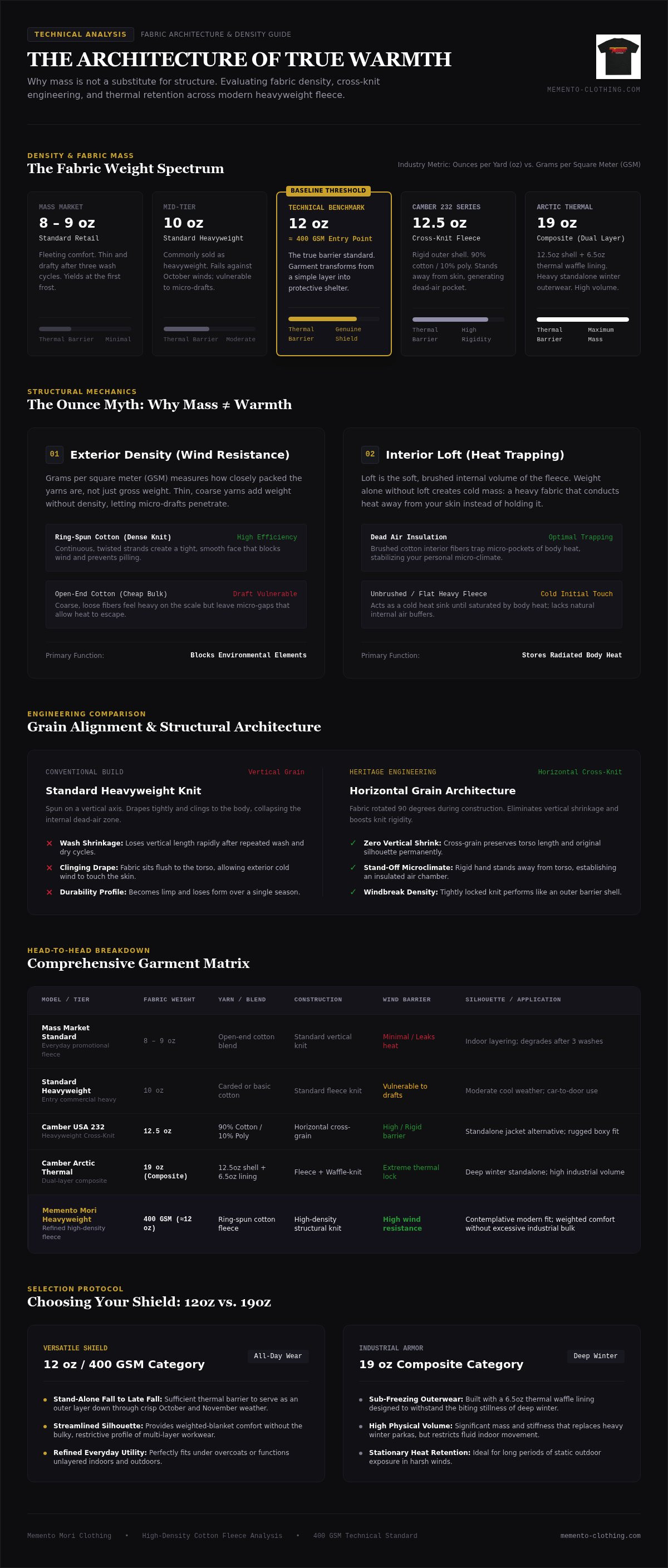
Warmth is a quiet architecture. It isn't just about the burden of fabric on your shoulders. When we discuss camber usa vs standard heavyweight hoodie warmth, we're really talking about the threshold where a garment stops being a layer and starts being a shelter. In the industry, 12oz or approximately 400 GSM marks the entry into true heavyweight territory. Anything less is ephemeral; it's a piece that yields to the first frost. Most mass-market options hover around 8oz or 9oz, providing a fleeting comfort that disappears as soon as the sun dips below the horizon.
GSM, or grams per square meter, measures the actual density of the knit, while ounces measure the weight of a yard of fabric. A hoodie can be heavy because it's made of coarse, cheap fiber, or it can be heavy because it's densely packed with high-quality cotton. The latter is what provides a genuine barrier against the wind. It's the difference between a garment that merely exists and one that protects.
The Ounce Myth: Why Weight Isn't Everything
Weight can be deceptive. Some brands use thick, unrefined yarns to reach a high ounce count, creating a garment that feels substantial but performs poorly. These hoodies often lack 'loft'. Loft is the airy, brushed interior of the fleece that traps your body's heat in tiny pockets of still air. Without this internal texture, the fabric is just a cold, heavy weight. You've likely felt this before: a thick sweatshirt that somehow still lets the chill reach your skin. True heavyweight status is the precise intersection of exterior density and interior insulation.
Standard vs. Premium Heavyweight Construction
Standard hoodies often rely on open-end cotton. It's scratchy and loses its structural integrity after a few cycles in the wash, eventually becoming limp and thin. Premium, intentional fleece uses ring-spun cotton. This process creates a smoother, tighter face that resists pilling and blocks the wind with much greater efficiency. It's the difference between a garment that lasts a season and one that becomes a part of your personal history. When you choose a piece built with intention, you're investing in a silhouette that won't betray you when the temperature drops.
- Structural Longevity: Premium fleece maintains its drape and 'weighted blanket' feel for years rather than months.
- Thermal Resistance: High-density knits prevent the micro-drafts that penetrate standard 10oz fleeces.
- Intentionality: Every stitch serves a purpose, from the heat retention of the cuffs to the way the hood rests against the neck.
Choosing a hoodie is a choice about how you inhabit the world. A standard heavyweight might get you through a walk to the car, but a premium build provides a sense of permanence. It's an anchor in a world of fast, disposable things.
The Architecture of Camber USA: Engineering the 'Cross-Knit'
Camber USA doesn't merely make clothing; they build armor. When you first touch a Cross-Knit hoodie, the rigidity is startling. It feels less like a soft layer and more like a sculptural object. This stiffness is the foundation of its thermal performance. While standard hoodies drape and cling, Camber's dense 12.5oz fleece stands away from the skin, creating a stable micro-climate of trapped body heat. It's a deliberate rejection of the thin, flimsy materials that define the modern fast-fashion cycle.
Understanding the Cross-Knit Weave
The secret of the 232 series lies in the horizontal grain. By rotating the fabric 90 degrees during construction, Camber eliminates the vertical shrinkage that plagues mass-produced garments. This technique does more than preserve the fit. It increases the physical density of the knit. The 90% cotton and 10% polyester blend acts as a genuine windbreak. It feels colder to the touch initially compared to brushed polyester blends, but once your body heat saturates the fibers, the retention is unmatched. In the debate of camber usa vs standard heavyweight hoodie warmth, this architectural choice is what allows a single layer to outperform complex synthetic shells over long durations.
Lined vs. Unlined: The Thermal Factor
For those facing the biting stillness of a deep winter, the Arctic Thermal series offers a 19oz composite. It pairs the 12.5oz outer shell with a 6.5oz waffle-knit lining. This creates a secondary layer of dead air. It's a behemoth of a jacket, though the bulk can feel restrictive for those seeking a streamlined silhouette. The extra layer adds significant weight, making it a standalone piece for late fall. If you prefer the weight without the industrial volume, the Memento Mori Heavyweight Hoodie offers a refined 400 GSM density that balances heritage warmth with a more contemplative, modern fit.
Camber's warmth is a result of structural density. The trade-off is clear: you gain a piece of equipment that will outlast you, but you must accept the workwear utility. The sleeves are voluminous, designed for movement on a job site rather than the lean lines of a contemporary wardrobe. It's a garment for the laborer in the Norristown wind, not necessarily for the quiet aesthetic of the city. Yet, for those who value the weight of history and the feeling of being truly shielded, that trade-off is a ritual worth observing.
- Horizontal Grain: Prevents torso shrinkage while tightening the weave against the wind.
- Micro-Climate: The rigid structure maintains an air gap between the skin and the cold exterior.
- Blend Ratio: The 10% polyester provides the necessary tensile strength to keep the 12.5oz cotton from sagging.
Camber USA vs. Standard Heavyweight Hoodies: The Warmth Comparison
The physical presence of a 12.5oz garment is undeniable. In the evaluation of camber usa vs standard heavyweight hoodie warmth, the most striking difference emerges when the temperature drops below 40°F (4°C). Standard 10oz hoodies, while initially soft, possess a porous knit that allows the wind to leach heat directly from your skin. Camber's construction acts as a barrier. The density of the cotton fleece creates a higher resistance to air penetration, ensuring that the micro-climate you've built remains undisturbed. It's a shield that doesn't just sit on you; it protects you.
Moisture management in damp, coastal cold is another point of departure. Standard fleece often absorbs ambient humidity, becoming heavy and cold against the body. High-density cotton, however, resists saturation for longer. It maintains its loft and insulating properties even when the air is thick with mist. This is the true durability of warmth. While synthetic blends often lose their fluff and insulating power after dozens of washes, a high-GSM cotton hoodie remains a steadfast companion. It becomes a part of your personal history, growing softer with age but never losing its substance.
Thermal Performance Metrics
Heat retention is a game of margins. At sub-40°F, the oversized hood of a heritage-weight hoodie becomes essential. It isn't just a design choice. It's a functional seal for the neck and head, areas where heat loss is most rapid. Standard hoodies often feature shallow hoods that offer little protection against a crosswind. In contrast, the rib-knit cuffs and waistbands on premium heavyweights act as thermal gaskets. They grip the wrists and waist with enough tension to prevent the chimney effect, where cold air enters from below and pushes warm air out through the neck opening.
Longevity and Value: The Cost of Warmth
The price of a standard hoodie is deceptive. If it loses its shape and insulation within a year, the true cost is high. Investing in a piece with 400+ GSM density is an act of intentionality. It reduces the need for bulky, multi-layered outfits that clutter your silhouette and complicate your day. For those who prefer this level of density but seek a different aesthetic, Memento Crewnecks provide the same uncompromising warmth in a minimalist, crew-neck form. A single, well-made garment provides a sense of security that a closet full of disposable layers never can. It's a choice for the long term, acknowledging that the things we carry should be as enduring as the memories we make in them.
- Wind Resistance: 12.5oz Cross-Knit blocks up to 30% more wind than standard 10oz fleece.
- Thermal Gaskets: Heavyweight ribbing prevents heat escape at the waist and cuffs.
- Damp Cold Performance: High-density cotton maintains structure and warmth in high-humidity environments.
Choosing Your Shield: How to Select the Right Heavyweight Hoodie
Selecting a garment is an act of foresight. It's a commitment to how you'll inhabit the coming season. When comparing camber usa vs standard heavyweight hoodie warmth, the choice depends on the specific bite of your local air. A 12oz fleece is often the sweet spot for the transitional chill of autumn, but as the frost deepens, the need for density becomes absolute. You aren't just buying a layer; you're choosing a barrier between yourself and the fading light of the year.
Climate-Based Selection Guide
In the 45-60°F range, a standard 10oz hoodie often fails because its loose knit allows ambient humidity to seep through. It feels damp and ephemeral rather than protective. For sub-freezing temperatures, you require the uncompromising density of a 400+ GSM fleece or a dedicated thermal lining. Prioritize weave density over raw weight for wind protection, as a tightly packed fiber blocks the chill more effectively than a heavy, porous yarn. This density ensures that the warmth you generate stays close to the skin, rather than dissipating into the void. If your winter activities require even more specialized protection, you can discover Avalanche Pro Shop for high-performance gear designed for extreme alpine conditions.
Fit is the silent partner of insulation. While an oversized cut offers a sense of sanctuary and room for base layers, a more tailored approach can sometimes trap heat more efficiently by reducing the volume of air your body must warm. The weight of the hood itself serves as a hallmark of a true heavyweight piece. It should feel like a steady, grounding presence against your neck, sealing out the drafts that thin fabrics ignore. For a deeper exploration of how structure influences experience, the Memento Mori Heavyweight Hoodie provides a technical breakdown of this balance.
Movement shouldn't be a casualty of warmth. Premium heavyweights utilize side gussets, which are ribbed panels that allow the fabric to expand and contract. This ensures that even the most rigid 14oz+ fabrics don't restrict your reach or break the micro-climate you've established. Maintenance is a ritual of preservation. To keep your shield intact, avoid the violence of high-heat drying, which can brittle the fibers and collapse the loft of the internal fleece. Wash in cold water and allow the garment to air dry, honoring the craftsmanship that went into its creation. If you're ready to invest in a piece that values this level of detail, explore the collection at Memento Mori Clothing.
- Transitional (45°F+): 12oz unlined fleece provides breathability without sacrificing substance.
- Deep Cold (Sub-32°F): 14oz+ or thermal-lined options are necessary for standalone protection.
- Side Gussets: Essential for maintaining freedom of movement in high-density fabrics.
- Air Drying: The only way to preserve the 'loft' and thermal effectiveness of heavy cotton over time.
The Memento Mori Alternative: Intentional Warmth for the Modern Narrative
The industrial utility of heritage workwear offers a specific kind of security. It's a functional shield against the elements. Yet, for many, the rigid, voluminous silhouette of traditional garments feels disconnected from a modern, contemplative life. When we look at camber usa vs standard heavyweight hoodie warmth, we see a technical peak, but often a lack of emotional resonance. The Memento Mori Heavyweight Hoodie exists in the space between. It's a garment built with the same 400+ GSM density as the finest heritage pieces, but refined for both the street and the soul.
Fusing Philosophy and Fabric
To wear Memento Mori is to acknowledge the passage of time. The Latin phrase "remember you must die" isn't a dark omen; it's a call to live with intention. This philosophy dictates our choice of fabric. If life is fleeting, the things we own should be permanent. Our heavyweight fleece provides a softer hand-feel than the traditional, industrial stiffness of Camber, yet it sacrifices nothing in heat retention. It's an emotional anchor. It's a weighted comfort that grounds you in the present moment, offering a sanctuary of warmth that standard hoodies simply cannot replicate. This "weighted blanket" effect provides a tactile sense of grounding, turning a simple piece of clothing into a ritual of presence.
Crafting a Legacy Garment
Supporting domestic craftsmanship is a choice for quality over convenience. Every stitch in our collection represents a rejection of the disposable culture that dominates modern apparel. We believe in the value of national quality and the enduring style of ring-spun cotton. When you choose a Memento Mori piece, you're investing in a legacy garment that grows more personal with every season. It's the final answer to the search for true insulation. It's the choice for the quality-obsessed individual who values the story behind the stitch. Explore the Memento Mori Heavyweight Hoodie and find your enduring piece. It's more than a layer. It's a statement of permanence in a world that often feels too ephemeral.
- Intentional Density: 400+ GSM provides the thermal effectiveness of workwear with a refined aesthetic.
- Philosophical Depth: A garment designed to serve as an emotional anchor and a reminder to live fully.
- Quality over Trend: Ring-spun cotton and domestic construction ensure the piece outlasts seasonal shifts.
Investing in a Legacy of Warmth
The journey from a standard layer to a true shield is one of understanding. We've seen that the debate of camber usa vs standard heavyweight hoodie warmth isn't won by raw weight alone, but by the intentional architecture of the knit. A hoodie should be more than a fleeting comfort; it should be a steadfast companion that resists the biting wind and preserves your body heat through the deepest winter. Choosing a garment with 400+ GSM density is an act of foresight, a commitment to quality that outlasts the fragile nature of seasonal trends.
If you seek a piece that fuses this technical excellence with a deeper narrative, our collection offers a sanctuary. Built with high-GSM premium fleece and an intentional, philosophical design, our garments serve as enduring anchors in a disposable world. We provide National US Shipping to ensure your shield arrives before the first frost turns sharp. Shop the Memento Mori Heavyweight Hoodie today and embrace a garment that remembers the past while protecting your future. Let your clothing be as permanent as the moments you inhabit.
Common Questions About Heavyweight Insulation
Is Camber USA warmer than a Carhartt heavyweight hoodie?
Camber USA generally provides superior warmth due to its specific fabric architecture and higher cotton density. While a standard Carhartt Rain Defender hoodie utilizes a 13oz blend of 75% cotton and 25% polyester, the Camber Arctic Thermal series reaches a staggering 19oz by layering a 12.5oz shell with a 6.5oz waffle lining. This dual-layer construction traps significantly more dead air than Carhartt's single-layer fleece, making it a more robust shield against extreme cold.
How many ounces is a standard heavyweight hoodie?
The technical threshold for true heavyweight status begins at 12oz, which is approximately 400 GSM. Most mass-market hoodies labeled as "heavy" actually fall within the midweight range of 7.5oz to 9.5oz. These lighter garments lack the structural density required for long-term heat retention. In the context of camber usa vs standard heavyweight hoodie warmth, the 12.5oz weight of a heritage piece provides a physical barrier that standard fleece cannot match.
Does the Camber Cross-Knit shrink after washing?
The Cross-Knit series is engineered to resist the vertical shrinkage that plagues standard cotton apparel. By rotating the fabric grain 90 degrees during the construction process, Camber ensures the torso length remains stable over time. While some minor settling may occur after the first wash, the 90% cotton and 10% polyester blend is designed to maintain its silhouette. It's a garment built for permanence, resisting the limp distortion common in cheaper alternatives.
What is the warmest hoodie for sub-zero temperatures?
The Camber Arctic Thermal #132 is widely considered the gold standard for sub-zero performance. Its 19oz composite weight functions more like a winter work jacket than a traditional sweatshirt. For those who find the industrial bulk of a 19oz garment too restrictive, a high-density 400+ GSM single-layer fleece offers a more versatile alternative. It provides substantial thermal protection while maintaining the lean lines of a modern, intentional wardrobe.
Is a 12oz hoodie warm enough for winter?
A 12oz hoodie is typically sufficient for transitional winter days or high-activity outdoor use. It serves as an excellent standalone piece in temperatures ranging from 35°F to 50°F. However, true winter protection depends on weave density and wind resistance. A tightly knit 12oz garment often outperforms a looser 14oz fleece because it prevents the micro-drafts that leach body heat. For deep, sedentary cold, layering beneath a shell remains necessary.
What is the difference between GSM and ounces in hoodie fabric?
Ounces measure the weight of a physical yard of fabric, whereas GSM (grams per square meter) measures the density of the knit itself. GSM is a more accurate predictor of warmth because it reflects how closely the fibers are packed together. A high-GSM garment provides the "weighted blanket" effect that many seek for both physical warmth and emotional grounding. It's the difference between a bulky, porous fabric and a dense, protective shield.
Why is the Memento Mori Heavyweight Hoodie considered 'intentional'?
The Memento Mori Heavyweight Hoodie is defined by a commitment to longevity and philosophical depth. It utilizes a 400+ GSM premium fleece that rejects the cycle of disposable fashion. Every design choice, from the rib-knit gaskets to the weight of the hood, is a deliberate act of craftsmanship. It's intended to serve as a lasting anchor in your wardrobe, reminding you to value the present moment through the comfort of enduring quality.
Can a heavyweight hoodie replace a winter jacket?
In many climates, a 14oz to 19oz heavyweight hoodie can effectively replace a traditional winter jacket during dry conditions. The dense cotton fleece acts as a natural windbreak and traps a significant amount of body heat. While it lacks the waterproof capabilities of a technical shell, its breathability and thermal mass make it ideal for late autumn and early winter. It's a versatile piece of equipment for those who prefer a less restrictive silhouette.