
Buying Clothes That Make You Happy: The Art of Intentional Style
The rush of adrenaline at the checkout counter isn't joy; it's a ghost. We often mistake the fleeting spark of a transaction for the lasting warmth of a meaningful possession. If you've felt the dopamine crash after a purchase or the weight of a closet that doesn't speak your name, you understand the cost of the ephemeral. Buying clothes that make you happy shouldn't feel like a race against obsolescence. It's an art of selection. A quiet rebellion against a fast fashion market projected to reach 180.6 billion dollars by 2026.
You recognize the exhaustion of decision fatigue and the guilt of wasteful spending. We'll help you move from impulsive consumption to a wardrobe that provides lasting emotional fulfillment. This guide explores the philosophy of intentional style. We'll examine the psychological shifts required to find peace in your attire. You'll learn to curate pieces that act as emotional anchors, ensuring every garment you own reflects your values and stands the test of time.
Key Takeaways
- Recognize the hollow nature of the buyer's high and learn the mindset shift required for buying clothes that make you happy.
- Explore how enclothed cognition turns your wardrobe into a mirror of your inner state and a tool for cognitive clarity.
- Embrace the philosophy of memento mori to filter out the noise of fleeting trends in favor of timeless, intentional pieces.
- Evaluate garments through the pillars of tactile integrity and structural longevity to ensure every piece provides lasting fulfillment.
- Understand why substantial, heavyweight fabrics offer a unique form of psychological grounding and physical self-care.
The Dopamine Trap: Why Buying New Clothes Doesn't Always Lead to Happiness
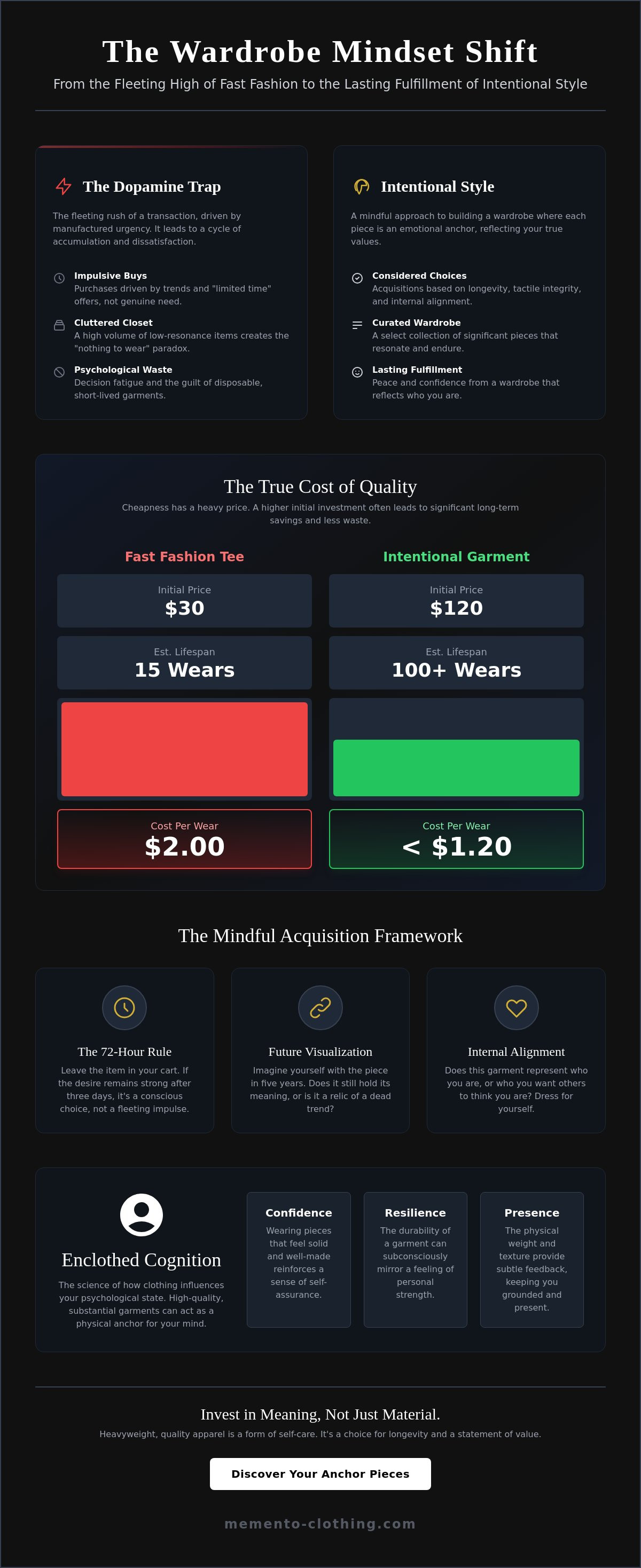
Happiness is often sold as a transaction. We chase the click of a button or the sliding of a credit card. Yet, the wardrobe fills while the spirit remains hungry. This is the paradox of plenty. We own more than any generation in history, yet the "nothing to wear" paradox persists. When volume increases, resonance fades. Each new item becomes a whisper lost in a screaming room. Buying clothes that make you happy requires a departure from this cycle of accumulation. It demands a move toward the singular and the significant.
The Science of the Shopping High
Dopamine is a hunter. It thrives on anticipation, not possession. Modern retail environments exploit this biological quirk through deliberate design. Bright lights, scrolling feeds, and "limited time" banners trigger a primitive urgency. We buy for the rush of the "maybe." We imagine a new version of ourselves that exists only in the future. Then the package arrives. The chemical spike recedes. We're left with a garment that lacks a soul. Long-term satisfaction can't be found in a neurotransmitter spike. It lives in the quiet, enduring relationship between the wearer and the worn.
The Cost of Fast Fashion Disposability
Cheapness has a heavy price. When a shirt costs less than a meal, it becomes disposable. This creates a psychological distance between us and our belongings. We stop caring for our things because they're easily replaced. A cluttered closet
The Science of Style: How Mindfulness Transforms Your Wardrobe
Clothing is more than a shield against the elements. It's a second skin. It's a silent dialogue between your inner world and the physical realm. When we move beyond the impulsive urge to accumulate, we enter the space of the intentional. True contentment isn't accidental. Buying clothes that make you happy is a deliberate exercise in mindfulness. It's about choosing pieces that resonate with your soul long after the initial novelty has faded. This shift in perspective transforms the act of dressing from a chore into a ritual of self-respect.
Understanding Enclothed Cognition
The relationship between what we wear and how we feel is rooted in science. Psychologists call this enclothed cognition. This concept suggests that clothing co-opts our sensory experiences to influence our psychological processes. When you wear a garment you perceive as high-quality, your brain adopts the characteristics you associate with that quality. Resilience. Confidence. Presence. The weight and texture of the fabric against your skin provide constant, subtle feedback to your nervous system. A heavyweight hoodie isn't just warm. It's a physical anchor that encourages a grounded, focused state of mind.
Practicing Mindful Acquisition
Mindfulness in fashion requires a pause. It's a refusal to be swept away by the current of disposability. By 2026, new EU regulations will require a Digital Product Passport for garments, highlighting the growing need for transparency and longevity. We can mirror this systemic change on a personal level through Conscious Consumerism. This involves looking past the price tag to the true value of an item. Consider the cost-per-wear. A $120 sustainable shirt that lasts for 100 wears costs only $1.50 per use. In contrast, a $30 fast-fashion alternative that survives only 15 washes costs double at $3.00 per wear. To master this, try these steps:
- The 72-Hour Rule: Leave the item in your cart or on the rack. If the desire remains after three days, it's likely a choice, not an impulse.
- Future Visualization: Imagine yourself wearing the piece five years from today. Does it still hold its meaning, or is it a relic of a dead trend?
- Internal Alignment: Ask if the garment represents who you are or who you want others to think you are.
Dressing for your internal state creates a lasting satisfaction that no trend can replicate. It's the difference between wearing a costume and wearing an identity. When your wardrobe reflects your values, the "nothing to wear" anxiety vanishes. You're left with a collection of emotional horgonyok—anchors that help you navigate the world with a quiet, aesthetic confidence.
Beyond the Trend: Embracing the Philosophy of Memento Mori in Your Closet
Time is the only currency that matters. When we acknowledge its finitude, our choices sharpen. This is the essence of Memento Mori. It's an ancient reminder that life is fleeting. In the context of a wardrobe, this philosophy acts as a powerful filter. It strips away the noise of seasonal marketing. It forces us to ask: is this garment worthy of the moments I have left? Buying clothes that make you happy starts with this quiet confrontation with transience. We stop seeking the "new" and begin seeking the "permanent."
The Power of Intentional Design
Meaning isn't accidental. It's woven into the fabric. When a brand builds upon a philosophical foundation, the result is more than a product. It's an artifact. You can explore the Memento Mori story to see how ancient wisdom informs modern creation. A trend-driven brand sells a look. A philosophy-driven brand sells a perspective. This creates a bond that fast fashion cannot replicate. Your clothes become a narrative. They're chapters in a personal history rather than clutter in a drawer. Every Memento Mori Vintage Tee or Memento Crewneck serves as a physical reminder to live with intention. These pieces don't just sit in your closet; they participate in your life.
Valuing the Permanent in a Transient World
Quality is a form of respect for the future self. We often buy for the person we are today, forgetting the person we'll be in a decade. A legacy mindset changes your criteria for selection. You look for pieces that age with grace. Consider the beauty of a well-worn vintage tee. It holds the shape of your body and the memory of specific places. It doesn't fray or pill after three washes. It endures. In a world of disposability, choosing the permanent is a radical act. It turns your closet into a curated collection of emotional anchors. This is the art of building a wardrobe that provides lasting fulfillment.
These aren't just garments. They're mementos of a life lived deeply. When you choose a heavyweight hoodie or a structured crewneck, you're opting for a companion. By investing in structural integrity, you're ensuring that your wardrobe remains a source of satisfaction, not a source of waste. This is how you build a collection that survives the wash and the whims of culture. It's about finding the beauty in the long-term. It's about recognizing that while we are temporary, the values we wear can be timeless.
The Buyer's Framework: 4 Pillars of Clothes That Spark Lasting Joy
Joy is a structure. It isn't a random occurrence or a lucky find in a bargain bin. It's the result of a rigorous selection process that aligns your physical needs with your internal values. Buying clothes that make you happy requires a framework that moves beyond the visual. It demands a four-fold check of sense and spirit. When these four pillars are met, a garment ceases to be a product. It becomes an artifact of your personal history.
- Pillar 1: Tactile Integrity. The skin is an organ of perception. If a fabric is thin, synthetic, or abrasive, it creates a sensory dissonance that no visual trend can overcome.
- Pillar 2: Structural Longevity. With the 2026 EU Ecodesign regulations coming into effect, the world is finally waking up to the necessity of durability. A garment must be built to survive the wash and the years.
- Pillar 3: Aesthetic Resonance. Trends are a form of collective amnesia. True style is a memory. A piece must look like you, reflecting your silhouette and your story.
- Pillar 4: Ethical Alignment. You cannot find peace in a garment born of exploitation. Satisfaction comes from knowing the hands and the heritage behind the stitch.
The Hierarchy of Wardrobe Needs
Fit and fabric are the foundations of clothing satisfaction. Without them, the most beautiful design is a failure. We often prioritize the "look" while ignoring the "feel," leading to a closet full of beautiful mistakes. Mastering intentional style and quality means identifying your style uniform. This isn't a limitation. It's a liberation. It's a curated set of silhouettes that guarantee a grounded, confident state of mind every time you dress. It reduces decision fatigue and ensures that buying clothes that make you happy becomes your default mode of acquisition.
Evaluating Ethical and Community Impact
The story of a maker adds a layer of emotional warmth to a garment. In an era of globalized anonymity, there's a profound joy in supporting a brand with a clear national identity and purpose. Knowing that your hoodie or tee is rooted in the craftsmanship of a specific community, like the spirit found in Ohio, creates a bridge between your wardrobe and your values. This community spirit isn't just marketing. It's a worldview. It's a choice to invest in the local and the lasting over the distant and the disposable. You can find these meaningful connections in our collection of intentional apparel.
Investing in Meaning: Why Heavyweight Quality is a Form of Self-Care
Self-care is rarely found in the frantic search for something new. It lives in the deliberate choice of what we allow to touch our skin. Buying clothes that make you happy isn't about the visual flash of a logo. It's about the physical reassurance of weight. A substantial garment provides a boundary between the self and the chaos of the outside world. It offers a sense of permanence in an era defined by the ephemeral. When a piece has substance, it demands that you slow down and acknowledge your own presence.
The Sensory Experience of Heavyweight Cotton
The grams per square meter (GSM) of a fabric is a metric of respect. High-GSM cotton doesn't just hang; it holds. It creates a protective envelope that signals safety to the nervous system. While thin, mass-produced fabrics feel like a temporary covering, Memento Crewnecks offer a different emotional experience. They possess a tactile grounding that lower-quality alternatives cannot replicate. This weight acts as a physical anchor for the mind. When you wear a Memento Mori Heavyweight Hoodie, you aren't just dressed. You're supported. The tactile grounding provided by heavyweight apparel serves as a constant, subtle reminder of your own presence and worth in a transient world.
Curating for the Long Haul
Building a wardrobe is an act of curation, not consumption. It's a slow gathering of pieces that will witness your life. Buying clothes that make you happy requires you to think in decades, not seasons. This shift transforms the way you treat your belongings. Caring for a high-quality garment becomes a ritual. You wash it with intention. You store it with care. You recognize that its value increases as it carries more of your personal history. Each fade and each soft crease becomes a map of where you've been and who you've become.
Dressing for the life you want to remember is the ultimate goal of intentional style. It's a refusal to be a bystander in your own aesthetic. Choose pieces that echo your values. Invest in the weight that keeps you grounded. Let your closet be a collection of emotional anchors that remind you of the beauty in the brief time we have. We don't just own our clothes. We inhabit them. Make sure they're worthy of the life you're building. Every choice is a footstep in your personal history; walk with purpose and wear what lasts.
Cultivating a Wardrobe of Lasting Resonance
True style is a dialogue with time. It's a refusal to let the ephemeral dictate your presence. We've seen how the dopamine rush of the transaction is a phantom. It's quickly replaced by the weight of a cluttered, uninspired closet. By embracing enclothed cognition and structural longevity, you move from accumulation to curation. Buying clothes that make you happy requires this philosophical shift. It's a choice to value the permanent over the disposable.
Your closet should be a collection of emotional anchors. These pieces remind you of your own depth. They celebrate the beauty of the present moment. Our collection combines premium heavyweight cotton construction with timeless, philosophy-driven designs. This is apparel as self-care. We offer national shipping across the United States to support your journey toward intentionality.
Discover intentional style with Memento Mori Clothing and find the pieces that will witness your history. Dress for the life you want to remember. Every garment is a choice. Make yours a testament to what lasts.
Frequently Asked Questions
Can buying clothes actually make you happy in the long term?
Lasting fulfillment comes from the resonance between a garment and your personal identity. While the "buyer's high" is a temporary chemical spike, intentional acquisition creates a wardrobe of meaningful artifacts. When you choose pieces based on structural integrity and philosophical alignment, they serve as enduring companions in your daily life.
What is 'dopamine dressing' and does it really work?
Dopamine dressing is the practice of wearing specific colors or textures to influence your mood. It's rooted in enclothed cognition, where the symbolic meaning of your attire changes how you think and act. Wearing a substantial, well-crafted piece can trigger a sense of competence and joy that transcends fleeting fashion trends.
How do I stop buying clothes I never wear?
Breaking the cycle of impulsive shopping requires a shift from accumulation to curation. Use the 72-hour rule to allow the initial dopamine rush to fade before finalizing a purchase. Buying clothes that make you happy involves evaluating tactile integrity and aesthetic resonance to ensure every new piece has a permanent place in your story.
Why do I feel like I have nothing to wear even though my closet is full?
This paradox occurs when volume dilutes the emotional value of your collection. A closet filled with low-quality, trend-driven items creates decision fatigue and a sense of disconnection. You aren't lacking options; you're lacking resonance. Removing the "noise" of disposable fashion allows your truly significant pieces to emerge.
Is it better to have a capsule wardrobe or a large collection of quality items?
The ideal wardrobe size is defined by intentionality rather than a specific number of items. A smaller, curated collection of heavyweight essentials often provides more satisfaction than a sprawling array of uninspired pieces. Focus on building a wardrobe where every garment reflects your values and stands the test of time.
What should I look for in a garment to ensure it lasts for years?
Prioritize high-GSM fabrics and reinforced construction. A heavyweight cotton hoodie or a vintage-style tee with substantial stitching will survive the wash and the years far better than thin alternatives. Quality is a form of respect for your future self; it ensures your favorite pieces remain part of your legacy.
How does the weight of a fabric affect my mood or confidence?
Heavyweight fabrics provide a psychological benefit known as tactile grounding. The physical presence of a substantial garment acts as a protective envelope for the nervous system. This sensory feedback can foster a sense of safety and focused confidence, making buying clothes that make you happy a practical form of self-care.
What is the Memento Mori philosophy in fashion?
Memento Mori is the awareness of transience used as a filter for intentional living. In fashion, it encourages us to reject the disposable and embrace the permanent. It's a reminder to choose garments that serve as emotional anchors, helping us navigate a changing world with a quiet, aesthetic confidence.