
Buy It for Life Clothing Essentials: 2026 Guide
What if the best buy it for life clothing essentials aren’t the pieces with the boldest durability claims, but the ones you’ll reach for, care for, and wear again? Substantial fabric or a reassuring label can hint at quality, but neither tells the whole story. It’s hard to judge a garment before it becomes part of your daily life, and trend-led choices can lose their meaning long before they wear out.
You don’t need a promise of forever to choose thoughtfully. You need clear criteria. This guide will help you compare materials and construction, assess fit for your routines, and check care instructions and repair options before buying. We’ll also look at versatility and repeat wear, so each essential earns its place rather than simply filling a gap. The aim is a smaller, more personal wardrobe, shaped by attention instead of hype and ready to gather the quiet marks of everyday life.
Key Takeaways
- Think of buy it for life clothing essentials as a buying philosophy, not a promise that a garment will last forever.
- Compare fabric, construction, fit, care needs, and repair options together. No single detail proves a piece is durable or right for you.
- Use a simple checklist to assess each garment’s product information, versatility, and likely repeat wear before deciding.
- Audit your wardrobe first, then prioritize purchases that fill a real gap and suit the routines you actually have.
- Consider Memento Mori Clothing apparel as one option to evaluate, and review product details rather than assuming lifetime durability.
What Buy It for Life Clothing Essentials Really Mean
Buy it for life clothing essentials are garments chosen for dependable use over time, based on their materials, construction, fit, care needs, and repairability rather than a promise that they’ll last forever. Their value also depends on whether you wear them regularly. A well-made piece that doesn’t fit your life may spend more time in a closet than on your body.
This idea shares ground with slow fashion principles, which favor considered design and longevity over constant replacement. That doesn’t mean dressing plainly or rejecting personal style. A distinctive graphic tee or a favorite color can earn a lasting place if it suits your taste and routine beyond a passing moment.
Can clothing genuinely last a lifetime?
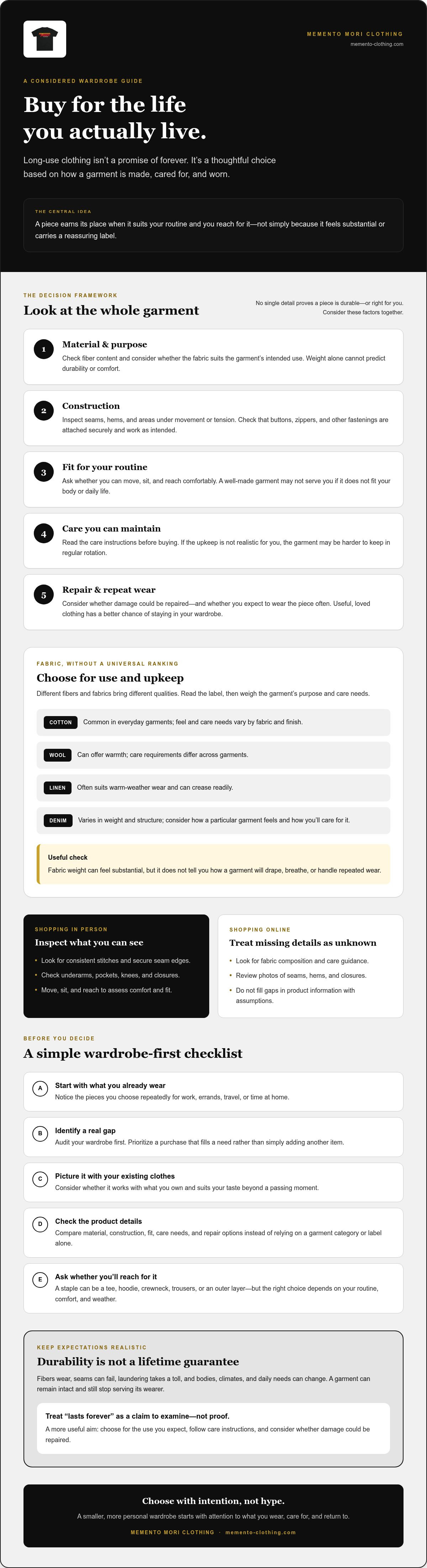
Not reliably, and not for everyone. Fibers wear, seams can fail, repeated laundering takes a toll, and bodies, climates, and daily needs change. Even a garment that remains intact may eventually stop serving its wearer.
A more useful goal is realistic durability: choose a piece that can handle the use you expect, follow its care instructions, and check whether damage could be repaired. Treat absolute language such as “lasts forever” as a claim to examine, not proof. Longevity depends on design, use, upkeep, and changing circumstances.
Which essentials deserve careful consideration?
Start with what you already wear often. For one person, that may be tees and hoodies; for another, well-crafted trousers or premium denim from brands like alvinvalley.com, or an outer layer suited to their climate. There’s no universal must-own list. Your routine, comfort, and weather determine which categories deserve closer attention.
Notice the garments you repeatedly choose for work, errands, travel, or time at home. Those are useful candidates for a more deliberate comparison. A heavyweight hoodie, vintage tee, or crewneck can be an everyday staple, but its category or name can’t confirm how a specific item will perform. Check the product details before deciding.
Durable essentials differ from trend-led purchases mainly in how you assess their staying power. A trend can still express something personal, and a classic silhouette isn’t automatically a wise buy. Ask whether you like the garment, whether it works with clothes you own, and whether you can care for it as directed. The aim isn’t to remove pleasure from getting dressed. It’s to choose pieces whose usefulness and meaning have room to continue, while accepting that every garment will change with wear.
How Fabric, Construction, Fit, and Care Shape Clothing Longevity
A garment’s staying power isn’t determined by its fiber content alone. The fabric must suit its purpose, its construction must hold together under expected use, and its fit must let you move comfortably. Care matters, too: a piece that needs handling you can’t realistically provide may be harder to keep in regular rotation.
How should you compare cotton, wool, linen, and denim?
Start with intended use and upkeep, not a universal ranking. Cotton appears in many everyday garments, but its feel and care needs vary by fabric and finish. Wool can offer warmth, while care requirements differ across garments. Linen often suits warm-weather wear and can crease readily. Denim varies in weight and structure, so consider how stiff or flexible a particular garment feels and how you’ll care for it.
Read the fiber content and care instructions before buying. The Federal Trade Commission’s guide to understanding textile labeling laws explains textile labeling requirements. Fiber names help you understand what a garment contains, but fabric quality also depends on how it’s made and what it’s designed to do. A soft knit tee and sturdy trousers have different demands.
Fabric weight alone can’t predict durability or comfort. Construction, intended use, and fit matter just as much. Heavier fabric may feel substantial, but that doesn’t tell you how it will drape, breathe, or handle repeated wear.
What construction details are worth inspecting?
In person, look closely at seams and hems. Are the stitches consistent? Do the seam edges appear secure? Check areas that experience movement or tension, such as underarms, pockets, knees, and closures. Buttons, zippers, and other fastenings should feel appropriately attached and work as intended. These details aren’t guarantees, but they give you practical evidence to weigh alongside product information.
Shopping online? Look for clear fabric composition, care guidance, and useful photos of seams, hems, and closures. If key details aren’t provided, treat that as uncertainty rather than filling the gaps with assumptions.
Fit can determine whether a garment remains wearable. Check that you can move, sit, and reach without persistent pulling or discomfort. A piece that’s too restrictive may strain at stress points; one that catches or shifts constantly may stay unworn. Follow the care label to avoid preventable damage from washing or drying. For an example to assess, review the available details for heavyweight hoodies and crewnecks, including their fabric, fit, and care information.
How to Compare Buy It for Life Clothing Essentials Before You Buy
A useful comparison starts with your actual week, not an imagined capsule wardrobe. For each candidate, note what you know, what remains unclear, and whether the garment suits the clothes and activities already in your life. The phrase buy it for life clothing essentials should prompt careful evaluation, not an assumption that any item is indestructible.
Which questions reveal whether a garment fits your life?
Ask yourself: How often would I wear this? Which pieces I own would I wear it with? Does its fabric and silhouette suit my climate and daily activities? Can I follow its care instructions without changing my routine? If you can’t picture regular use, appealing details may not make it a practical choice.
Compare potential purchases using the same criteria:
| Criterion | What to check |
|---|---|
| Fabric information | Is the fiber content clearly stated, and does it suit the garment’s intended use? |
| Construction | Are seams, hems, stress points, and closures visible or described? |
| Fit | Can you move comfortably, and does the silhouette work with your existing clothes? |
| Care | Are the washing and drying instructions manageable for your routine? |
| Repair | Are repair options or relevant warranty terms clearly explained? |
| Versatility | Can you picture wearing it in more than one setting you actually frequent? |
How can you spot quality claims that need scrutiny?
Specifics are more useful than superlatives. Look for stated fabric composition, close-up construction details, care instructions, and clear terms for any repair policy or guarantee. Claims such as “premium,” “built to last,” or “lifetime” don’t explain how a garment is made or what a promise covers. Treat them as prompts to investigate. SGS describes textile durability testing that can include abrasion resistance, tear strength, and color fastness. Its overview of industry standards for fabric durability offers context for what performance testing may assess.
Neither a higher price nor heavyweight fabric proves a garment will last longer. Cost per wear can help you compare options personally: divide the price by the number of times you realistically expect to wear the item. It’s a planning tool, not a savings guarantee. Your estimate depends on use, care, and how well the garment continues to suit you.
For a product-specific example, review the Memento Mori Heavyweight Hoodie guide and assess the information provided against the same criteria. Let the details, not the product name or weight alone, inform your choice.
How to Build and Care for a Wardrobe of Long-Use Essentials
A considered wardrobe doesn’t begin with a shopping list. It begins with noticing what you wear, what no longer works, and what you already own. Use a simple sequence: audit, prioritize, compare, purchase deliberately, then maintain. Each step makes the next one clearer.
How do you choose what to buy first?
Start with garments you reach for often that are worn out, missing, or difficult to style. Then set priorities around your daily use, comfort, and versatility. If an existing piece still meets your needs, there’s no urgency to replace it. A pause can reveal whether you truly need something new or simply need to wear what you already own differently.
- Audit: Identify the clothes you wear regularly and those that stay untouched.
- Prioritize: Note the real gaps, such as a frequently worn layer that no longer fits comfortably.
- Compare: Review fabric, construction, fit, care, and repair information.
- Purchase deliberately: Choose only a piece you can picture using in your actual routine.
- Maintain: Follow its care instructions and respond to damage thoughtfully.
This is a practical way to approach buy it for life clothing essentials without turning the idea into a rigid checklist. Your needs may change with the season, work, or everyday life. Let the wardrobe you have guide what comes next.
What habits help clothes stay wearable longer?
Care starts with the garment’s own label. Don’t apply one washing or drying rule to every fabric; follow the specific instructions and store each piece in a way that suits its shape and use. Check clothing periodically for loose buttons, small holes, or seams beginning to open. If repair is practical, addressing minor damage early may help prevent it from worsening.
For a garment-specific example, read this guide to vintage tee care guidance. Always use the instructions provided for the particular item you own; a general guide shouldn’t override its care label.
Care is part of choosing well, not a promise that every garment can be preserved indefinitely. Before adding a piece, consider whether its care fits your routine as comfortably as its style does. If you’re weighing an everyday layer, explore Memento Mori Clothing and check the available product details before deciding whether it belongs in your wardrobe.
Choose Buy It for Life Essentials With Intention, Not Hype
The strongest choice isn’t necessarily the garment with the most confident claim. It’s the one that suits your routine, feels right when worn, and comes with details you can assess. Consider fit, fabric information, construction, care instructions, and any stated repair or warranty terms together. None guarantees a garment will last indefinitely, but each helps you make a more informed decision.
Memento Mori Clothing is one apparel option to evaluate, not a proven lifetime purchase. Its product categories include heavyweight hoodies, vintage tees, and crewnecks. Those categories may suit different wardrobes, but the category or product name alone doesn’t establish fabric composition, construction quality, or durability. Review what’s actually stated for the garment you’re considering, and weigh those details against how you expect to wear and care for it.
What should you verify on a product page?
Look for available fabric, sizing, construction, and care information. Check whether the sizing details help you judge fit and whether the care instructions work for your routine. Compare the information with your priorities: a preferred feel, comfortable movement, easy care, or versatility with clothes you already own. If a detail matters to your decision but isn’t provided, don’t assume the answer.
For a focused example, explore the Memento Mori Vintage Tee buying guide. Use it as a prompt to consider a specific garment thoughtfully, not as a substitute for checking the available product details or as proof of a lifetime guarantee.
What is the next step toward a more intentional closet?
Begin with one category you wear often. A tee, hoodie, or crewneck might be a sensible place to start if it’s part of your real routine. Take stock of what you own, identify a genuine gap, and consider whether a new piece would meet it. If your current clothes still serve you well, waiting is a valid choice.
You can review the garments and details available through Memento Mori Clothing’s homepage as part of your comparison. There’s no need to rush. The value of buy it for life clothing essentials grows from thoughtful choices, repeated use, and attentive care, not from a promise that time will leave a garment unchanged.
Choose Pieces That Earn Their Place
Building a wardrobe for the long term isn’t about finding a garment guaranteed to last forever. It’s about choosing pieces for real routines, checking their materials and construction, finding a comfortable fit, and caring for them as directed. The best buy it for life clothing essentials are the ones you’ll wear often and thoughtfully, not simply admire in a closet.
Begin with one category you rely on. Compare the details that matter to you, and add something only when it fills a genuine gap. A clear product description is more useful than a sweeping durability promise; care and repair, where practical, are part of the garment’s story, too.
Memento Mori Clothing serves customers across the United States. Its apparel includes heavyweight hoodies, vintage tees, and crewnecks, each worth evaluating through its available product details rather than assuming it’s a lifetime purchase. Explore Memento Mori Clothing and consider whether a piece suits the way you dress and live.
A more intentional wardrobe takes shape one considered choice at a time. Let what you wear reflect what matters to you, and give those pieces the care they deserve.
Frequently Asked Questions
What does buy it for life mean when it comes to clothing?
For clothing, “buy it for life” is a way of choosing garments for repeated, long-term use, not a guarantee that they’ll last forever. Consider the fabric, construction, fit, care requirements, and whether repairs may be practical. The best buy it for life clothing essentials suit your routine and remain wearable through regular use. Personal style matters, too, because a piece has little value if you don’t enjoy wearing it.
Can clothing really last a lifetime?
No garment can be counted on to last indefinitely or suit the same person throughout every stage of life. Repeated wear and washing can cause changes, repairs may eventually be needed, and your fit or daily needs may shift. Aim instead for realistic durability: choose an item suited to its purpose, follow its care instructions, and look into repair options when damage occurs. Treat “lifetime” language as a claim to examine, not proof.
Which fabrics are best for long-lasting clothing?
There isn’t one best fabric for every garment. Cotton, wool, linen, and denim have different feels, uses, and care needs, and their performance depends on construction as well as fiber. Consider where and how you’ll wear the piece, then check its fiber content and care label. A fabric that suits your climate and routine is more likely to stay in rotation than one chosen for a general claim about durability.
Is heavyweight cotton more durable than lightweight cotton?
Not necessarily. Weight describes how substantial a fabric feels, but doesn’t by itself establish how well it resists wear or how comfortable it will be. Construction, fabric quality, intended use, fit, and care all matter. A heavyweight cotton garment might suit the way you like to dress, while a lighter one may be more comfortable in another setting. Compare the available product details instead of using weight as a stand-alone durability test.
How can I tell if a piece of clothing is well made?
Inspect what you can see and verify what you can’t. In person, check whether seams and hems look consistent, stress points appear secure, and closures work properly. Online, look for clear information about fiber content, construction, sizing, and care, plus photos that show garment details. No single sign proves lasting quality, but specific, checkable information gives you a stronger basis for comparison than broad claims such as “premium.”
Does expensive clothing always last longer?
No. Price alone doesn’t confirm the quality of a garment’s materials or construction, and a higher-priced piece may not suit your routine or care preferences. Compare specific details and consider how often you realistically expect to wear it. Cost per wear can be a personal planning tool: divide the price by your estimated wears. The result depends on your assumptions, so it isn’t a promise of savings or longevity.
How should I care for clothes so they stay wearable longer?
Follow the care label for each garment rather than applying the same washing and drying rules to every fabric. Store clothes in a way that suits their shape and use, and check periodically for loose buttons, small holes, or seams beginning to open. If a repair is practical, addressing minor damage early may help keep it from worsening. Care can support continued wear, though it can’t prevent every change over time.