
Building a Wardrobe That Reflects Your Personal Values
What if a wardrobe could express what matters to you without becoming a uniform of good intentions? Building a wardrobe that reflects personal values can feel abstract when the choices are as ordinary as getting dressed. Trend-led purchases may promise a fresh start, yet still leave you with clothes that don’t feel like your own.
It’s understandable to want your choices to mean something while also wanting to feel comfortable, creative, and free to change. Sustainability, self-expression, and simplicity don’t have to compete, and no single outfit can prove what you believe. A practical place to begin is with the clothes already in your care.
This article will help you identify values that can guide everyday decisions, make more intentional use of what you own, and choose future pieces with greater purpose. You’ll find ways to balance personal style with thoughtful habits, so your wardrobe feels like a living reflection of you, not a performance for anyone else.
Key Takeaways
- Define a values-led wardrobe through principles that feel personally meaningful, not a universal checklist.
- Use moments when clothing felt most like you to identify the qualities you want your style to express.
- When values compete, weigh each choice against your daily context, practical needs, and personal meaning.
- Begin building a wardrobe that reflects personal values by noticing what you wear, what feels authentic, and what no longer fits your life.
- Let meaning appear through details and personal choices. Your clothes can express your values without proving them or becoming a uniform.
What Does a Wardrobe That Reflects Personal Values Actually Mean?
A values-led wardrobe isn’t a prescribed look. It’s a way of making clothing choices with principles that matter to you in view, whether those choices involve comfort, creativity, simplicity, cultural connection, or something else. A principle can guide a decision without dictating a uniform.
A values-led personal style is a flexible way of choosing, wearing, and caring for clothes in keeping with principles that matter to you.
Clothing can carry meaning. As the discussion of clothing as personal expression describes, dress can signal identity, affiliation, modesty, and style. But what someone wears can’t establish their character or replace how they act. A garment may remind you of a belief or a moment in your life. It isn’t proof of either.
It also helps to separate enduring values from preferences that may shift. A favorite color or silhouette can be a genuine part of your style without representing a core principle. Trends and other people’s expectations can offer ideas, but neither has to become a rule. Ask what feels important even when no one else can see the choice. Your values may endure while the way you express them changes.
To make a value useful in daily decisions, translate it into an observable priority and a question you can return to:
- Principle: What matters to me?
- Priority: What would that look like in how I choose, wear, or care for clothes?
- Decision: Does this choice suit my real life and reflect that priority?
This isn’t a test of virtue. It’s a way to turn an abstract ideal into a choice you can make.
How Personal Values Show Up in Everyday Style
Values can shape what you reach for, how you put an outfit together, and what makes a purchase feel worthwhile. Someone who values ease might favor clothes that work across different parts of the day. Someone drawn to self-expression might enjoy a striking graphic or meaningful detail. A person who values connection may choose clothing that recalls a community or shared memory.
These are possibilities, not prescriptions. Two people can care about the same principle and express it in entirely different wardrobes. The useful clue is the reason behind a choice, not whether it matches a recognizable aesthetic.
Values, Personal Style, and Trends Are Not the Same Thing
Personal style is the evolving language of shapes, colors, and details you enjoy. A trend is a fashion idea with a moment in the spotlight. A value is a principle that helps you decide what feels worthwhile. They can overlap: trying a trend may feel authentic if it suits your taste and priorities. The distinction matters when a passing look starts to feel like an obligation.
No aesthetic is automatically more ethical or meaningful than another. A simple outfit doesn’t prove simplicity is someone’s deepest value, just as a bold or trend-led choice doesn’t make a wardrobe less considered. Ask whether the choice feels intentional for you. Building a wardrobe that reflects personal values begins with that honest connection, not with dressing to meet someone else’s idea of what values should look like.
How to Identify the Values You Want Your Wardrobe to Reflect
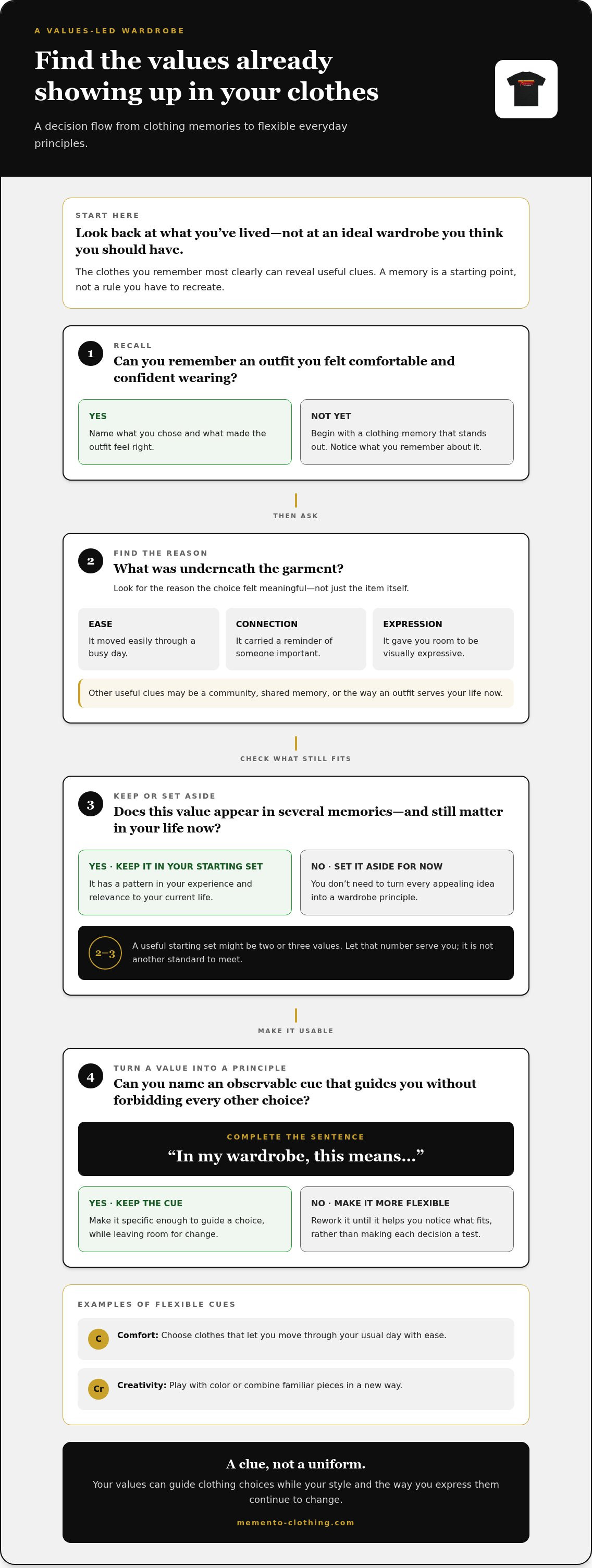
Start with what you’ve lived, not with a list of admirable words. The clothes you remember most clearly may reveal more than an abstract idea of the person you hope to become. Notice the patterns, then give them names. You’re looking for a small, useful set of principles, not a perfect personal manifesto.
Values guide your wardrobe best when you define them in language that feels true to your own life.
Use Your Own Experiences to Find Core Style Values
Recall a few outfits you’ve felt comfortable and confident wearing. What did you choose, and what made each outfit feel right? Perhaps it moved easily through a busy day, carried a reminder of someone important, or gave you room to be visually expressive. Look for the reason beneath the garment. A memory is a clue, not a rule you have to recreate.
Bring that reflection into the present. Your routine, responsibilities, and needs may have changed, so focus on what serves your life now rather than an idealized past or imagined future.
Turn Broad Values into Personal Wardrobe Principles
A broad value becomes easier to use when it points toward a choice you can recognize. If comfort matters, your principle might be to choose clothes that let you move through your usual day with ease. If creativity matters, you might look for opportunities to play with color or combine familiar pieces in a new way. Neither example is a rule for everyone.
Keep the principle flexible. It should help you notice what fits, not make every decision feel like a test.
To find a manageable starting set, write down the values that come to mind. Narrow the list by asking which ones appear in several memories and still matter in your current life. You might begin with two or three, but let the number serve you rather than become another standard. For each value, complete the sentence: “In my wardrobe, this means…” Make the answer specific enough to guide a choice, yet open enough to leave room for change.
- Name the value: Choose a word that resonates, such as simplicity, connection, comfort, or self-expression.
- Make it personal: Describe what that word means in your own routines and circumstances.
- Turn it into a cue: Identify one quality you can notice when choosing, wearing, or caring for clothes.
- Check for flexibility: Ask whether the cue guides you without forbidding every choice that falls outside it.
For instance, “simplicity” might mean fewer decisions in the morning for one person, but a preference for clear shapes for another. The word matters less than the meaning you give it. Memento Mori Clothing describes its ethos as “live fearless, remember humbly.” Treat it as a prompt for reflection, not a template to adopt.
Once your values have personal definitions, they can become a steady reference point as you look at your wardrobe. Building a wardrobe that reflects personal values isn’t about getting every choice right. It’s about choosing with a clearer sense of what feels meaningful to you, and letting that understanding evolve.
How to Balance Competing Values in Your Wardrobe
Personal values don’t always point toward the same choice. You might want a wardrobe that feels expressive, is simple to use, and reflects thoughtful consumption. In a particular moment, one priority may take the lead while another has to wait. That isn’t a failure of consistency. It’s a reminder that clothes are part of a changing life, not a test with one correct answer.
A values-led choice depends on the wearer’s context. Consider what the garment is for, how often you’re likely to wear it, whether it carries personal meaning, and what your day-to-day life requires. Those details make a comparison more useful than asking which option is “best” in the abstract.
When Sustainability, Self-Expression, and Simplicity Pull Differently
These can all be important priorities, but each means something personal. You might value simplicity and prefer a small range of familiar outfits, yet also want a distinctive piece that feels expressive. Or you may be drawn to a new look while wanting to make thoughtful use of clothes you already own. There’s no need to make claims about a garment’s environmental impact to weigh these priorities. Focus on your reasons, its likely place in your life, and what you’re choosing between.
A comparison table can help you see the trade-offs without giving each priority an invented score. Imagine weighing a familiar item you already own against a new piece that catches your eye:
| Consideration | Familiar item | New expressive piece |
|---|---|---|
| Context | Where does it suit your routine? | What occasions would it serve? |
| Likely wear | How often do you reach for it now? | Can you picture wearing it regularly? |
| Personal meaning | Does it hold a memory or feel like you? | What draws you to it beyond its newness? |
| Practical needs | Does it meet your current needs? | Does it work with clothes you already wear? |
The answers don’t need to be perfectly balanced. They help reveal what matters most in this decision, rather than forcing every choice to serve every value equally.
A Practical Test for Making a Values-Aligned Choice
Before deciding, compare the choice with the principles you’ve named and the life you have now. Ask whether it meets a real need, fits with your existing wardrobe, and seems likely to be worn. If it has personal significance, consider whether that meaning will still matter after the first excitement fades. You can’t predict the future with certainty, but you can make a considered choice with the information you have.
- Context: What will you wear it for, and does that match your routine?
- Frequency: Can you imagine reaching for it more than once in a while?
- Compatibility: Does it work with pieces you already enjoy wearing?
- Meaning: Is the attraction connected to a value or personal reason you recognize?
Use the answers as a decision aid, not a verdict. Building a wardrobe that reflects personal values means allowing priorities to shift with circumstance while staying attentive to the reasons behind each choice.
How to Build a Values-Led Wardrobe from What You Already Own
Begin with what’s already in your closet. A values-led wardrobe doesn’t require a dramatic clear-out or an immediate replacement of the clothes you own. A calm review can show what serves your life, what feels true to you, and what has gradually become less useful. Treat the process as observation, not judgment.
Audit Your Closet for Evidence of What Matters
Notice which pieces you reach for repeatedly and what they have in common. Is it how they feel, how easily they fit your routine, their color, or a memory attached to them? Then notice what feels authentic, even if you wear it less often. Set aside what no longer fits your current life, but don’t turn past purchases or changing preferences into reasons for guilt. They’re information, not a verdict.
Use a Values Check Before Adding Something New
Before considering a new piece, ask whether it suits your stated principles, your daily needs, and the clothes you already enjoy wearing. A trend can create a sense of urgency, but a brief pause can help you tell a genuine gap from a passing impulse. No single purchase or shopping habit guarantees a particular ethical or environmental outcome. Focus on what you can thoughtfully assess.
Once you’ve made a few observations, put your existing clothes to work. Choose a piece you wear often and try combining it with something that usually stays untouched. A different pairing may make the less-worn item feel more like you. Build outfits for the situations that actually fill your week, rather than an imagined routine. As you experiment, note which combinations feel comfortable, expressive, or simply practical.
Use this sequence as a repeatable closet review. Return to it when your routine, priorities, or sense of style shifts:
- Notice: Identify the clothes you wear most and the qualities that make them easy to choose.
- Recognize: Separate pieces that feel authentic or meaningful from those that no longer suit your life.
- Recombine: Create outfits from what you own before assuming you need something new.
- Identify a gap: Name a specific need that your current wardrobe doesn’t meet, such as an outfit for a regular activity.
- Pause and assess: If you’re considering a purchase, consider its likely use, how it fits with existing pieces, and whether your interest lasts beyond a moment of trend pressure.
- Revisit: Repeat the review as your circumstances change, without expecting your wardrobe to stay fixed.
This process makes building a wardrobe that reflects personal values an ongoing practice rather than a one-time project. Keep the observations that help, and let the rest change with you. If you’re ready to explore apparel as one form of personal expression, explore Memento Mori apparel.
Make Personal Meaning Part of Your Wardrobe Without Turning It into a Uniform
Personal meaning doesn’t need to announce itself. It might live in a familiar color, a detail you return to, or a garment that holds a memory of a person, place, or turning point. These quiet choices can make getting dressed feel more connected to who you are, without requiring every outfit to carry a message.
Building a wardrobe that reflects personal values isn’t about dressing in a single recognizable aesthetic. Slogans, labels, and visible statements may resonate with some people, while others prefer expression that feels private or understated. Neither approach is more sincere. Clothing can offer a way to communicate, but it can’t prove what you believe or how you act.
Let Clothing Express Your Values in a Way That Feels Natural
Choose the level of visibility that feels comfortable. You might wear a graphic that expresses an idea openly, repeat a particular silhouette because it feels like you, or keep a meaningful piece—like sustainable fine jewelry from JOSMIRLUXE—for moments when you want its reminder close. A personal detail doesn’t need an explanation to matter. Nor does every item need to carry deep significance. Room for ease and play belongs in a personal wardrobe, too.
Meaning can shift. A garment that once marked a certain season of life may become an everyday favorite, or its significance may soften over time. Let that change happen without treating it as a contradiction. Personal style has space for continuity and renewal.
Connect a Brand’s Stated Philosophy with Your Own
A brand’s philosophy can offer a point of reflection, not a ready-made identity. Memento Mori Clothing describes its mission as “New Season. New Perspective.” and its ethos as “live fearless, remember humbly.” Those words express the brand’s point of view. Whether they resonate with you is a personal question, and wearing a garment isn’t proof that its message defines your choices or character.
If the philosophy prompts you to think about change, memory, or how clothing can hold personal meaning, explore the Memento Mori story. For a closer look at the brand’s apparel, read this Memento Mori clothing article. The products currently featured by Memento Mori Clothing are the Memento Hockey Jersey, Mighty Mori Hockey Jersey, and Memento Side-Zipped Hoodies. All three are sold out and unavailable for purchase.
Let those ideas sit alongside the principles you’ve named for yourself. You can appreciate a brand’s message without adopting it wholesale, and you can choose personal meaning that never appears on a label. The point is to make space for clothes that feel connected to your life, while leaving room for your style and values to keep evolving.
Let Your Wardrobe Keep Growing With You
Your values don’t need to become a fixed dress code. Let them guide your choices while leaving room for curiosity, change, and the unexpected piece that simply feels right. Over time, a wardrobe’s meaning can come from what you keep wearing, the memories attached to certain garments, and the small decisions that make getting dressed feel like your own.
That sense of renewal echoes Memento Mori Clothing’s stated mission, “New Season. New Perspective.” Its ethos, “live fearless, remember humbly,” offers a point of reflection, not a standard anyone else needs to follow. Personal meaning remains yours to define.
Start with one choice: wear something you already own in a way that feels true to you, or pause before your next purchase and ask what you want it to add to your life. Building a wardrobe that reflects personal values can begin quietly, then evolve with you.
Explore Memento Mori Clothing for apparel shaped by a distinct point of view. The Memento Hockey Jersey, Mighty Mori Hockey Jersey, and Memento Side-Zipped Hoodies are currently sold out and unavailable for purchase. Let your next wardrobe choice feel considered, personal, and open to what comes next.
Frequently Asked Questions
How do I start building a wardrobe that reflects my personal values?
Begin by writing down a few principles in words you’d actually use, such as “ease” or “creativity.” Then think through a typical week and notice which outfits meet its demands without fuss. For building a wardrobe that reflects personal values, translate each principle into a choice you can recognize, like choosing an outfit that works for both errands and a casual gathering. Revisit your notes before making wardrobe changes.
Can my wardrobe reflect my values without buying new clothes?
Yes. Give an overlooked piece a different role: wear a favorite shirt under a sweater, or pair a familiar item with something you usually style another way. You could also plan a few outfits for the week using only what’s already in your closet. These experiments can reveal which combinations feel personal and useful. A new purchase isn’t required for your clothes to express something meaningful.
Do I need to choose only one core value for my personal style?
No. You can hold several priorities at once, and they may come forward differently depending on the occasion. For example, you might favor ease for a packed workday and self-expression for a gathering with friends. Keep a short list as a reminder, not a ranking carved in stone. If two principles seem to conflict, decide which matters more for that particular outfit or situation.
What if my personal values change over time?
Let your wardrobe principles change as your life does. A new schedule, role, or season may shift what feels practical or expressive. Instead of clearing everything out, revisit pieces individually: does this still suit my routine, bring back a meaningful memory, or work for an occasional need? Some clothes may remain useful even if they no longer represent your current priorities. You can adjust your regular rotation without erasing your past.
Is a values-led wardrobe the same as a sustainable wardrobe?
Not necessarily. Sustainability can be one priority, while another person may focus more on comfort, simplicity, cultural connection, or creative expression. If sustainability matters to you, define what you mean by it before making a choice. For instance, consider whether you’ll use a piece often or whether a claim about it is supported by clear information. No single garment or shopping decision proves an overall impact.
Can clothing alone communicate what I believe?
Clothing can offer a glimpse of personal taste or meaning, but it can’t tell someone your whole story. A graphic might express an idea to you while another person reads it differently. Treat what you wear as one part of communication, not a substitute for words or action. If you want to share what a garment means, you can explain its significance. You don’t owe anyone an explanation for every choice.